
What the 20,000mAh (74Wh) actually amounts to
The Gaming Power Bank 20K packs a 20,000mAh lithium-ion cell, which Belkin translates into 74Wh of nominal energy. The maths is honest: 20,000mAh at 3.7V, the standard lithium-ion nominal voltage, works out to exactly 74Wh, with no favourable rounding or overstated voltage of the kind sometimes used in this segment to inflate the headline figure.
That 74Wh figure matches the Belkin UltraCharge 20K and the INIU 20000mAh, two rivals of the same nominal capacity compared later in this review. At 74Wh, the Gaming Power Bank 20K stays comfortably under the 100Wh cabin limit most airlines allow without special permission, a real plus for packing it alongside a console.
The maths behind the three Nintendo Switch 2 recharges
The core claim of this battery is its promise: up to 3 full recharges of the Nintendo Switch 2. To check whether that figure physically holds up, it needs comparing against the console's own official capacity, which Nintendo lists at 19.7Wh (5,220mAh).
Three full recharges of 19.7Wh add up to 59.1Wh that actually needs to reach the console. Against the pack's 74Wh nominal figure, that implies an overall efficiency of around 80% between the energy stored in the Gaming Power Bank 20K and what actually ends up in the console's battery, once losses in both charging circuits are counted. That is a credible order of magnitude for a wired USB-C PD link, more favourable than what a wireless charge typically achieves. Belkin's figure therefore holds up under scrutiny, unlike some claims on the market that would imply an efficiency above 100% once the rechargeable device's real capacity is taken into account.
This calculation stays theoretical: it assumes charging under favourable conditions, console off or asleep. It says nothing about the number of recharges reached if the console stays on and in active use while charging, an angle covered in the next section.
30W shared across three outputs: what it actually buys
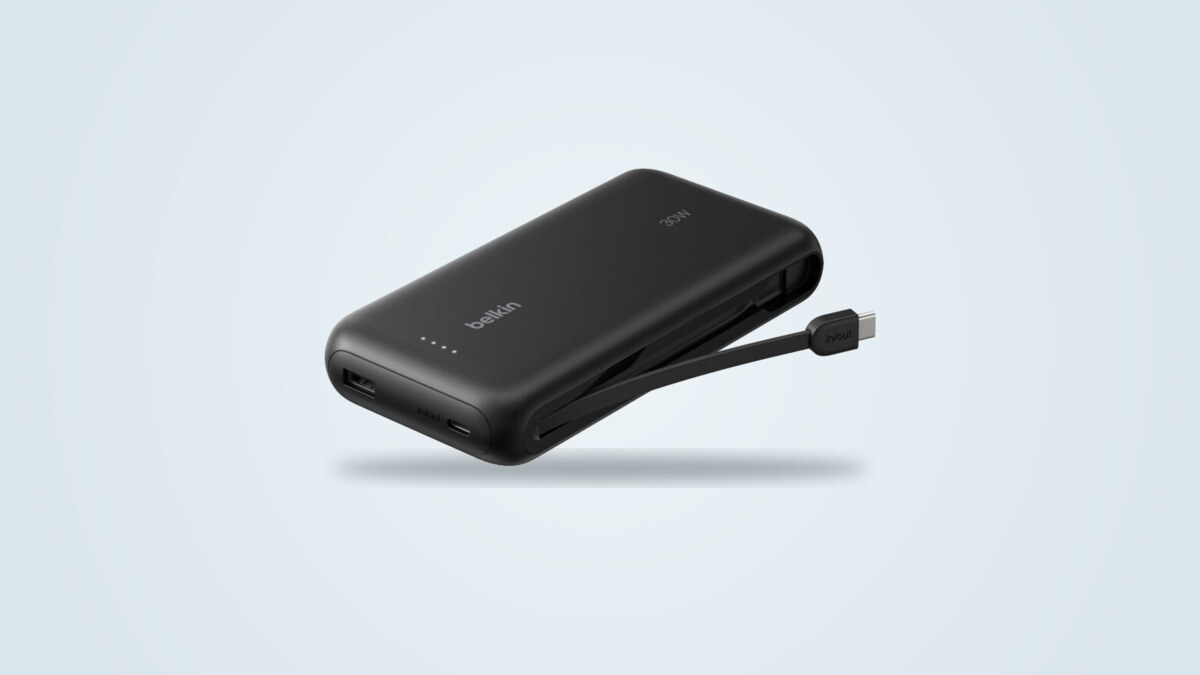
The 12cm built-in USB-C cable, an extra USB-C port and a USB-A port capped at 12W make up the Gaming Power Bank 20K's three outputs, sharing a total of 30W as soon as more than one device charges at once. USB-C Power Delivery is the only protocol Belkin lists for this model, with no mention of PPS.
On a compatible smartphone, that 30W stays useful: Belkin claims 0 to 50% in about 25 minutes on an iPhone 16 Pro, genuine fast charging despite the modest total output. The limit shows up as soon as all three outputs are active together: Belkin does not detail the exact port-by-port split once everything is drawing power, only that the total stays capped at 30W. Splitting that total evenly between two active outputs would leave around 15W each, a ballpark figure rather than an official port-by-port number.
Why the Nintendo Switch 2 never draws on the full 30W
The 30W printed on the shell should not suggest the Nintendo Switch 2 actually makes use of it during a gaming session. In active handheld use, the console does not exceed about 16 to 17W of input, regardless of the charger or power bank behind it: an official 60W adapter, a 140W third-party charger or a generic power bank all produce a charge clustered around 16 to 17W once the console is in active use. The console itself caps its own current draw, independently of what the source can supply.
In practice, the gap between the 30W available on the Gaming Power Bank 20K and the 16 to 17W the console actually uses almost never speeds up charging the Switch 2 itself. Instead, it benefits the second use case Belkin markets directly: charging a phone or accessory on one of the other two ports while the console stays plugged into the built-in cable, without either flow choking the other to the point of being unusable. That is a coherent engineering choice for the stated use case, rather than a wattage arms race that this particular console would never actually use.
Recharging the battery itself: 30W input, a duration estimate
Belkin caps the Gaming Power Bank 20K's own recharge input at 30W, without publishing an official full-charge time. A simple calculation gives a theoretical minimum: 74Wh spread over a 30W input works out to a little under 2.5 hours under ideal conditions, ignoring conversion losses and the usual lithium-ion slowdown past roughly 80%. In practice, a duration closer to 3 to 3.5 hours is more realistic for a full charge.
That 30W input puts the Gaming Power Bank 20K on par with the Belkin UltraCharge 20K on this specific point, but well behind the Anker Power Bank 20000 and the INIU 20000mAh, both rated at 65W input for a full charge in 90 to 120 minutes according to their own spec sheets. Belkin does not publish any information about a possible pass-through mode (using a device while the battery itself recharges from the mains) for this particular model.
No screen: four LEDs instead of an exact percentage
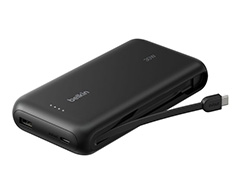
The Gaming Power Bank 20K shows its charge level through four simple LEDs, in 25% steps, with no digital screen. That is a real difference from its closest sibling, the Belkin UltraCharge 20K, which shows an exact percentage on a small button-activated screen, and from the INIU 20000mAh and Anker Power Bank 20000, both fitted with an LCD screen.
In everyday use, four steps are enough for a rough idea before heading out, but they cannot tell whether the remaining charge sits at 26% or 49%: either way, the same two LEDs light up. For a gamer who wants to know precisely whether there is enough left for a full console recharge or only half of one, this approximation is the most visible trade-off Belkin made on this model, likely to keep the price closer to entry level than the UltraCharge 20K.
75% recycled plastic, a claim with two speeds
Belkin highlights a shell made with 75% post-consumer recycled plastic, a figure repeated on this site's own product page as well as on the manufacturer's official pages. Belkin's own product pages note in small print, however, that this 75% figure applies to certain components only, and that the aggregate total for the whole shell, cables excluded, works out to 42.9%.
This gap between the headline figure and the aggregate one does not undermine the real value of using recycled plastic, nor the fully plastic-free packaging that comes with the product. It simply illustrates a common environmental-marketing practice, where the most flattering figure from a set of components becomes the main talking point. A reader focused on the precise detail would do well to treat 42.9% as the more representative figure for the shell as a whole.
Weight and size, a deliberate trade-off
At 399g for 154 x 76.2 x 25.1mm, the Gaming Power Bank 20K sits at the upper end of its capacity class. It is slightly heavier than the Belkin UltraCharge 20K (390g) but noticeably lighter than the Anker Power Bank 20000 (431g), and outweighs the INIU 20000mAh by 75g, the lightest of the four thanks partly to its lack of a built-in cable.
| Product | Belkin Gaming PB 20K | Belkin UltraCharge 20K | Anker Power Bank 20000 | INIU 20000mAh |
|---|---|---|---|---|
| Weight | 399g | 390g | 431g | 324g |
| Dimensions | 154 x 76.2 x 25.1mm | 136 x 76 x 31mm | 157.5 x 73.5 x 26mm | not published |
| Built-in cable | Yes (12cm) | Yes | Yes | No |
None of the four slips discreetly into a trouser pocket: this is a bag or backpack size, a deliberate trade-off rather than a hidden flaw for a 20,000mAh capacity. For nomadic gaming, packing the battery in the same bag as the console and its case is not an issue.
Against the Anker Power Bank 20000, the INIU 20000mAh and the Belkin UltraCharge 20K
In the crowded segment of 20,000mAh power banks with a built-in cable, three references help place the Gaming Power Bank 20K precisely.
| Criterion | Belkin Gaming PB 20K | Belkin UltraCharge 20K | Anker Power Bank 20000 | INIU 20000mAh |
|---|---|---|---|---|
| Capacity | 20,000mAh (74Wh) | 20,000mAh (74Wh) | 20,000mAh (72Wh) | 20,000mAh (74Wh) |
| Max power | 30W | 45W | 87W | 65W |
| Screen | 4 LEDs (25%) | Digital (%) | LCD | LCD |
| Switch 2 optimisation | Claimed by Belkin | Not claimed | Not claimed | Not claimed |
| Weight | 399g | 390g | 431g | 324g |
| Recharge (input) | 30W | 30W | 65W (90 min) | 65W (120 min) |
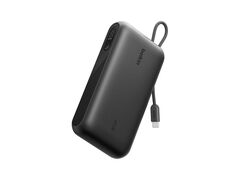
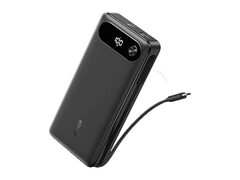
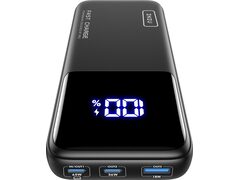
The Anker Power Bank 20000 dominates on raw power (87W, enough to get a small laptop moving) and on its own recharge speed, at the cost of a higher weight. The INIU 20000mAh offers a different trade-off: 65W, an LCD screen and the lightest build of the four, but no built-in cable. The Belkin UltraCharge 20K, from the same brand as the model in this review, adds a digital percentage screen and 15W more, for almost the same weight.
None of these three rivals, however, claims any specific optimisation for the Nintendo Switch 2: it is the one argument the Gaming Power Bank 20K can set against generally more powerful or better-equipped competitors on paper.
A confusing Belkin 20K lineup, and a recall that does not concern this model
Belkin sells several power banks carrying the number 20K in their name, creating real room for confusion when buying. This review covers only the Gaming Power Bank 20K (reference ENA013, optimised for the Nintendo Switch 2), identifiable by the 30W marking printed on the shell and its four LEDs.
| Product | Distinguishing feature | Power | Screen |
|---|---|---|---|
| Gaming Power Bank 20K (ENA013) | Optimised for the Nintendo Switch 2 | 30W | 4 LEDs |
| BoostCharge Power Bank 20K (BPB012) | USB-A to USB-C cable included separately | 20W | LED |
| UltraCharge Power Bank 20K (BPB030, separate review on this site) | Built-in, magnetic USB-C cable | 45W | Digital (%) |
| BoostCharge Pro 3-Port Laptop Power Bank 20K (BPB020) | Laptop-focused, three ports | 65W | Digital (%) |
A reader interested in the Switch 2 optimisation and the 30W marking should therefore double-check that it is the ENA013 reference, and not one of these other products from the same brand, with very different specs and target use.
In November 2025, Belkin recalled around 83,500 units in the United States and 2,385 in Canada of a different 20,000mAh power bank, the BoostCharge USB-C PD Power Bank 20K (references BPB002 and PB0003), over a risk of the lithium-ion battery overheating and potentially causing a fire or burn. The recall, announced on 13 November 2025, counts one fire in the United States and fifteen reports internationally, including two minor burns.
Who it suits, and who it does not
It suits a gamer with a Nintendo Switch 2 who wants a cable that is always at hand and a battery sized for their console, without needing more power than the console can actually use during play. Its 74Wh clears the 100Wh cabin limit with room to spare, and the 2-year warranty backed by Belkin's connected equipment cover is reassuring over time.
It suits less anyone who also wants to quickly recharge a laptop or regularly plug in several power-hungry devices at full power at once: the Anker Power Bank 20000 (87W) and the INIU 20000mAh (65W) do better on this specific point. It also suits less anyone who wants a precise charge-level display rather than four rough LEDs, a need better served by the Belkin UltraCharge 20K, the INIU 20000mAh or the Anker Power Bank 20000.