
20,000mAh on the box, 76Wh in reality: what the capacity is actually worth
One figure dominates the packaging: 20,000mAh. Converted at the 3.8V Baseus uses for this pack, that comes to 76Wh of nominal energy, the number that actually matters for comparing power banks regardless of their cell voltage.
Baseus states on its technical sheet an energy conversion rate of 75% or higher, a fairly typical value for this kind of circuit. Applied to the 76Wh nominal figure, that puts declared usable capacity at a floor of around 57Wh. A recent smartphone typically carries a 15 to 19Wh battery (4,000 to 5,000mAh at the usual cell voltage): those 57Wh are therefore enough, by simple arithmetic, for roughly 3 to 4 full charges, a figure consistent with the product's positioning.
With its 76Wh, the Bipow Pro stays comfortably under the 100Wh threshold that nearly all airlines allow in cabin baggage, with no declaration or special permission needed before boarding.
This positioning holds up: nothing in the Bipow Pro's declared specifications suggests a gap between rated capacity and the conversion rate it claims, unlike some rivals in the same segment whose gap between promise and real output weighs heavily on their score.
22.5W on output: broad compatibility, but not for a laptop
On paper, 22.5W is a modest figure next to the 65W, 100W or more offered by many recent rivals. But that ceiling genuinely covers the main use case: fast charging a smartphone or tablet. The bidirectional USB-C port recognises Power Delivery (PD), Quick Charge (QC) 3.0, AFC (Samsung) and SCP/FCP (Huawei), broad compatibility that covers nearly every recent phone and tablet without a special adapter.
The two USB-A ports round out the offer for older devices or small accessories (earbuds, smartwatches, small speakers). Baseus does not, however, state an individual power ceiling for these two ports, a reservation worth knowing before relying on them for fast charging.
On this front, the Bipow Pro plainly accepts its limits: it never claims to charge a demanding laptop, unlike the INIU 20000mAh 65W, which specifically targets that use case at a slightly higher price. Anyone needing to top up a laptop on the move should look elsewhere; for phones, tablets and small accessories, 22.5W is more than enough.
The digital screen: the real selling point at this price
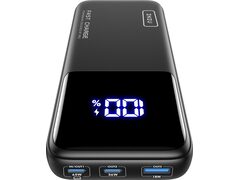
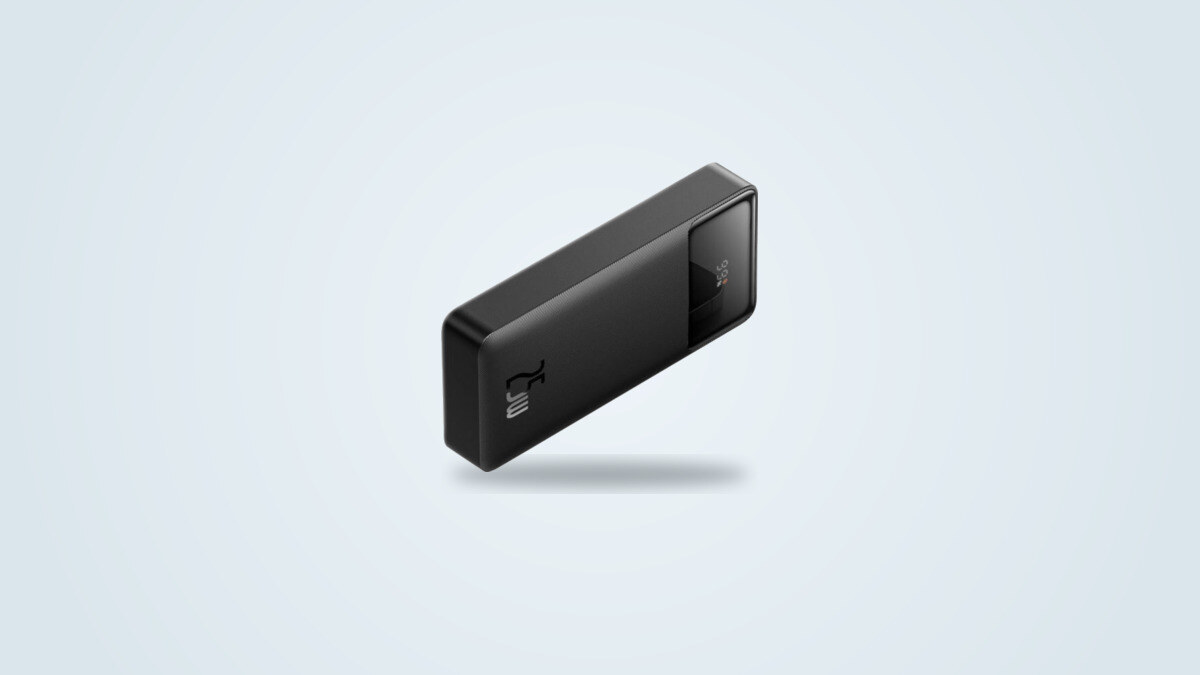
Under £25, most large power banks make do with a row of 4 LEDs to show charge level, in steps of 25%. The Bipow Pro instead has a digital screen showing the exact percentage left, a feature usually reserved for far pricier models. That is the real selling point of this price bracket, and it delivers a genuine practical benefit: knowing precisely whether 43% or 8% remains actually changes the decision to head out with the pack or not.
The choice not to build the cable into the case, unlike a growing share of the market (including its own successor, covered below), deserves a mention. A built-in cable that wears out or gets cut usually dooms the whole device; a separate cable, like the one bundled with the Bipow Pro, costs only a few pounds to replace. The three independent ports (2 USB-A and 1 USB-C) also let you plug in up to three devices at once without having to choose.
The pack also supports pass-through charging, meaning it can charge itself while powering a connected device, useful for a desk or bedside setup where it doubles as a permanent USB hub.
Charging it back up: budget more time than the headline figure suggests
On input, Baseus caps the Bipow Pro's own charging at 20W over its USB-C port. That is a modest figure, and one with a real effect on how long a full charge takes.
A simple calculation using only the manufacturer's own declared figures sets a realistic floor: transferring the pack's 76Wh at a constant 20W already takes, arithmetically, a minimum of 3 hours and 48 minutes, before accounting for the usual tapering near the end of a charge (voltage stabilises, current drops) or for input conversion losses, both of which stretch that time further in practice.
This input ceiling contrasts with the output side, which reaches 22.5W and recognises several fast-charging protocols. That asymmetry is common at this price point: manufacturers tend to optimise output, the number shown prominently on the box, ahead of input, which gets far less attention but matters just as much day to day.
Size and weight: right in line with the 20,000mAh class
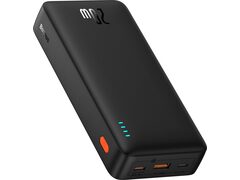
At 340g and 126.7 x 75.4 x 32mm, the Bipow Pro sits squarely in the average for the 20,000mAh format, neither especially compact nor notably bulky next to power banks of the same capacity. It fits easily in a backpack pocket, but stays clearly noticeable as an object in its own right once slipped into a jacket pocket.
Relative to its 76Wh, this weight reflects a fairly conventional choice of standard lithium cells rather than a push for lightness at all costs, an approach Baseus generally reserves for its pricier ranges with a built-in cable and a slimmer case.
Built-in protections, and a build that stays decent without aiming premium
On electrical safety, Baseus declares an NTC temperature sensor that detects heat in the charging circuit and automatically cuts power when needed, backed by overcurrent and overvoltage protection. These are standard safeguards for this type of product, but their explicit presence on the manufacturer's spec sheet is worth noting.
The plastic build stays decent without aiming for the premium end: it feels a touch less upmarket than rivals priced higher, a fair trade-off given the price. No recurring build defect or safety recall affects this specific model to date; the one identifiable Baseus recall covers a different range entirely, magnetic wireless-charging power banks, a technology the Bipow Pro does not carry.
One thing worth checking before searching for it on Amazon
A vigilance point concrete enough to deserve its own section: in early September 2026, the black Bipow Pro's Amazon listing (product reference PPBD2) is marked "currently unavailable" on the French, German, British, Italian and Spanish Amazon storefronts alike, with no customer reviews showing at all. More surprising still, the technical details listed on that exact page no longer describe a power bank in any way: they read as an accessory for a foldable smartphone (kickstand, pen holder, screen protector), a sign that the listing has been recycled by the platform for an unrelated item once stock ran out.
This is not a total disappearance from the market: the pack is still sold through Baseus's own official online store and several specialist European resellers, generally close to its launch price. The episode mainly illustrates a fairly common end-of-cycle pattern for this type of product: Baseus is now pushing the Bipow 2 Pro, a successor with a very similar positioning, which likely explains why the original model is gradually being pulled from some platforms' inventory.
Against direct rivals, and against its own successor
Best-batteries.com already places the Bipow Pro against two direct rivals of the same capacity: the Anker 335 PowerCore (20W, no screen) and the INIU 20000mAh 65W (also has a screen, but built to charge a laptop). A third point of comparison is now worth adding: its own successor.
| Criterion | Bipow Pro (this model) | Bipow 2 Pro |
|---|---|---|
| Capacity / power | 20,000mAh, 22.5W | 20,000mAh, 22.5W |
| Cable | Separate, replaceable | Built into the case, not replaceable |
| Weight | 340g | around 356g |
| Screen | Digital, percentage | Digital, percentage |
The two models are evenly matched on paper for capacity and power. The choice then comes down to a single trade-off: the Bipow 2 Pro's built-in cable simplifies daily use (nothing to forget before heading out) but means replacing the entire unit if that cable wears out, while the original Bipow Pro, simpler in design, keeps the edge on repairability. Against rivals outside the brand, the Anker 335 PowerCore lags on display (no screen at all), and the INIU 65W targets a different use case, laptop charging, at a higher price.
Who it suits, and who it does not
The Bipow Pro suits anyone after a large backup capacity at a low price, with a proper digital display rather than approximate LEDs, to recharge smartphones and tablets several times over. The non-integrated cable is a plus for anyone who would rather replace a worn part than the whole device.
It suits less well anyone who needs to charge a demanding laptop (look for at least 65W elsewhere), anyone who needs fast input charging to head out in a hurry (budget several hours for a full charge), or anyone who insists on buying exclusively through Amazon without first checking whether the listing is actually in stock.
Beyond that, it remains what it has always been since launch: a safe bet in the segment of large, affordable power banks, with a screen that on its own accounts for much of its commercial success.