
65W and a screen: the car charger that does more
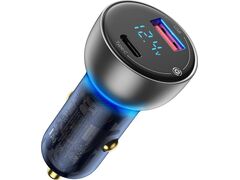
Most car chargers simply convert the vehicle's 12V into USB power, with no other function beyond charging itself. The Baseus 65W adds a feature rarely seen on this kind of product: a built-in screen that reports on the car battery's condition, on top of a headline port that climbs to 65W, above what the closest same-wattage rivals in the catalogue offer.
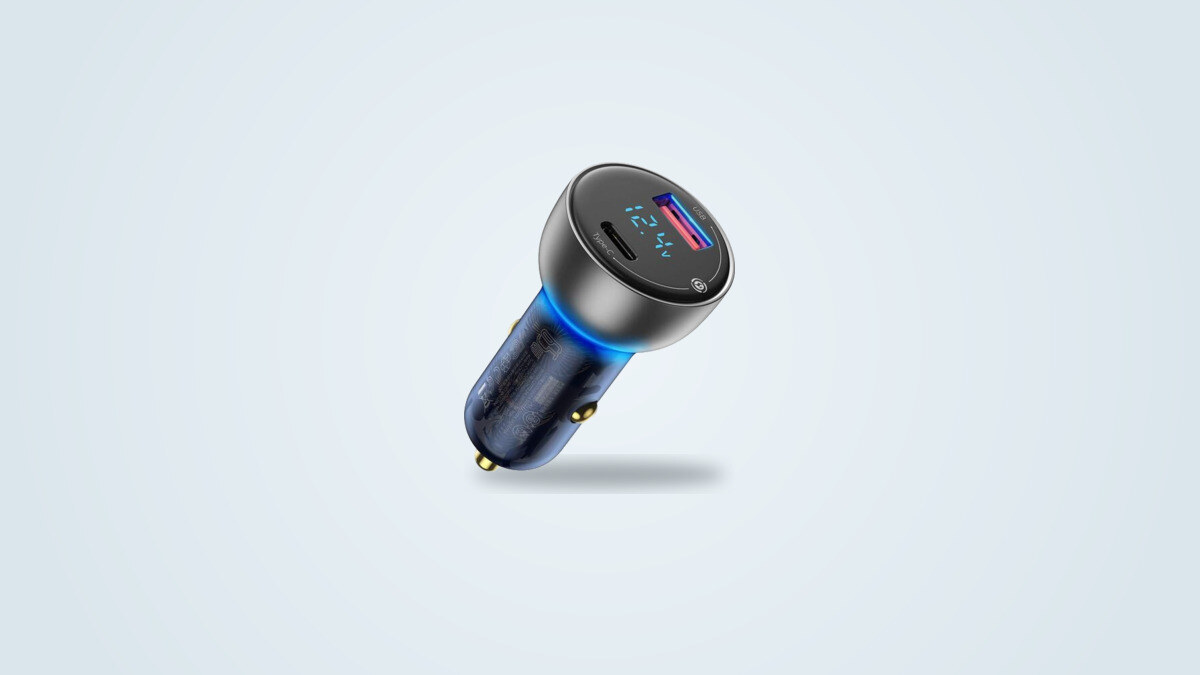
The body plugs into the vehicle's 12V socket and offers one USB-C port and one USB-A port, each managed independently by the internal control circuit. The rest of this review breaks down what each figure actually means in daily use.
65W alone on USB-C, the full PD ladder
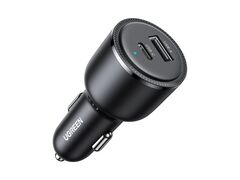
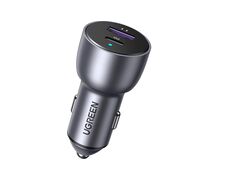
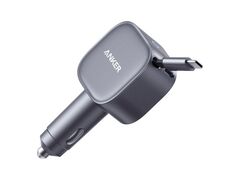
The USB-C port runs the full Power Delivery 3.0 ladder: five fixed steps (5V/3A, 9V/3A, 12V/3A, 15V/3A and 20V/3.25A) plus a PPS range from 3.6 to 12V/3.25A, up to roughly 39W, to fine-tune the voltage for the device plugged in. Used alone, this port climbs to 65W, a ceiling above the 45W maximum offered by the Ugreen 63W and the Anker 75W on their best port, and well above the Ugreen 52W's 30W.
This 65W ceiling should not be read as a guarantee of laptop charging in every case: it states the maximum electrical power the port can supply to a device able to request it correctly, not the outcome on any device plugged in.
45W + 18W together, a step below the 65W headline figure
As soon as both ports are used at the same time, the picture changes: the USB-C port drops to 45W maximum and the USB-A port to 18W, for a 63W total, two watts below the 65W figure on the front of the listing. The USB-A port, which can reach 30W alone, therefore loses 40% of its power as soon as the USB-C port joins in.
For charging two devices at once, a phone and a tablet for instance, 18W on the second port is still plenty for a fast charge. The limit only shows up if both devices plugged in are themselves power-hungry, two phones each pulling more than 20W for example.
PD, QC, SCP, AFC: broad compatibility
Both ports recognise a wide range of fast-charging protocols: Power Delivery 3.0 with PPS on USB-C, rounded out on both ports by Quick Charge 2.0/3.0, AFC, FCP and SCP. This coverage goes beyond the Ugreen 63W and the Ugreen 52W, limited to PD/PPS and QC 3.0, adding AFC and FCP that matter for older Huawei and Honor phones that do not recognise standard PD.
One point worth qualifying: the QC4.0 label attached to this charger in some listings actually reflects PD3.0 plus PPS compatibility, the path a QC4.0 device uses in practice to negotiate fast charging, rather than a separate QC4.0 hardware block. The internal circuitry only reaches QC2.0/3.0 outside that PD/PPS path, a technical nuance that changes nothing for compatibility with a recent phone but is worth spelling out.
In practice, this broad protocol coverage mostly means the cable matters more than the phone: a basic USB-C cable without the right data pairs can cap the PD/PPS negotiation and limit charging to a standard speed, whichever port is used.
A compact body, among the lightest in its segment
The body measures about 33.7 mm across by 68 mm long, a classic bullet shape that sticks out slightly from the socket once plugged in, like most chargers of this power. On the scale, the body lands between 28 and 29 g, noticeably lighter than the compared rivals.
This light body comes with no GaN claim attached: unlike some mains chargers, the Baseus 65W does not use this technology and does not claim it either, which avoids any unmet promise on that particular point.
The screen: battery monitor or plain gadget?
This is what sets the Baseus 65W apart from every rival compared here: none of the three includes a screen. The Baseus screen fills two distinct roles, one after the other.
At rest, with nothing plugged in, the screen shows the car battery's voltage on a continuous scale, with a red zone below 11.6V flagging a weak or dying battery, before the car even struggles to start. As soon as a device is plugged in, the display switches to the voltage and current actually delivered by each port, useful for confirming that a fast charge has actually kicked in rather than guessing blind.
So this is not just a lit-up gadget: the car-battery monitoring function stays useful regardless of any charging use, and answers a real need, catching a failing battery early, that no ordinary car charger addresses. The reservation is more about readability in bright sunlight, never specified by the manufacturer, and the lack of any audible alert: the screen informs, it does not actively warn.
Inside the shell: components and warranty
The body combines a plastic shell with an aluminium section for heat dissipation, plus a lower section in blue-tinted polycarbonate that lets a backlight show through. Inside, the design centres on a Weipu WP7038 controller that runs both ports independently, a Chengxin CX8576 converter on the USB-A side, a Polarity PL5501 circuit on the USB-C side, a Vanguard VS3618AE transistor (30V, 6 milliohms of resistance) and solid capacitors rated 35V/100µF and 25V/100µF. The unit shows clean soldering and a tidy build overall.
No recurring build fault, premature breakage, loose contact or a screen giving out, shows up on this model beyond that warranty-length reservation.
Protections and certifications
The controller runs the standard protections expected on this kind of product: overvoltage, overcurrent, overheating and short-circuit, with power management handled independently on each port. CE and FCC markings are found directly on the circuit board, not just printed on the packaging.
Two reservations: no IP rating against dust or water is claimed, a secondary point for cabin use but worth watching for exposed utility-vehicle use. And the UL mark, sometimes cited on retailer listings, is not among the markings found on the board itself.
Charging a laptop: a result that depends on the laptop
The USB-C port lists 65W alone, a power level that in theory covers a good share of light USB-C laptops. In practice, the outcome varies sharply from one machine to another. A MacBook reached the full 65W on this port. On the other end, a Lenovo ThinkPad T14 Gen 1 plugged in to charge stayed stuck at 94%, with no visible gain over the session.
This gap comes down to the Power Delivery negotiation specific to each laptop, not just the charger: a laptop that fails to request the right voltage step, or that requires a proprietary protocol on top of standard PD, may receive only a trickle charge, or none at all, even facing a port able to supply more. The vehicle's own cigarette-lighter socket, often limited in available current, and the quality of the USB-C cable used also play a role.
For occasional trickle-charging of a light ultrabook, the USB-C port earns its keep. For regular use with a power-hungry laptop, caution is warranted until exact compatibility has been checked for that specific model.
Against the Ugreen 63W/52W and the Anker 75W
How does the Baseus 65W stack up against the three closest same-wattage rivals in the catalogue?
| Criterion | Baseus 65W | Ugreen 63W | Ugreen 52W | Anker 75W |
|---|---|---|---|---|
| Listed total power | 65W | 63W | 52.5W | 75W |
| Best port, alone | 65W (USB-C) | 45W (USB-C) | 30W (USB-C) | 45W (cable/USB-C) |
| Both ports active | 45W + 18W | total 63W | 30W + 22.5W | 45W + 30W |
| Built-in screen | Yes, voltage + charging data | No | No | No |
| Weight | ≈ 28-29 g | Not listed | 57.2 g | 77 g |
| Price observed | ≈ £29 | ≈ £23 | ≈ £11 | ≈ £25 |
The Baseus 65W stands out on two points that none of the three rivals combine: a higher ceiling on its best port, and a functional screen. It remains the priciest of the four, and its split under simultaneous use (45W plus 18W) does not match the transparency of the Ugreen 52W or the Anker 75W, whose combined totals equal exactly the sum of their two ports.
The catalogue also lists the Iniu 90W, another option in this accessible price segment with two USB-C ports and a listed voltage screen, at a lower price. That product has not yet been the subject of a dedicated review on this site and cannot be compared here on equal footing.
Who the Baseus 65W is for
The Baseus 65W suits anyone who wants both a strong fast-charging port and a simple way to keep an eye on the car battery's health, a useful combination for an older or lightly used vehicle. On a tighter budget without a screen, the Ugreen 52W remains a solid choice for two phones. For a permanently attached cable and a more generous split across two ports, the Anker 75W targets the same budget with a different approach. For a power-hungry laptop in regular use, none of the rivals compared here, Baseus included, guarantees reliable charging: it is worth checking exact compatibility for that specific laptop beforehand, or saving mains charging for once you arrive.