
Adaptive conductance: what Autel's figures show, and what they do not prove
The BT506 delivers no current: like the screen-based testers already reviewed on this site, it reads one instead. Its adaptive conductance technology sends a low-intensity signal through the battery and derives the state of health (SOH), state of charge (SOC), internal resistance and an estimated cold cranking amperage (CCA) from the electrical response. The underlying principle is identical to the Topdon BT100 and the Konnwei KW208: the "current actually delivered" axis, originally designed for a jump starter, therefore reads here, as for its two direct competitors, as measurement reliability rather than amperage output.
These three figures come from Autel's official documentation for its adaptive conductance technology, repeated identically across several pages from the manufacturer and its authorised resellers. Neither the Topdon BT100 nor the Konnwei KW208, both already reviewed on this site, publish an equivalent figure: their own product sheets claim high accuracy without ever specifying a value or a method. On this specific point, the BT506 is therefore more transparent, without this amounting to independent verification: no comparison against a professional reference instrument was found for this model, exactly the same reservation already noted for its two competitors.
The official documentation also presents adaptive conductance as a method that avoids the voltage interference that hampers a simple voltmeter, which would allow reading the condition of a battery even when heavily discharged. An independent temperature probe ships in the box (more on this below), consistent with the temperature compensation this same documentation claims for this model: since the internal resistance of a lead-acid battery varies strongly with cold, correcting the reading for the battery's actual temperature is, in theory, a genuine advantage over a unit that does not do so. None of the documents consulted for the Topdon BT100 or the Konnwei KW208 mention such a probe or such compensation.
An operating range halfway between its two direct competitors
The BT506 only works in the presence of a phone or tablet and carries no meaningful battery of its own: its measurement electronics are powered by the battery under test itself, through the clamps. Cold-weather performance therefore mainly concerns this electronics. Its official documentation states an operating range of -10 °C to 50 °C (14 °F to 122 °F) and a storage range of -20 °C to 60 °C (-4 °F to 140 °F).
This -10 °C places the BT506 between its two direct competitors already reviewed on this site: colder than the Konnwei KW208, whose label stops at 0 °C, but well short of the Topdon BT100, whose documentation states -20 °C. In practice, this gap matters most exactly when this kind of tool tends to come out: a frosty morning, when a tired battery struggles to crank the engine. The BT506 stays usable in these conditions where the KW208 already sits outside its guaranteed range, without covering as harsh a winter as the BT100.
No cold-weather malfunction was found for this model: this range is most likely a safety margin set by the manufacturer rather than a hard failure threshold, the same reservation already noted for its two competitors.
100 to 2000 CCA, five chemistries: coverage almost identical to its competitors
On paper, the BT506 targets the same ground as its two direct competitors. The manufacturer's most recent technical chart credits its 100 to 2000 CCA range with eleven recognised standards (CCA, CA, MCA, JIS, DIN, SAE, IEC, EN, EN2, BCI, GB), slightly wider coverage than the Topdon BT100 (ten standards) and the Konnwei KW208 (nine standards). The five lead-acid chemistries covered, flooded, AGM plate, AGM spiral, EFB and Gel, are exactly the same as its two competitors: no lithium compatibility is claimed on this model either.
Like the Topdon BT100 and the Konnwei KW208, the BT506 tests a battery both fitted in the vehicle and placed on a bench, useful for checking a new or used battery before fitting.
One point remains unclear and deserves to be flagged rather than wrongly settled: successive versions of the manufacturer's own official documentation do not agree on the maximum voltage covered. The oldest technical sheets limit the BT506 to 12V, with a 1.5 to 16V measurement range; a more recent version of the same official comparison chart now extends coverage to 6V and 12V for the battery and to 12V and 24V for the electrical system, with a widened 1.5 to 36V measurement range. This site's product page keeps, out of caution, the more widely confirmed 6V/12V version; compatibility with a 24V truck or agricultural-vehicle system cannot be stated with the same certainty.
Protected clamps and readings possible very low in voltage
The electrical risk of a tester has nothing to do with that of a jump starter: the BT506 supplies no cranking current, it simply reads a battery already in place. The official documentation describes copper clamps protected against reverse polarity, short circuits and sparking on contact, with a status LED that changes colour to signal the connection state and flashes red on a reversed connection. These protections match, without exceeding, those already verified on the Topdon BT100 and the Konnwei KW208.
One point does set the BT506 apart on paper: its official documentation presents adaptive conductance as able to read the condition of a very heavily discharged battery, by avoiding the voltage interference that hampers a simple voltmeter at low charge. No minimum guaranteed voltage threshold was reliably found for this specific model, unlike the Topdon BT100 (which refuses to power on below 6V) and the Konnwei KW208 (whose label sets a measurement range of 8 to 16V): it is therefore impossible to claim the BT506 does better on this specific point, only that it takes a different approach.
The restriction to lead-acid technologies has, here as with its competitors, a safety dimension beyond simple compatibility: trusting a state-of-health percentage calculated for a different chemistry than the one actually tested risks a false sense of reliability on a battery that could carry a very different risk profile. No recall or safety incident was found for this model to date.
A compact housing, a warranty half as long as its best-covered competitor
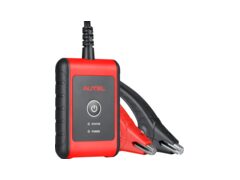
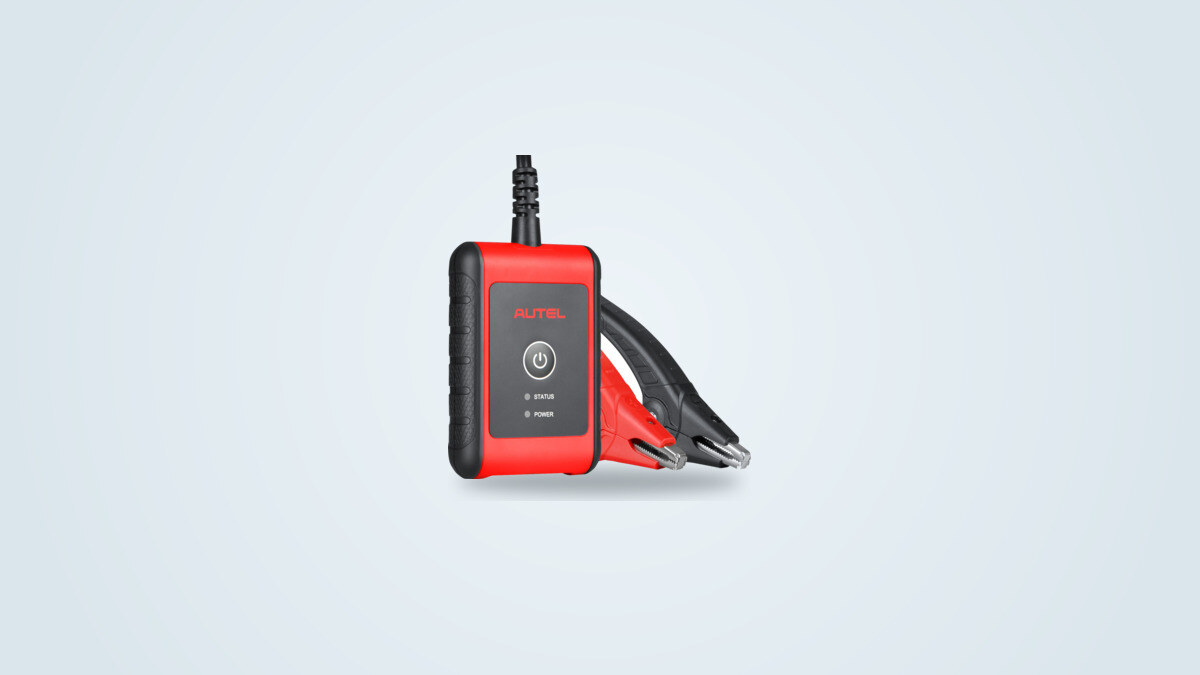
The BT506 comes in a compact 107 x 75 x 26mm housing weighing 320g, roughly the size of a thick deck of cards, with a red and black shell and non-slip side grips. The clamp cable runs about 60cm, ending in two wide-opening, low-profile crocodile clamps, better suited to hard-to-reach terminals than a short, stiff cable. An independent temperature probe and a USB-C port round out the box, alongside the clamp cable and a quick-start guide.
On longevity, though, the BT506 falls short of the best-covered of its two direct competitors already reviewed on this site: its manufacturer warranty stands at 12 months, half the 24 months displayed identically across several official Topdon pages for the BT100. It remains, based on available information, comparable to the Konnwei KW208, whose duration could not be confirmed consistently from one source to another. For a tool priced well above its competitors, this shorter warranty is a real point worth knowing before buying, even though it does not by itself call the housing's sturdiness into question.
No recall or recurring fault was found for this model. A single real case was found in the manufacturer's official support channels: a Bluetooth pairing error message ("the connected device does not match") encountered when replacing a unit under warranty, an isolated case rather than a recurring fault.
Battery, cranking, alternator: three diagnostics run from the phone
Like the Topdon BT100 and the Konnwei KW208, the BT506 runs three complementary measurements rather than one, which helps pinpoint the source of a fault rather than guessing at it.
The battery test shows state of health (SOH), state of charge (SOC), voltage and an estimated CCA, with a verdict summarised by a colour code in the app. The cranking test measures how the circuit behaves during the starter's current draw, with the engine running. The alternator test, finally, is run with the engine turning between 2,000 and 3,000 rpm, with electrical loads (headlights, blower, defroster) switched on and off in sequence, while the app assesses the charging system's output voltage under several electrical load configurations.
This last step goes further than the one described for the Topdon BT100 (a fixed speed around 2,500 rpm for 5 seconds): varying the electrical load during the measurement, rather than relying on a single engine speed, can in theory reveal an alternator that holds up under a light load but drops out under a heavier one. The BT506 runs this diagnostic both on the vehicle and off it, a capability already shared with its two direct competitors, useful for checking a new or used battery before fitting.
The BT506 adds a function absent from the sheets consulted for its two competitors: battery location diagrams by vehicle model within the app, useful on vehicles where the battery is not under the bonnet.
BT506, BT508, BT608, BT609: where this model really sits in Autel's lineup
The "MaxiBAS" name covers a family of four fairly different testers at Autel, and the BT506 deliberately sits at the entry point. Here is exactly where it sits in the manufacturer's own official comparison chart.
| Criterion | BT506 | BT508 | BT608 | BT609 |
|---|---|---|---|---|
| Screen | None (app only) | None (app only) | 5.5-inch touch, Android 9 | 7-inch touch, Android 9 |
| Battery registration | No | 53 makes | 53 makes | 53 makes |
| Vehicle diagnostics | None | One brand included | All brands (AutoSCAN) | All brands (AutoSCAN) |
| Temperature compensation | Yes | Yes | Yes | Yes |
| Email report / cloud | Yes | Yes | Yes | Yes |
| Built-in printer | No | No | Yes | No |
| Maximum CCA range | 2000 | 2000 | 3000 | 3000 |
| Multimeter / amp clamp | Not available | Not available | Optional | Optional |
The BT508 adds battery registration for 53 vehicle makes and diagnostics limited to one included brand (other brands and annual updates being charged separately), without changing the screen or the measurement principle. The BT608 makes a full hardware leap: a 5.5-inch touchscreen running Android 9, a built-in thermal printer, a range extended to 3000 CCA, complete multi-brand diagnostics with no annual update fee, plus an optional amp clamp and multimeter. The BT609 uses a similar base with a 7-inch screen and more storage, this time at the cost of a paid annual update that the BT608 does not require.
The BT506 therefore takes a deliberately stripped-down entry-level position within its own family: no vehicle diagnostics, no battery registration, no printer, only what is needed to diagnose a battery, a starter and a charging system. Against direct competitors from a completely different price segment, such as the Topdon BT100 and the Konnwei KW208, its added value does not come from diagnostic options reserved for its own bigger siblings, but from its app ecosystem and its integration with the professional Autel MaxiSys tablets already found in some workshops.
BT506 against the Topdon BT100 and Konnwei KW208: several times the price, for what exactly
The BT506 shares its sub-category with the Topdon BT100 and the Konnwei KW208, both already reviewed on this site, and all three units aim at the same basic diagnostic: battery, cranking, alternator, over a 100 to 2000 CCA range with identical lead-acid chemistries. The price tells a very different story.
At the catalogue price on this site, the BT506 costs more than five times the Topdon BT100 and just over six times the Konnwei KW208. Here, item by item, is what that gap actually buys.
| Criterion | BT506 | BT100 | KW208 |
|---|---|---|---|
| Catalogue price | £245.31 | £45.00 | £40.19 |
| Test range | 100 to 2000 CCA | 100 to 2000 CCA | 100 to 2000 CCA |
| Lead-acid technologies | 5 | 5 | 5 |
| Recognised standards | 11 | 10 | 9 |
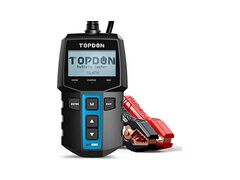
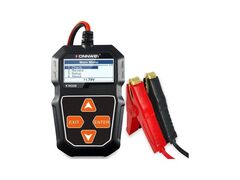
| Interface | No screen, app/tablet | Monochrome LCD 128x64 | Colour (TFT) |
| Operating range | -10 °C to 50 °C | -20 °C to 65 °C | 0 °C to 50 °C |
| Result history | Yes, app and cloud | Last result only | None, one check at a time |
| Manufacturer warranty | 12 months | 24 months | Not confirmed consistently |
On raw test coverage (CCA range, chemistries, ability to test off the vehicle), the three units are, in practice, equivalent. The price gap is therefore not explained by a wider range or an extra chemistry, but by three real elements: an app ecosystem with a saved history and emailed reports, integration with professional Autel tablets already found in some workshops, and accuracy figures more detailed in the manufacturer's documentation. On the other side, the BT506 loses on total autonomy (no screen at all, a phone and an account required) and on warranty length, half as long as the Topdon BT100's.
Who the BT506 is for, and who it is not for
The BT506 suits a workshop or a mobile professional already equipped with Autel MaxiSys tablets, who can then fold battery diagnostics into an existing workflow rather than adding a stand-alone unit. It also suits anyone who values a usable measurement history and a report that can be emailed to a customer, two functions absent from the screen-based testers already reviewed on this site.
It suits less well anyone after an immediate, one-off check without reaching for a phone: the Topdon BT100 and the Konnwei KW208, several times cheaper, cover the same CCA range and the same chemistries, with no account to create and no app to open. It is also a poor fit for anyone running a lithium starter battery, not claimed by the unit, or looking for a built-in printer or multi-brand diagnostics, reserved for the BT608 and BT609 in the same lineup.
The bottom line: the BT506 does what it claims on battery diagnostics, with a transparency about its own accuracy figures that its direct competitors do not offer, but without a wider test range or an extra chemistry to justify, on its own, a catalogue price several times higher. Its real appeal lies in the app ecosystem, not in the measurement itself.