
7.5 W wireless, the weakest spec in its category, but not the charge count
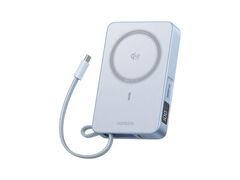
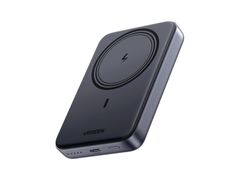
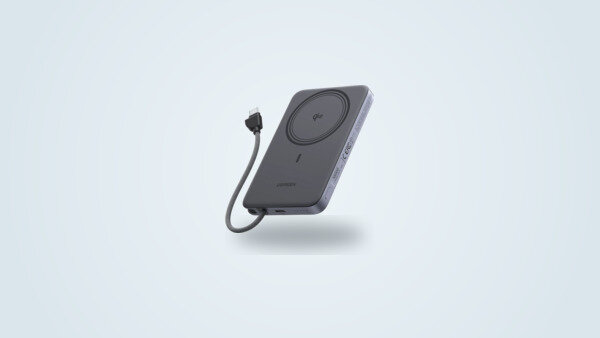
The figure that raises the most concern on paper is wireless charging power: 7.5 W, while Anker's own MagGo (the maker's other magnetic line) reaches 15 W, the Ugreen Nexode 10000 also reaches 15 W, and the Ugreen MagFlow 10000 climbs to 25 W, more than three times as much. On paper, the magnetic Zolo is therefore the slowest wireless charger in its entire comparison segment.
The number of smartphone charges actually achieved tells a different story, though. In a head-to-head comparison including several equivalent magnetic batteries, a recharge score of 191% on a recent iPhone (close to two full charges before the external battery is fully drained) puts this magnetic Zolo in the lead, ahead of models with faster wireless charging on paper. Between 2 and 4 full charges depending on the phone is the range most generally retained, consistent with a usable capacity of around 7000 mAh out of the advertised 10,000 mAh, a yield of around 70%, in line with what is normal for this type of conversion. The wattage figure advertised for wireless charging therefore does not tell the whole story: what ultimately matters, the amount of energy actually transferred over the life of the charge, also depends on overall conversion efficiency, not just the advertised peak power.
The built-in cable and the kickstand, the two real successes
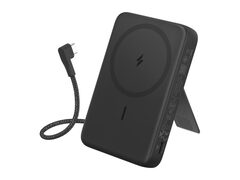
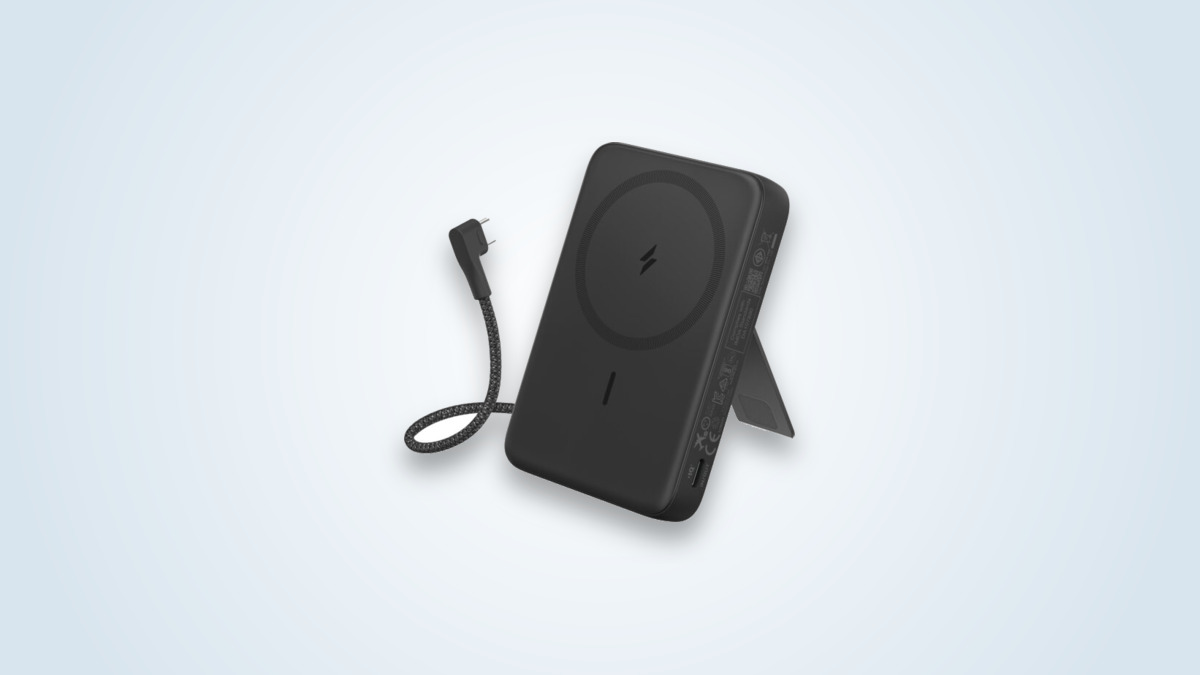
The USB-C cable built into the casing solves a real everyday problem: no cord to bring along or forget, and a single port that serves both to charge a device and to recharge the battery itself. Along with the built-in kickstand, it is one of this object's two genuinely distinctive strengths.
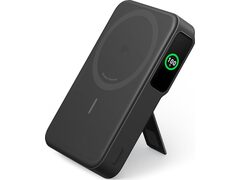
Once unfolded, the kickstand tilts the phone to a comfortable viewing angle while it charges, handy on a plane, on a train or at a desk. The mechanism is deliberately stiff, which limits the risk of it folding back accidentally. The product is still too recent, however, for a multi-year track record to exist on how well the hinge and the cable hold up over time: for now, that remains unknown rather than solidly established, unlike the charge count, detailed above.
30 W advertised, 15 W real once both outputs are used together
The 30 W advertised for wired charging only holds true if a single output is used at a time. As soon as the built-in USB-C cable and the casing's USB-C port are used at the same time to charge two different devices, the total power shared between the two drops to 15 W, half as much. This is not a hidden flaw, it is a classic physical limit of this type of charging circuit, but it does not appear in the official specifications on display, even though it concretely changes things for anyone planning to charge two devices at once rather than one at full speed.
Recharging the battery itself: up to 8 times longer depending on the charger
Recharging the battery itself takes a very variable amount of time depending on the charger used, a point the technical sheet does not detail. With a 65 W USB-C charger, a full charge takes around 3 hours. With a 5 W charger, like the ones historically bundled with some smartphones, the same full charge can take close to 24 hours, eight times longer. The maximum advertised input power is 20 W: a charger more powerful than that ceiling therefore does not shorten the charge below the time already achieved at that threshold, but a charger weaker than 20 W lengthens it in near-proportion to the power gap.
The practical takeaway is simple: a standard USB-C smartphone charger, often limited to 18 or 20 W for compact models, already delivers most of the advertised speed. An older 5 W charger, on the other hand, multiplies the charging time several times over, with nothing on the product sheet flagging this point.
49.99 € listed, often cheaper in practice
The catalogue price of 49.99 € corresponds to the reference price advertised by the manufacturer, consistent from one market to another. The price actually charged, however, is often lower: around 38 € directly on the product page at certain times, with occasional promotions bringing it down to 29 to 32 €. At this price level, the gap with the MagGo, the same maker's other magnetic line sold between 76 and 90 €, remains very wide even without a promotion.
240 g matching the spec sheet, but a weight you feel once stuck to the phone
The 240 g weight matches the technical sheet exactly, with no gap between the claim and reality. It is nonetheless the most notable weak point of this product, more than any other drawback. The explanation likely lies in the implicit comparison with an ordinary phone case: permanently attached to the back of an iPhone by the magnet, this battery nearly doubles the total weight held in the hand, an effect more noticeable than for a battery that is only pulled out of a pocket occasionally.
So this is not a manufacturing flaw or a gap with the advertised specifications, but a trade-off inherent to the fixed magnetic format: the same capacity sitting on a table rather than stuck to the phone would not weigh any less, but it would feel like less.
The 2025 Anker recall does not concern this model, the real warranty is shorter than advertised
In 2025, Anker carried out an official recall covering around 481,000 power banks, following an overheating risk linked to defective lithium-ion cells from a single supplier. This recall affects several of the brand's references, including two variants of the Zolo line, but only the 20,000 mAh models with two built-in cables. The 10,000 mAh magnetic version featured in this review does not appear on the list of references covered by this recall.
A second, more modest gap concerns the warranty: the real duration is 18 months, not the 2 years generally advertised. This is not a flaw in the product itself, but information worth checking before any purchase relying on this specific duration.
Apart from these two points, no recurring failure or safety alert specific to this exact model exists to date. The product remains too recent, at just under two years on the market, for a long-term reliability track record to be available.
Who it suits, and who it does not
This battery suits anyone with a MagSafe-compatible iPhone who wants a single object that charges wirelessly, doubles as a video stand and provides a wired backup at 30 W without having to carry a separate cable. The number of charges actually achieved is solid, leading its head-to-head comparison despite a lower advertised wireless power than its rivals.
It suits less well anyone looking for the fastest possible wireless charging, since the 7.5 W remains clearly behind the 15 to 25 W available elsewhere, anyone planning to charge two devices simultaneously at full speed, or Android users without a magnetic case, for whom only the built-in USB-C cable remains usable.