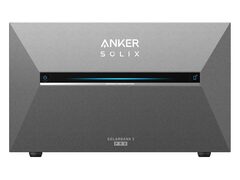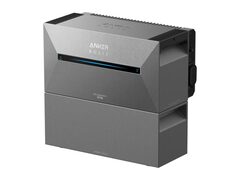

2688 Wh claimed, about 2390 Wh actually recoverable
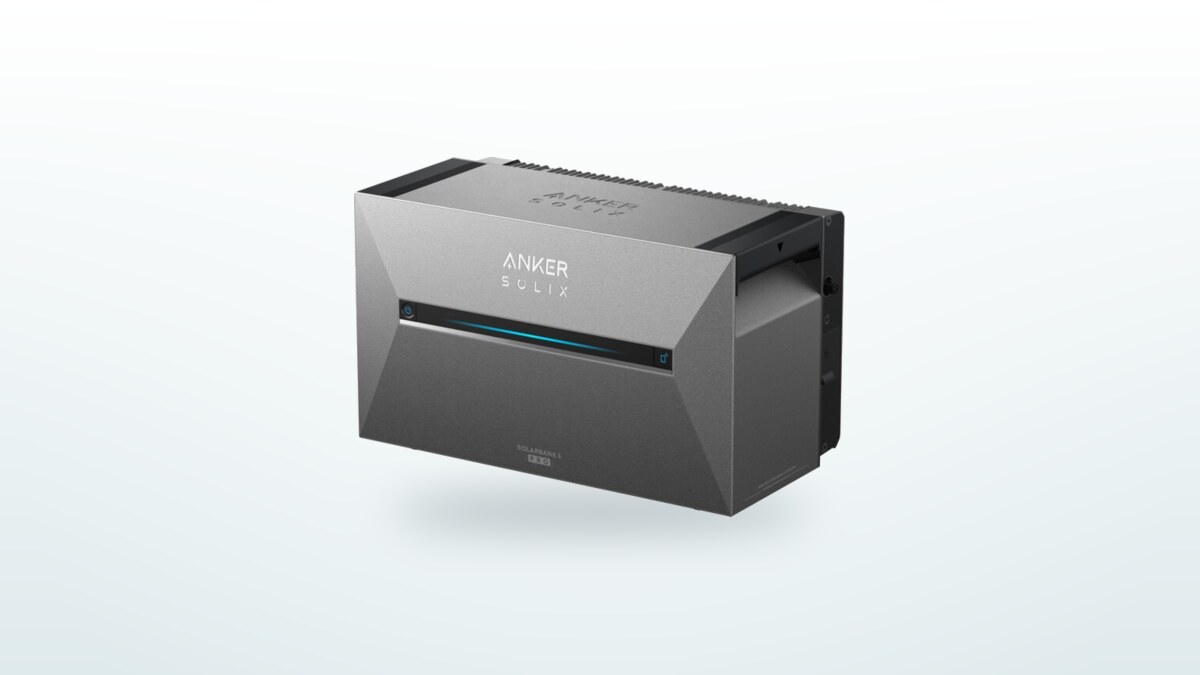
The LiFePO4 chemistry in the Solarbank 3 E2700 Pro stores 2688 Wh in total. But between what goes into the battery and what comes back out, the inverter and the conversion electronics take a real cut, as the figures below show across several conditions.
| Metric | Condition | Efficiency |
|---|---|---|
| Manufacturer figure | Charge and discharge measured separately | 90.4 % each |
| Continuous discharge | At 400 W, down to 10 % reserve | 2127 Wh extracted |
| Full round trip | 230 V AC output | 82.1 % |
| Low-power discharge | At only 150 W | 71.6 % |
The manufacturer's 90.4 % figure covers charge and discharge taken separately, not a full round trip. Each conversion (charging the battery, then discharging it) takes its own share of losses, and they add up over a full cycle, which explains the gap with the 82 to 83 % figure for a full round trip. It is not a contradiction, these are two different measurement scopes.
More telling for balcony use: at only 150 W of discharge, efficiency drops to 71.6 %. That is precisely the typical power draw of light household use in the evening, the most common situation for this type of product. The capacity actually recoverable, across all conditions, sits around 2390 Wh of the 2688 Wh claimed, or about 89 %.
3600 W of solar input, but not for the standalone unit
With its 4 MPPT controllers, the Solarbank 3 E2700 Pro offers the most generous solar input in the whole Anker Solix lineup for this format: enough to connect several panels facing different directions with no loss of efficiency, a real asset on a balcony or facade that gets uneven sun through the day.
One nuance is worth knowing before buying: the 3600 W of solar input is only reached once the unit is paired with at least one additional battery. On its own, the Solarbank 3 E2700 Pro caps out at 1800 W of PV input. That is not a flaw, it is an architecture consistent with the product's expandability, but anyone planning to connect four entry-level panels to the standalone unit needs to revise that figure downward.
Against the previous generation, the progress is real: the best version of the Solarbank 2 (the Pro variant) capped out at 2400 W on its own 4 MPPT, while the current version promises 3600 with expansion. One generation further back, the very first Solarbank offered only a single MPPT and no built-in inverter.
1200 W on the box, 800 W in practice: the nuance that changes everything
The bidirectional microinverter in the Solarbank 3 E2700 Pro is rated at 1200 W of hardware power, a figure repeated even in the listing title at several resellers. That is accurate, but incomplete: it is not the power that actually feeds into the home grid day to day.
800 W is the default value, the one matching the simplified regime that applies to this type of balcony kit, in France as in Germany. The 1200 W is a hardware power level available in back-up mode, off-grid, or unlockable in the app, explicitly on condition of complying with local regulations. A French reader should not turn on that unlock without first checking that their own situation allows it: it is not a simple convenience option to tick.
A second condition, even less visible, concerns charging speed: it drops sharply in cold weather. Below 10 °C, the allowed charging power falls to a fraction of the maximum, and the temperature needs to pass 22 °C to reach it in full. A north-facing balcony in winter will therefore never recharge as fast as the marketing figures suggest.
Four generations, nine variants: getting the right Solarbank
The Anker Solix Solarbank lineup has grown quickly since launch, to the point of becoming hard to follow for an unprepared buyer. Here is what actually sets each generation apart.
| Generation | Launch | Capacity | Solar | Built-in inverter |
|---|---|---|---|---|
| Solarbank (1) | June 2023 | 1600 Wh | 1 MPPT | None, external MI80 unit required |
| Solarbank 2 Plus | April 2024 | 1600 Wh | 2 MPPT, 1200 W | 800 W |
| Solarbank 2 Pro | April 2024 | 1600 Wh | 4 MPPT, 2400 W | 800 W |
| Solarbank 2 AC | April 2024 | 1600 Wh | 2 MPPT, 1200 W | 800 W, + 800 W mains charging |
| Solarbank 3 E2700 Pro | April 2025 | 2688 Wh | 4 MPPT, 3600 W with expansion | 1200 W hardware / 800 W by default |
| Solarbank 4 E5000 Pro | 2026 | 5024 Wh | 4 MPPT, 5000 W | 2500 W off-grid / 800 W export |
Two concrete traps to know about. First, the very first Solarbank, with no suffix, has no built-in inverter at all: without the MI80 unit sold separately, it only stores energy and never feeds it back to the grid. Second, generation 2 comes in three distinct models that share the same lineup name but not the same specifications: only the AC version charges from the mains, only the Pro version reaches 4 MPPT. A seller or a comparison site that mixes these three variants under a single listing spreads real confusion, including on specialised sites.
Anker Intelligence: a central selling point, provided you pay for it
The most heavily promoted selling point of this product is its AI, Anker Intelligence: it analyses household consumption, weather forecasts and market tariffs to decide on its own when to store energy, when to release it and how much to feed into the grid.
One point is not promoted with the same clarity: an Anker smart metre, sold separately, is required to fully activate this function. Without it, the AI simply cannot be evaluated in practice, for lack of the accessory, and the system falls back to manual control.
On the real benefit this AI actually brings, no rigorous, independent measurement has been found anywhere in this market, whether from Anker or its competitors. That is a blind spot for the entire sector rather than a weakness specific to this product: better to know that than to rely on an unverifiable savings percentage.
The app itself is a recurring weak point: unreliable production forecasts, a status still marked "beta", and no manually adjustable AC power ceiling for anyone who would rather stay in control than let the AI decide.
One useful piece of context: Anker is not alone on this front. Zendure offers its own AI ("ZENKI") on part of its lineup, and the EcoFlow Stream Ultra X also includes automated control based on tariffs and weather. The difference lies less in whether an AI is present than in its approach: individualised learning of household habits at Anker, against more general market and weather rules for part of the competition.
2688 Wh as standard, up to 16 kWh with expansion
The base capacity, 2688 Wh, covers a good part of one evening's consumption for an average household. To go bigger, up to five additional BP2700 batteries can be added, taking the total to a little over 16 kWh.
One setting is worth knowing about: the minimum battery reserve, adjustable in the app to 5 % or 10 %, effectively acts as the depth of discharge. No standalone DoD figure is published by the manufacturer as a separate spec; this setting stands in for it.
Worth noting for anyone considering the expansion: each additional BP2700 battery is a purchase in its own right, in the same price range as the main unit. Going from 2688 Wh to 16 kWh therefore represents a budget running into several thousand euros, worth weighing against actual consumption before being tempted by the maximum figure shown on the spec sheet.
Simple installation, but paperwork that is still poorly mapped out
The installation itself stays plug-and-play: connect the panels to the microinverter, mount the unit, finish setup in the app. No electrician is needed for typical balcony use, within the default power limits detailed above.
The administrative side is less clear-cut. For a balcony kit without storage, no filing is required below 800 W of panels. For a kit WITH a storage battery like this one, the picture is less settled: a specific Consuel certificate may be required as soon as a storage device is added to the installation, with a possible exemption for plug-and-play equipment certified compliant with standard NF EN 50549-1-4, though that specific certification is not confirmed for this model at the time of writing.
Noise in dispute, still limited track record on reliability
Noise is the point with the least consistent picture for this unit, ranging from a light, occasional hum that is not bothersome outdoors, up to a level distinctly higher than the competition, with an audible relay click on activation. Nothing found explains that spread, so rather than pick one side, the fair conclusion is that this point remains unsettled.
Standby consumption sits at 9.5 W, noticeably higher than part of the direct competition. A figure worth confirming, since no second measurement is available to check it.
On reliability, no large-scale usage record exists yet: the unit launched in April 2025, too short a time span to draw a reliable trend from. Two isolated cases exist: a solar input that stops working after a mains outage, on one unit after about two months of use; abnormally low power after three weeks on another, with the cause unresolved between shading and a software update. Two isolated, uncorroborated cases do not establish a trend, but deserve mentioning in full transparency.
The manufacturer's warranty, confirmed in the official documentation, runs for 10 years. One point of vocabulary not to confuse: Anker explicitly distinguishes this contractual warranty from an estimated 15-year service life, a more flattering figure that does not carry the same commitment.
Up against the EcoFlow Stream Ultra X and the Zendure ecosystem
In this still-young segment, two names come up systematically for comparison.
| Criterion | Solarbank 3 E2700 Pro | EcoFlow Stream Ultra X |
|---|---|---|
| Base capacity | 2688 Wh | 3840 Wh |
| Expandable | ≈ 16 kWh | ≈ 23 kWh |
| Inverter | 1200 W / 800 W by default | 1200 W / 800 W by default |
| MPPT / solar input | 4 MPPT, 3600 W | 4 MPPT, 2000 W |
| Smart control | Anker Intelligence | Built-in tariff/weather control |
| Cycles / warranty | 6000 / 10 years | 6000 / 10 years |
| Price | ≈ 1199 € | ≈ 1199 € |
The EcoFlow Stream Ultra X aims bigger on capacity and expandability, now at the same price. On single-unit output power, both share the same architecture: 1200 W hardware, 800 W by default. It also includes automated control based on tariffs and weather, so it is not a "no intelligence" choice next to the Solarbank 3, but that control comes as a subscription rather than a one-off accessory purchase. Zendure, for its part, offers its own AI (ZENKI) on part of its SolarFlow lineup, a modular ecosystem that leans more on entry price than on single-unit integration.
For expandability that is already generous on a contained budget, the Solarbank 3 E2700 Pro remains well positioned. For anyone after a larger base capacity from the start and control without a recurring subscription, that trade-off deserves to be weighed case by case.
Who it suits, and who it does not
It suits anyone who already has balcony or facade solar panels and wants to stop losing the energy not consumed during the day, with real room to expand and go bigger later, and who is willing to work with AI-assisted control rather than demanding full manual control.
It does not suit anyone looking for full independence from an app and an internet connection, nor anyone counting on the 1200 W shown on the product sheet as a daily export power without first checking what their own situation actually allows.