
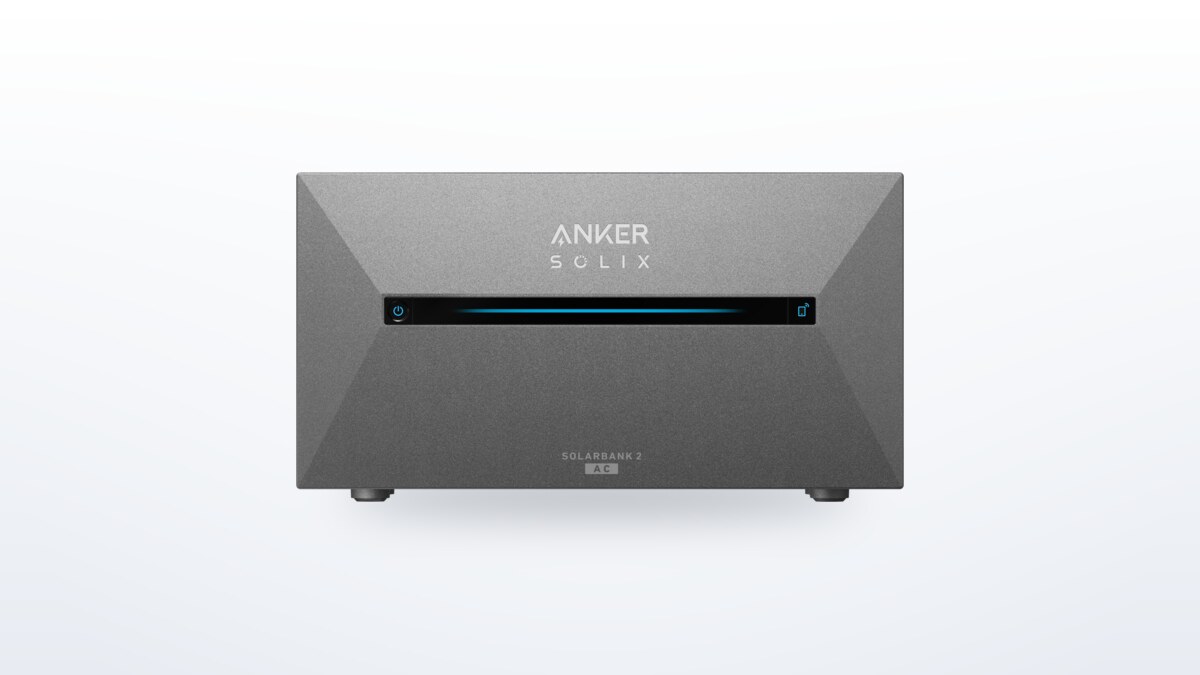
1343 Wh usable out of 1600 Wh rated, but no dedicated round-trip efficiency figure
Out of the 1600 Wh rated capacity, the portion actually available for use works out to around 1343 Wh, or roughly 84 % of the rated figure. That is in line with the protection buffer typically built into this type of battery.
That second figure needs an important caveat: no round-trip efficiency figure (mains to battery, then battery back to mains) specific to the Solarbank 2 E1600 AC is available. The 15 to 20 % system-loss range, plausible for this type of product, actually applies to the Solarbank 4 Pro, a different model in the lineup with a similar but distinct architecture. Treat it as a reasonable ballpark, not as a direct figure for the unit covered here.
Expandable to 9.6 kWh, compatibility beyond that still needs checking
The base 1600 Wh capacity extends up to 9.6 kWh by adding up to five additional BP1600 battery packs, a figure listed on the manufacturer's official spec sheet for this market.
Configurations beyond that ceiling, using higher-capacity BP2700 packs, are sometimes offered for sale, but official compatibility of that pack format with the AC unit could not be confirmed on a manufacturer page. Do not count on this configuration without direct confirmation before buying.
Two MPPT trackers, but not fully independent under shading
Both MPPT inputs accept up to 600 W each, for 1200 W of solar input in total. There is a structural limitation, though: when a panel on one input falls into shade, output from the second panel wired to that same input drops as well, since the two panels sharing a tracker are not fully independent of each other.
For flexible power distribution across two different panel orientations, it is therefore better to plan for four panels (two per input) rather than two, so each tracker stays internally matched.
Power ratings that climb with each additional battery
Several different power figures circulate for this unit, and they stop looking contradictory once each one is tied to its exact configuration: battery charging power, grid output power, and off-grid output power all climb with the number of additional batteries connected, from 1000 W for the base unit alone up to 2400 W with two additional batteries, according to the official spec sheet.
These figures describe the hardware's capability, which is a separate thing from the regulatory cap on feeding power into the public grid, set at 800 W in France for balcony solar setups under the simplified connection regime. It is this second figure, not the hardware capability, that limits what the unit can legally send back to the grid.
1000 W of backup for the base unit, 1200 W with an expansion
During a grid outage, the base unit alone delivers up to 1000 W through its dedicated backup outlet; that figure rises to 1200 W as soon as one additional battery is connected, according to the official spec sheet. An automatic mechanism switches power to that outlet as soon as an outage is detected.
No transfer-time figure specific to this exact model is available: a sub-10-millisecond figure circulates for the lineup, but it applies to a different unit from the brand, the Solarbank Max AC, which uses a much more powerful inverter. No first-hand account of an actual outage with this model turned up either, only descriptions of the mechanism itself.
Off-peak/peak hours: a few euros a year, not several hundred
The manufacturer highlights the option of charging the battery from the grid during off-peak hours and drawing it back down during peak hours. The principle works, but its real scale for the base unit deserves to be put into numbers.
On the French regulated tariff (an off-peak/peak spread of around 5.5 cents per kWh) and with a round-trip efficiency in the 82 to 85 % range (the same reference range as in the previous section), one full daily cycle on the base 1.6 kWh nets on the order of 10 to 11 € a year, even when charging and discharging the unit every single day at full capacity.
That figure is a long way from the several-hundred-euros-a-year claims sometimes made for the Solarbank lineup: those claims consistently apply to much larger configurations (7 to 14 kWh) paired with a multi-kilowatt-peak solar array, not the standalone base unit covered here. The manufacturer's own blog stays cautious on this point and does not publish a specific savings figure for grid charging, while also warning that a surplus buy-back contract (the EDF feed-in obligation) contractually bars charging the battery from the public grid.
NF EN 50549-10: compliance that appears underway, without full confirmation
In France, every balcony solar setup remains subject to an Enedis declaration (a self-consumption connection agreement), free and handled online, regardless of its power rating. The injection cap under the simplified regime stays fixed at 800 W. A Consuel certificate is not required below 900 VA.
10-year warranty, 15-year rated lifespan: two distinct figures
The official spec sheet distinguishes two figures that should not be confused with each other: a 10-year warranty, and a 15-year rated lifespan, backed by the LiFePO4 chemistry. The first figure is a contractual commitment; the second is a manufacturer estimate, not a covered promise.
One isolated failure case, cold sensitivity for fast charging
One failure case surfaced after roughly a year of use: the main battery stuck at 0 % charge in winter, with the additional battery continuing to work normally on its own. After several resets with no effect, the manufacturer eventually acknowledged a hardware fault and offered a replacement, with about a month passing before that acknowledgment. No comparable case turned up alongside it: treat this as an isolated incident, not a trend.
Another point worth noting: full-power charging (1000 W) appears to only kick in once the battery's temperature climbs back to around 21 °C, a real constraint in mid-winter for anyone installing the unit outdoors without extra protection.
No recognised consumer-testing body has evaluated this specific model to date, whether for reliability, safety, or electromagnetic emissions.
Simple installation, smart metre best left to a professional
Installing the unit itself stays plug-and-play, with no electrician needed for the basic hookup. The app is responsive: under 3 seconds to adjust output when a smart metre is present, up to 5 seconds without one.
That smart metre, needed to get the full benefit of fine-grained consumption control, does need to go into the electrical panel, though: connecting it calls for a professional, an extra cost and an extra step to plan for on top of the price of the unit alone.
599 € in practice, down sharply since launch
The price on Anker's official site currently sits at 599 €, against a reference list price of 1099 €. That is a sizable drop since launch, when the suggested price hovered around 1099 € with an introductory promotional rate down to 799 €.
The same 599 € price shows up at a general price-comparison site and at a well-known French retailer, a cross-check that adds confidence in the figure. A smart metre and an additional battery typically add around 700 € more for a complete setup.
Integrating with an existing setup instead of replacing it
The central strength of this AC version is that it can be added to a balcony solar kit that is already in place, regardless of which micro-inverter is already installed, rather than forcing a replacement of it: a core design difference from the Pro version of the same generation, which takes the place of the existing micro-inverter.
For everyday solar self-consumption, the base capacity covers a good share of a household's standby power draw over an evening. Expandability up to 9.6 kWh allows the reserve to grow gradually, without swapping out the main unit.
Up against the Zendure SolarFlow 800 Plus and the Pro version
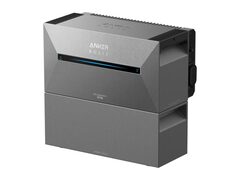
In this segment, the Solarbank 2 E1600 AC runs into the Zendure SolarFlow 800 Plus, already covered on this site, as well as its own Pro variant.
| Criterion | Solarbank 2 E1600 AC | Solarbank 2 E1600 Pro | Zendure SolarFlow 800 Plus |
|---|---|---|---|
| Capacity | 1600 Wh | 1600 Wh | 1920 Wh |
| MPPT trackers | 2 (1200 W) | 4 (2400 W) | 2 (1500 W) |
| Grid coupling | Yes | No | Yes |
| Max expansion | 9.6 kWh | 9.6 kWh | 11.52 kWh |
Against the Zendure, the Solarbank 2 AC starts from a slightly lower base capacity and a somewhat lower expansion ceiling, but it has the advantage of integrating with a micro-inverter that is already installed. Against its own Pro version, it gives up admissible solar power (2 MPPT trackers versus 4) but gains the ability to charge from the grid, a function the Pro lacks.
Who it suits, who it does not
It suits anyone who already has a balcony micro-inverter and wants to add storage without replacing it, and anyone who prioritizes solar self-consumption above all, with off-peak arbitrage staying a minor bonus with the base unit.
It does not suit anyone without a micro-inverter yet (the Pro version or an all-in-one system are more direct choices in that case), nor anyone counting on tariff arbitrage alone to pay back the purchase quickly. Before installation, checking NF EN 50549-10 compliance directly with the manufacturer remains a step not to skip.