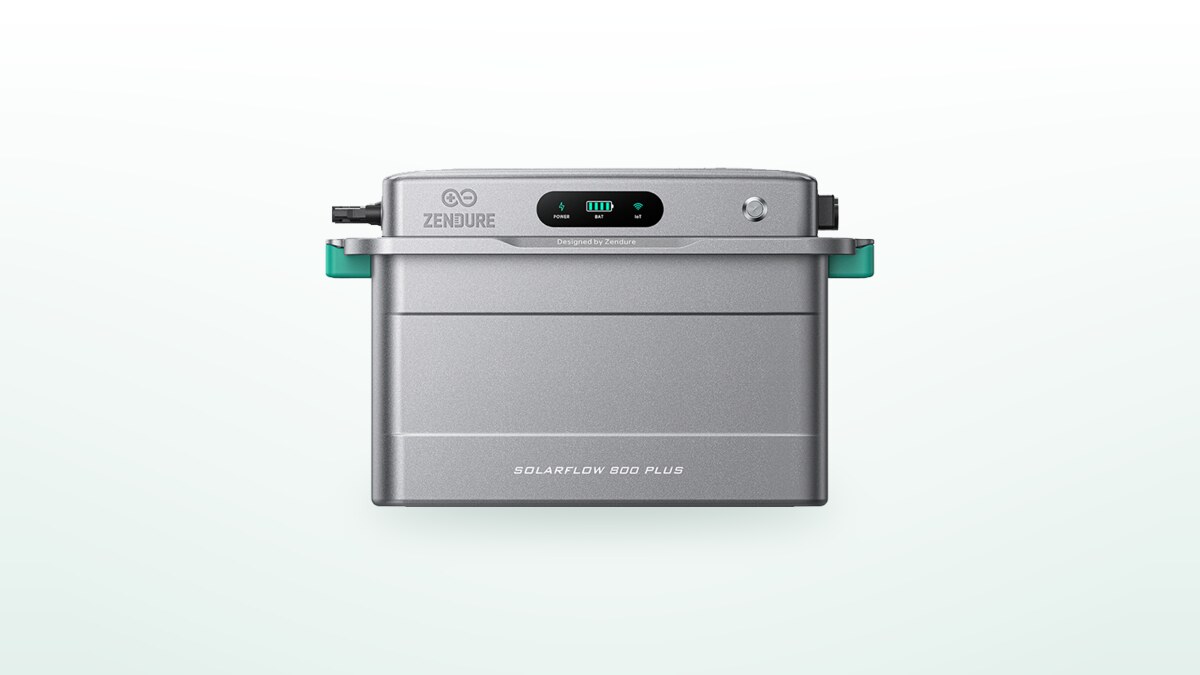
96 % or 83 %? Two different metrics, not a contradiction
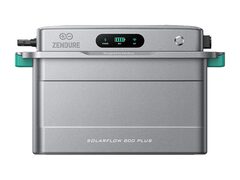
The efficiency figure Zendure advertises, 96 %, refers to the conversion from solar panel current to the battery, a single step in the chain, measured at the maximum power point. The efficiency that matters most for real-world use, the full cycle from grid to battery and back from battery to grid, is noticeably lower.
Several distinct round-trip efficiency figures cluster within a narrow range: around 83 to 85 % over three full cycles, around 84 % with usable capacity estimated at 1600 Wh out of 1920 Wh gross, and 85 to 86 % depending on discharge power. One nuance is worth noting: efficiency barely changes between an 800 W discharge and a 200 W discharge, which is actually a good sign for the lower-power, end-of-day use that is the most common case on a balcony.
The manufacturer itself acknowledges, in a blog post on its own site about storage profitability, system losses of 15 to 20 %, which lines up exactly with the range given above. So the two figures do not contradict each other: they simply measure two different steps of the conversion.
1920 Wh gross, about 1600 Wh usable, expandable to 11.52 kWh
Out of the 1920 Wh of gross capacity, the portion actually usable once the battery's protective reserve is deducted sits around 1600 Wh, or about 83 % of the advertised figure. That is an order of magnitude consistent with the LiFePO4 chemistry used, which keeps a margin to extend cell lifespan.
Expansion up to 11.52 kWh happens by adding compatible extra batteries, without changing the base unit or its inverter. For a use case centreed on off-peak/peak-rate arbitrage rather than solar self-consumption, the manufacturer itself recommends a usable capacity of 3 to 5 kWh for the payback to stay reasonable: the base capacity, on its own, therefore sits below the threshold the manufacturer itself considers relevant for this specific use.
Two independent MPPT trackers, useful for mismatched panels
The two independent MPPT trackers (750 W each, 1500 W announced in total) allow panels with different orientations or different power ratings to be connected without one dragging down the other, since each input seeks its own maximum power point. That is a genuine structural advantage over a system with a single shared MPPT tracker.
However, combined power would cap at around 1300 W when both inputs are drawing at once, short of the 1500 W listed on the spec sheet., a figure that should be treated as an indication rather than a firmly established number.
For panels of different brands or power ratings on the same input, it is better to group identical modules per MPPT tracker rather than mixing them, and to check that the panel's maximum current stays under the limit the input accepts.
Charging that weakens in cold weather, despite the announced range down to -20 °C
The spec sheet lists an operating range of -20 °C to +55 °C. Cold-weather charging power would drop sharply below 0 °C, staying reduced until internal warming kicks in, and remains lower up to around 15 °C.
This is a software threshold issue, not hardware failure or damage from cold or humidity: the limitation lies in the trigger thresholds, not in the IP65 enclosure's integrity itself.
No back-up function during a power cut
Unlike a portable power station, the SolarFlow 800 Plus has no back-up mode: if the grid goes down, the system shuts off rather than switching to its battery reserve to keep powering anything. That is a limitation worth knowing for anyone hoping for combined solar storage and home back-up in a single device.
Off-peak/peak rates: a real but modest gain
Beyond solar storage, the unit can also charge from the grid at up to 1000 W to store electricity during off-peak hours and release it during peak hours. The principle works, but its real-world scale deserves some nuance.
The manufacturer itself publishes a detailed calculation on its own blog: accounting for system losses of 15 to 20 %, the gain works out to between 18 and 38 € per year per kWh of usable capacity, depending on the available tariff gap, and it recommends a usable capacity of 3 to 5 kWh for a reasonable payback on this specific use, beyond the base unit alone. Below roughly 5 kWh of usable capacity and a 10-cent average gap per kWh, the economic upside stays marginal once conversion losses are deducted, a threshold consistent with what the manufacturer itself recommends.
Under France's regulated tariff, the gap between peak and off-peak rates runs around 5 to 6 cents per kWh, which lines up with that same cautious conclusion for everyday use. The gap is markedly more favourable on certain peak days under a variable-pricing plan, but those days remain limited in number over the year.
Another point worth knowing: making full use of this function requires a compatible smart metre, sold separately as an option from the base unit. In short, off-peak arbitrage remains a bonus that slightly speeds up the payback, not a stand-alone reason to buy.
A new mandatory standard since July 2026, compliance to be checked
In France, any balcony solar setup still requires an Enedis declaration (a self-consumption agreement), free and completed online, regardless of its power output. The export cap under the simplified regime, with no dedicated installation work, remains set at 800 W, which matches this unit's AC output exactly.
One question also remains without a clear answer: does adding a storage battery to the setup trigger a Consuel inspection requirement? This point is also worth checking directly before buying, since regulation in this area has changed more than once in recent years.
10-year warranty, on condition of regular recharging
The official warranty runs for 10 years, a solid figure for this product category, backed by LiFePO4 chemistry and a rated 6000 cycles.
It does carry exclusions worth knowing, though: deep discharge or overcharging, unauthorized opening, physical damage, and, more unusually, a clause under which coverage can be lost if the battery is not fully recharged at least once every 3 months. That point deserves attention for seasonal use or a second home, where the unit could easily go a long stretch without a full charge.
A still-recent product, little long-term hindsight
The SolarFlow 800 Plus has been on sale since late November 2025, a little under a year at the time of this review. That is not enough hindsight to judge long-term durability, particularly how the IP65 seal holds up under permanent outdoor exposure: no multi-year usage exists yet for this product.
Potential friction points are identifiable on concrete topics: deep-discharge protection, switching between charge and discharge in multi-unit setups, and integration with third-party smart metres, though it is not possible to establish how frequent they are or whether they have been resolved.
Installation in about ten minutes, designed for balcony use
Setup takes just a few simple steps through the app, with no electrician needed: connect the panels on one side, a household outlet on the other. The whole unit can sit outdoors uncovered thanks to its IP65 rating, ideally in a shaded, ventilated spot.
Once installed, the unit prioritizes solar self-consumption: the surplus produced during the day is stored and released in the evening, rather than fed back to the grid for free. The base 1920 Wh roughly covers one evening's standby-level consumption in an apartment, including the internet box, fridge, lighting, and TV.
539 € for the unit alone, in stock on the official site
The price currently listed on Zendure's official site for the unit alone (without the smart metre) is 539 €, against a reference price shown at 599 €, in stock with shipping in 3 to 5 days. The suggested price announced at launch was noticeably higher, around 699 €, with a promotional launch price that dropped to 399 € during the year-end sales that followed the launch.
The price has therefore shifted considerably since the product's release, with a frequent plateau between 450 € and 540 € depending on the promotional period. The product is also carried by solar specialist retailers, as well as on general marketplaces.
Up against the other SolarFlow models in the lineup
Zendure offers its SolarFlow 800 lineup in several versions. The SolarFlow 800, without "Plus", is the micro-inverter alone, with no built-in battery, at a much lower price but requiring a separate battery to be added for an equivalent result. The SolarFlow 800 Pro steps up to four MPPT trackers instead of two, for higher allowable solar input (up to 2640 W), with more advanced AI-driven control.
The SolarFlow 800 Plus sits in an intermediate position: capacity built in from the start, two MPPT trackers sufficient for most balcony roof setups, and one of the lowest price-per-kWh figures in the lineup. The choice between Plus and Pro mostly comes down to the actual panel surface you plan to install: beyond what two trackers can handle efficiently, the Pro becomes worth considering.
Who it suits, and who it does not
It suits anyone who wants a simple, expandable balcony solar kit, with storage built in from the start rather than added later, and who prioritizes solar self-consumption above all, with off-peak/peak arbitrage staying a bonus rather than the main selling point.
It does not suit anyone looking for a back-up solution during power cuts, nor anyone counting on tariff arbitrage alone to pay back the purchase quickly. Before any installation, checking the micro-inverter's compliance with the NF EN 50549-10 standard (or the equivalent requirement in your own country) remains a step not to skip.