
25W over Qi2: real power, under specific conditions
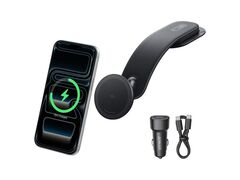
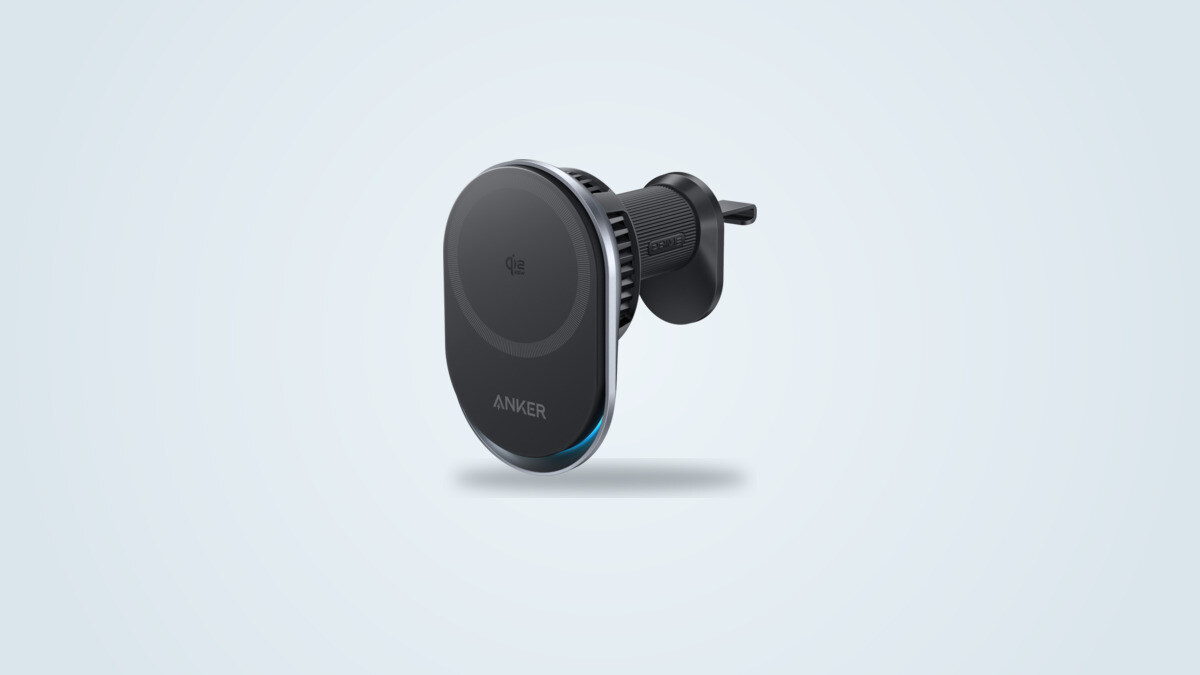
The Prime is Qi2 certified at 25W, the highest wireless power Anker currently offers for in-car use. That figure doesn't apply the same way to every iPhone, though: it's limited to the 16 and 17 series, and only once a software update on the phone unlocks that tier. iPhone 12 to 15 remain capped at 15W on this same charger, a limit set by the phone rather than the charger.
A separate case entirely is the iPhone 16e, which reaches neither tier: this model shipped without the built-in MagSafe magnets on the back of the case, a hardware difference rather than a simple software setting. No update can unlock magnetic charging on this particular phone, which simply won't clip onto the mount.
In practice, the 25W promise is real, but confined to a fairly narrow slice of the current iPhone lineup: the two latest generations, updated, excluding the entry-level model. For every other case, this charger behaves like an ordinary 15W Qi2 charger, without the packaging spelling that out as clearly as it deserves.
Active TEC cooling: what it solves, and its own limit
Fast wireless charging has a well-known physical drawback: it generates heat. Past a certain threshold, a phone throttles its own charging speed to protect itself, which in practice caps the useful power of a standard wireless charger regardless of the number printed on the box. That's the problem the Prime sets out to solve with an active TEC (thermoelectric) cooling system, a technology more commonly found in aerospace than in a car accessory.
The principle: a built-in fan paired with a Peltier module carries away the heat generated by fast charging, aiming to keep the phone below 31 °C according to the manufacturer, where a rival wireless charger often climbs past 42 °C during extended use. The ActiveShield 5.0 system runs up to 10 million temperature checks a day, and the whole unit is TÜV Rheinland certified.
This caveat doesn't undermine the system's value: most drives don't happen in the most extreme conditions, and imperfect active cooling in hot weather still beats the complete absence of cooling on a standard wireless charger. It simply tempers a marketing promise that, taken literally, could suggest flawless thermal control in every circumstance.
22 minutes to 50%: the promise and the real-world gap
The Prime's central selling point fits in one sentence: charge an iPhone to 50% in 22 minutes, up to 6 times faster than a standard 5W wireless charger. That figure comes from the manufacturer's own internal testing, carried out under conditions it does not fully detail (ambient temperature, starting charge level, exact iPhone model).
In practice, the time needed to reach 50% runs closer to 30 minutes than the advertised 22, a real gap but one that doesn't undermine the bigger picture: this speed remains far ahead of a standard 15W wireless charger, which takes about 45 minutes for the same result, and in a different league from an entry-level 5W charger. The gap with the advertised 22 minutes likely comes down to the manufacturer's test conditions being more favourable than everyday use: cool ambient temperature, the original adapter, a certified cable, and the phone already in place before the drive starts rather than clipped on while moving.
This slight gap between the promise and the everyday result isn't unique to this product: almost every fast-charging figure, across every brand, comes from optimised lab conditions. It's still worth knowing before expecting an identical result on every single drive.
Mounting, magnets and compatible cases
The phone is held in place by two magnets rated at 13N, a figure the manufacturer claims after 8 rough-road scenarios. For comparison, the manufacturer's own Nano model, simpler and without active cooling, claims a stronger 16N: an entry-level charger can therefore hold on tighter than a premium one, the real difference lying elsewhere, in charging speed and thermal management rather than raw magnetic strength.
Compatibility with a case you already own deserves a careful check before buying. The manufacturer recommends a magnetic case, either official MagSafe or with a built-in Qi2 ring, no more than about 2.5mm thick. A thicker, metal, or non-magnetic case degrades alignment and therefore charging efficiency, or can even prevent the phone from clipping on properly while driving.
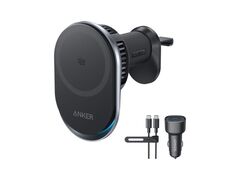
The mount rotates a full 360° and tilts up to 32°, enough to switch between portrait and landscape depending on the app in use (landscape for navigation, portrait for calls) without removing the phone. An additional locking hook secures the whole assembly to the air vent, mechanical reinforcement that complements the magnets rather than replacing them.
Air vent compatibility: the main friction point before buying
All the charging and cooling engineering counts for nothing if the mount won't clip onto the vehicle's air vent. That's where the Prime's main practical constraint lies, even before its price.
The mount only clips onto horizontal air vents, with blades spaced 7.5 to 13mm apart and a blade depth between 10 and 24mm. Outside that range, the grip is unstable or simply impossible. Three vehicle brands are explicitly excluded by the manufacturer regardless of their vent shape: Tesla, Mercedes-Benz and Honda, whose dashboards don't offer a vent compatible with this type of mount.
Before buying, measuring your own vehicle's air vent remains the only reliable way to avoid disappointment, since vent shape and depth vary considerably from one model to the next, even within the same brand.
The 60W adapter and its second port
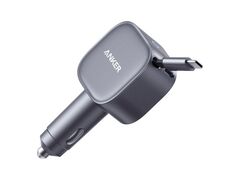
The box includes a dual-port cigarette lighter adapter rated 60W total, split into a 48W USB-C port dedicated to the charger and a 12W USB-A port left free for a second device. This fixed split has a real merit: it's predictable, unlike some multi-port chargers whose total power is shared less transparently between the ports in use.
| Port | Power | Realistic use |
|---|---|---|
| USB-C (Prime mount) | 48W | Powers the wireless charger and its fast charging |
| USB-A (free) | 12W | Standard charging for a second phone, no modern fast charging |
12W is enough for normal charging of a second smartphone or a small accessory (earbuds, a watch on its own puck), but it won't deliver modern USB-C fast charging to a demanding second device. A passenger who also needs a fast charge still needs a separate cigarette lighter charger: this port helps in a pinch, it doesn't match a dedicated high-power second port.
Against the manufacturer's own Nano and the direct competition
Anker's own catalogue already includes a simpler magnetic cigarette lighter charger, the Nano 15W: no active cooling, capped at 15W, but with stronger magnets (16N) and a noticeably lower price. The choice between the two comes down to almost a single factor: how much you use GPS navigation while charging.
| Criteria | Anker Prime 25W | Anker Nano 15W |
|---|---|---|
| Wireless power | 25W (updated iPhone 16/17) | 15W |
| Active cooling | Yes (TEC + fan) | No |
| Magnet strength | 13N | 16N |
| Adapter included | 60W, 2 ports | 25W, 1 port |
| Price positioning | Noticeably higher | Affordable |
For occasional use or short trips, the Nano covers the essentials for less, and its stronger magnets are more than a marketing line. The Prime earns its keep mainly on long, regular drives with navigation running continuously, exactly when the heat built up by extended fast charging is felt the most and active cooling makes the most sense.
Against the wider market, two profiles stand out: chargers fitted with a plain fan and no thermoelectric module, which often tolerate deeper air vents but cool less effectively, and chargers with no active system at all, cheaper but stuck with the classic limit of fast wireless charging, namely real-world power that drops as soon as the phone heats up.
Safety, reliability and warranty
The Prime carries several electronic protections: foreign object detection (to avoid heating up a stray coin or paperclip left on the mount), overvoltage and overcurrent protection, and continuous thermal monitoring via ActiveShield 5.0. The whole unit is TÜV Rheinland certified, an independent certification body well known in consumer electronics.
The product is too recent to offer a multi-year reliability track record: on sale for under a year, it can't yet be judged on long-term durability the way a product available for several seasons can. That said, no recall or recurring build defect has surfaced so far, and general sentiment on mount stability and the strength of the magnetic grip is positive. The 24-month commercial warranty matches the brand's usual standard.
The fan built into the cooling system adds a moving mechanical part rarely found on this type of accessory: worth keeping an eye on over time, inside a cabin exposed to dust and temperature swings, even though nothing so far points to a weakness in this component.
Who it's for, and who should look elsewhere
This charger makes the most sense for anyone with an updated iPhone 16 or 17, who drives long distances regularly with GPS navigation running continuously, and wants to avoid finding a phone still low on battery despite an ongoing charge. Active cooling earns its keep here, and the gap between 22 and 30 minutes to reach 50% becomes a minor detail next to the comfort of charging without plugging in a cable on every drive.
It makes less sense for anyone with an iPhone older than the 16 (capped at 15W, missing out on the most expensive part of the product), an iPhone 16e (incompatible with magnetic charging entirely), a vehicle with an incompatible air vent (Tesla, Mercedes-Benz, Honda, or a vertical, round, or too-deep vent), or simply a tight budget: the manufacturer's own Nano, or a standard wired cigarette lighter charger, cover everyday needs for considerably less.