
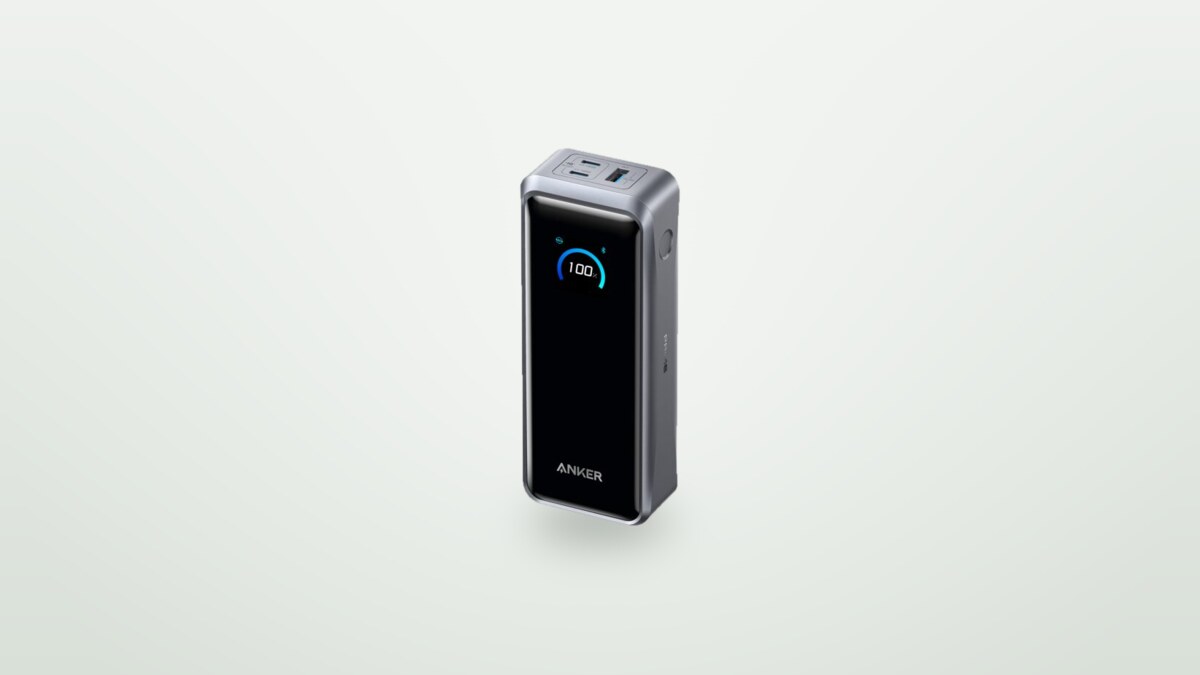
140 W per port: genuinely reachable, no proprietary lock
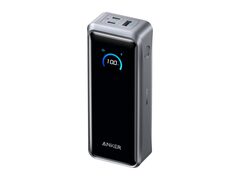
The question is worth asking directly, given the precedent set by the Anker 737 Power Bank already reviewed on this site: is the advertised 140 W per port genuinely reachable, or only under unspecified restrictive conditions? On the Prime 26250, the answer differs from the 737's. The 737 never exceeded 90 to 93 W over direct USB-C, with the 140 W figure only reachable using a 16-inch MacBook Pro over a proprietary MagSafe cable. The Prime 26250 has no MagSafe port at all: everything runs over standard USB-C PD 3.1 / PPS, and the actual draw holds steady close to 140 W with a MacBook Pro connected over plain USB-C.
The real nuance, then, is not a hidden proprietary lock but two ordinary conditions of the USB-C PD standard: a receiving device capable of genuinely requesting 140 W (a high-end 16-inch MacBook Pro or a handful of gaming laptops, not a smartphone or a compact laptop), and a cable certified for at least 5 A. A device that does not request 140 W, such as a 14-inch MacBook Pro with a smaller battery or a smartphone, will naturally not draw more than it needs, which is not a limitation of the product itself.
No independent measurement has clocked whether the 140 W draw holds up for the full length of an intensive work session (video editing, code compiling): the claim holds up for a short, one-off charge, not yet for a long, sustained one.
Recharging the battery pack itself: faster in practice than advertised
The manufacturer rates a full recharge at around 1 hour and 13 minutes with both USB-C ports drawing power at the same time, up to 250 W input. In practice, the actual recharge time is faster than that figure: 46 minutes with two 140 W chargers, 55 minutes with a single 150 W charger, 59 minutes with a single 140 W charger. Reaching 50 % takes 13 to 15 minutes. The combined measured input power across both USB-C ports reaches 238 to 246 W, close to the advertised 250 W ceiling without quite reaching it.
That is a fairly rare situation: most marketing claims in this category tend to be optimistic next to the real-world figure. Here, the measured full recharge time under good conditions beats the official number.
80 to 90 % real-world efficiency, no clear improvement over the previous generation
Out of the 99.75 Wh advertised, the energy actually delivered, measured across several full charge cycles, falls between 79.6 and 89.8 Wh, or 80 to 90 % real-world efficiency. That is in the same range already measured on the Anker Prime 20000 (200 W), the previous generation in the same lineup: 82 % measured efficiency (70.72 Wh consumed on input for 58.18 Wh delivered on output). Despite the charging input being raised from 100 to 250 W and the per-port output raised from 100 to 140 W, overall energy efficiency therefore does not improve much from one generation to the next.
An actual measured weight under the advertised 600 g
The official spec sheet lists around 600 g. The measured weight comes in lower, between 577 and 580 g, with dimensions of around 160 x 63 x 38 mm. The difference, on the order of 3 to 4 %, is minor and works in the buyer's favour: it is one of the rare cases in this review where the measured reality is more favourable than the manufacturer's figure rather than the other way around.
Safety: the Prime lineup left out of every Anker recall in 2024 and 2025
Anker has issued several external battery recalls in 2024 and 2025: a recall in June 2025 covering around 1.15 million units of the PowerCore 10000, and a recall in September 2025 covering around 481000 units across five references in the Power Bank 10K, MagGo, and Zolo lineups, over a risk of overheating or fire. The manufacturer's official recall page lists these exact references and makes no mention at any point of the Prime lineup or the Prime 26250 model. No recall specific to this model has otherwise been identified.
This is based on an absence across every available list rather than an explicit manufacturer statement excluding the Prime lineup: it is a strong signal, not a formal guarantee. No report of failure, overheating, or a hardware defect has otherwise been identified for this specific model either, still a cautious judgment for a device on the market only since November 2025.
Against the Prime 20000 (200W): a real gain, but concentrated on power
| Criterion | Prime 26250 | Prime 20000 |
|---|---|---|
| Capacity | 99.75 Wh | 72 Wh |
| Power per USB-C port | 140 W | 100 W |
| Total power | 300 W | 200 W |
| Charging input | 250 W | 100 W |
| Measured real-world efficiency | 80 to 90 % | 82 % |
| Weight | 577 to 580 g measured | 544 g measured |
The generational progress is real but concentrated on available power (140 W against 100 W per port, measured on both sides) and on how fast the pack itself recharges, thanks to the input being raised from 100 to 250 W. Energy efficiency, by contrast, stays flat around 80 to 90 %, and weight naturally increases with the extra capacity on board. Both generations also share similar thermal safety behaviour, with power reduced under sustained full-power load, a sign of a consistent protection policy rather than a radical change.
PowerIQ 4.0 and ActiveShield 4.0: marketing names not independently verified
According to the manufacturer's documentation, PowerIQ 4.0 refers to dynamic power redistribution between ports based on each connected device's needs, re-evaluated roughly every 3 minutes, on top of PD 3.1 and PPS support up to 140 W. ActiveShield 4.0 refers to temperature monitoring claimed at 120 times per second. No independent, quantified measurement can confirm to date a real gain from these technologies over the previous generation (PowerIQ 3.0): these are feature names documented by the manufacturer, not results verified by a third party.
One concrete technical limitation is worth flagging, however: the firmware does not support Adaptive Voltage Scaling (AVS), a USB Power Delivery standard feature offered by some high-end rival chargers. That is a technical detail absent from the marketing pitch.
The USB-A port, secondary next to the two USB-C ports
The secondary USB-A port delivers 22.5 W when used on its own. When both USB-C ports are drawing full power at the same time, its actual output drops to around 20 W. This is consistent with the advertised 300 W total spread across the three ports, but a useful reminder that the USB-A port is not given priority in that split.
99.75 Wh: just under the cabin limit, but not without friction
The 26250 mAh capacity was calculated to stay under the 100 Wh threshold beyond which most airlines ban external batteries from the cabin (26250 mAh at a nominal voltage of 3.8 V works out to 99.75 Wh). This calculation complies with current regulations, but the unit's imposing size can still draw questions from security staff at the checkpoint, despite its legal compliance.
Who it suits, and who it does not
It suits anyone with a laptop genuinely capable of drawing 140 W (a high-end 16-inch MacBook Pro in particular) who wants fast top-up charging for it, along with a capacity close to the maximum allowed in an airplane cabin.
It does not suit anyone looking above all for a gain in energy efficiency over an entry-level model from the same brand, since real-world efficiency stays close to that of the previous generation despite the higher price, nor anyone who only needs to charge a smartphone, for which the 140 W per port makes no real difference.