
What the Apple Watch charger is really worth
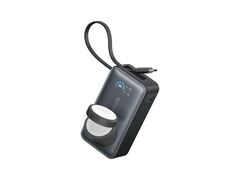
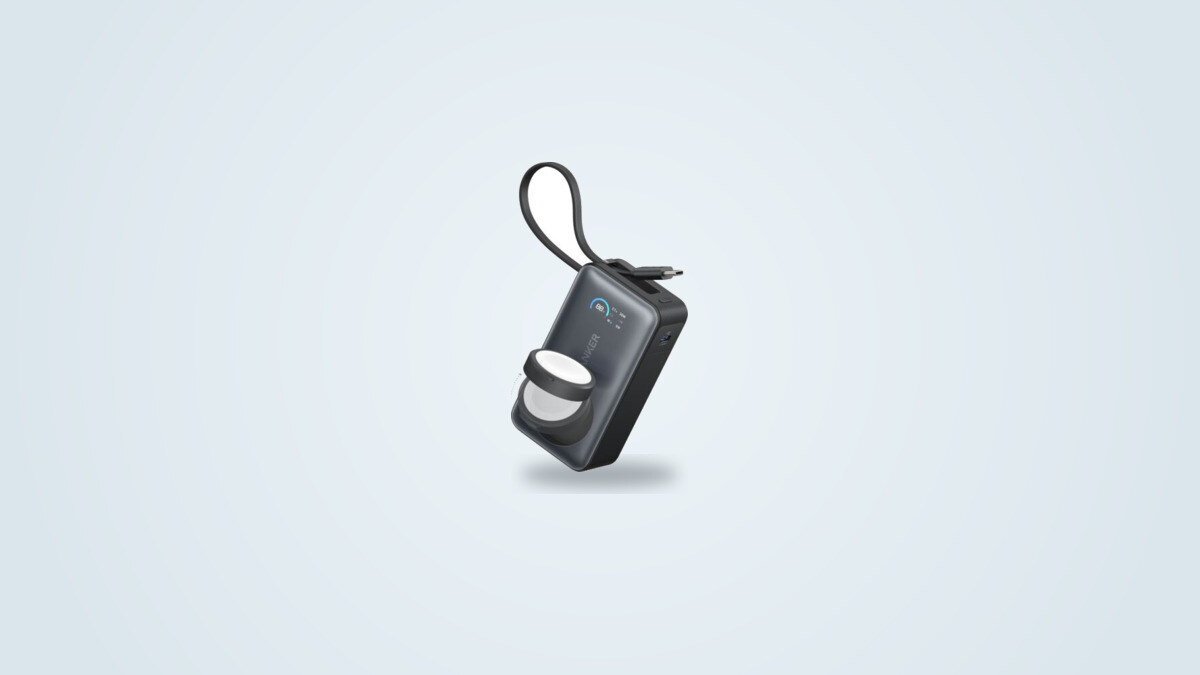
The real selling point of this Anker MagGo comes down to one line: it is an MFi-certified Apple Watch charger, not a generic coil that merely approximates the protocol. That certification shows in real use, since charging speed matches Apple's own puck, where many third-party accessories fall noticeably behind. The magnetic puck delivers up to 5W, an Apple Watch Series 9 reaches 47% charge in 30 minutes from empty, and a newer Series 10 climbs to 65% over the same half hour. The stand tilts up to about 90°, letting the watch sit flat, face visible, a position built for still wearing it overnight and tracking sleep without staying tied to a wall outlet.
Compatibility spans the entire lineup, from the Series 1 to the Ultra models and the SE, but one detail is worth spelling out before buying: true fast charging only kicks in from the Series 7 onward. An Apple Watch SE or a Series 6 and earlier still charges normally on the same stand, just at standard speed, without the early-minute boost. Worth checking if the watch on your wrist isn't a recent one.
The built-in cable and a real 30W for the rest of your Apple gear
The second pillar of this power bank is a USB-C cable welded to the case, which avoids the classic problem of a cord lost at the bottom of a bag. It delivers up to 30W, a figure that holds up on an iPhone as well as on more demanding devices: an iPhone 15 gains about 50% in 30 minutes, an 11-inch iPad Pro about 35% over the same span, and a MacBook Air M3 used as a backup source gains roughly 26% in half an hour. The USB-C port hits its advertised 30W without trouble, with peaks reaching 33W in some setups.
This built-in cable isn't the only wired option: a second, independent USB-C port lets you plug in an extra device with its own cable. One small catch for owners of an iPhone 14, 13, or older, still fitted with a Lightning port: the MagGo Apple Watch 10000 doesn't include a USB-C to Lightning cable, so you'll need your own. Recent Samsung, Google, or Huawei phones, all now on USB-C, charge straight off the built-in cable with no extra accessory.
What the advertised 35W actually becomes
35W is the number on the spec sheet and the box, but it only applies in one specific setup, and it's worth spelling out clearly before buying. On a single output, the built-in cable holds its 30W. As soon as that cable and the second USB-C port are used at the same time, each toward a different device, combined output drops to 24W, roughly a 20% cut from the theoretical total of two 30W outputs. This detail is disclosed in the manufacturer's own documentation, which is worth noting: unlike some other power banks in this segment, the limit isn't hidden.
Pairing the cable, for the phone, with the magnetic puck, for the watch, doesn't run into the same limit: the two circuits are separate and split the advertised 35W without a noticeable drop, with an iPhone and an Apple Watch both progressing normally in a shared charging session. The real limit shows up elsewhere, in a rarer but real scenario: the bank plugged into the wall to recharge itself, while also powering a phone at the same time. In that case, the power available to the connected device falls to around 7W, three to four times slower than normal use. The system still works, but at overnight-charge pace, not quick-top-up pace.
Size and portability
At 245g on the scale for 95 x 51 x 32.4mm, the MagGo Apple Watch 10000 fits a jacket pocket or a tech pouch without drawing attention, barely bigger than a computer mouse. The case rests on small rubber feet that keep it from scratching a nightstand, a detail suited to the overnight use the tilting stand is built for. Once stowed in its notch, the cable forms a loop that doubles as a carry strap, a simple solution that avoids hunting for a separate accessory.
What the MagGo name doesn't tell you: no wireless charging for the phone
Anker uses the MagGo name for an entire family of magnetic accessories, and several of them do charge an iPhone by induction, up to 15W on some models in the same range. Not this one. On this specific unit, the magnet only positions and steadies the Apple Watch on its puck; the phone always goes through the built-in USB-C cable instead. A buyer who spots the name without reading the full spec sheet could reasonably expect to drop their iPhone on it wirelessly, as with other products from the same brand: that isn't what this power bank does.
The trade-off isn't necessarily a bad one: wired charging at 30W is structurally faster and more efficient than induction charging, even at an advertised 15W, due to the losses inherent to magnetic power transfer. The real question to settle before buying isn't about performance, but about use case: this particular MagGo is built for someone happy to plug a cable into their phone in exchange for genuinely wireless watch charging, not for someone who wants to set their iPhone down with no cable at all.
The physical friction points
The one detail that sets this power bank apart from the general competition, its built-in Apple Watch charger, is also what limits the rest of its connectivity. Only one free USB-C port sits alongside the built-in cable, with no USB-A port at all: enough for a use case built around the Apple ecosystem, more limiting for anyone still relying on older accessories. The built-in cable, fairly short once extended, also makes it awkward to comfortably use the connected device while it charges, a common trade-off with captive cables but a real one here.
The Apple Watch charger's stand, built to tilt up to about 90°, can show signs of design flex if pushed past that normal travel, a point worth watching in daily use rather than an obvious flaw at the point of purchase. Nothing in the available feedback points to an outright break or a widespread failure on this hinge, but the mechanical margin is clearly built to a tight tolerance.
Real-world runtime: what those 37Wh actually charge
The advertised 10,000mAh works out to a real 37Wh, a figure that matches the description of the internal cells, two 5,000mAh elements in series at 7.4V, rather than a simple, flattering conversion at 3.6 or 3.7V as is common for this kind of product. That transparency is a genuine plus: the listed capacity matches what the pack actually holds.
In practice, that 37Wh is good for about two full charges of an iPhone 15 Pro, or up to eleven charges of an Apple Watch Series 9 depending on the starting charge level. Capacity still stays modest given the price and the dual-purpose positioning of the device: fine for an occasional top-up or a weekend, not for several days with no access to an outlet. The pack itself fully recharges in about 90 minutes at 30W, a duration consistent with its modest capacity.
Compatibility beyond the Apple ecosystem
The built-in USB-C cable isn't limited to Apple devices: a recent Samsung, Google Pixel, or Huawei phone, as long as it has a USB-C port, charges straight off it with no extra accessory. Only the magnetic puck stays an Apple Watch exclusive, since the watch's charging geometry and protocol have no equivalent on Android or Wear OS.
The real point to watch concerns older iPhones: the 14, 13, and earlier models, still fitted with a Lightning port, can't plug directly into the built-in USB-C cable. You'll need to add your own USB-C to Lightning cable, not included in the box, to get full use of the device. From the iPhone 15 onward, the wider shift to USB-C removes that constraint.
Reliability, warranty, and the context of Anker's recalls
The advertised manufacturer warranty is two years, standard for Anker products in this range. Worth checking for anyone buying an Anker power bank right now: two safety recall waves hit Anker power banks in October 2024 and again in September 2025, over an overheating risk affecting specific units (A1642, A1647, A1652, A1257, A1681, and A1689, per the official lists). The unit covered in this review, the A1657, doesn't appear on either list.
On sale since fall 2024, the MagGo Apple Watch 10000 has now been on the market for nearly two years with no recurring failure pattern identified, beyond one minor point already flagged by the manufacturer itself: a slight residual draw from the watch-charging stand, around 0.1W, that continues for one to two minutes after the watch is removed. This behavior, explained in the manufacturer's own user guide, accounts for the small battery drain some users notice when the unit sits stored for several days with the stand engaged.
Against the direct competition
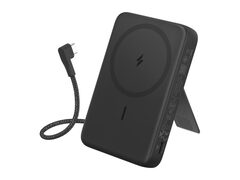
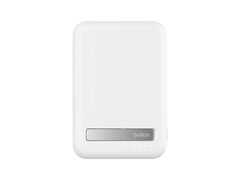
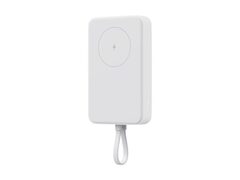
In the segment of power banks built for Apple Watch owners, three names come up repeatedly for comparison: the Anker Zolo Magnetic 10000, the Belkin BoostCharge Pro 10K, and the Xiaomi 33W Magnetic 10000. The Zolo and the Xiaomi bet on induction for the phone, at 7.5W, but skip the watch entirely. The Belkin also charges the Apple Watch, even at a slightly higher 7.5W versus 5W here, but has no built-in cable and costs noticeably more, roughly 60% more at the time of writing. The MagGo Apple Watch 10000 remains the only one of the four to combine a cable welded to the case with genuinely certified watch charging, at a mid-range price.
| Criterion | Anker MagGo Apple Watch 10000 | Anker Zolo Magnetic 10000 | Belkin BoostCharge Pro 10K | Xiaomi 33W Magnetic 10000 |
|---|---|---|---|---|
| Apple Watch charging | Yes, 5W, MFi-certified | No | Yes, 7.5W | No |
| Phone charging | USB-C cable 30W only | Wireless 7.5W + cable 30W | USB-C cable 20W (not built-in) | Wireless 7.5W + cable 33W |
| Built-in cable | Yes | Yes | No | Yes |
| Weight | 245g | ≈ 240g | not disclosed | not disclosed |
The choice between these comes down to a simple trade-off: wanting wireless phone charging points toward the Zolo or the Xiaomi, both cheaper, at the cost of giving up watch charging entirely; wanting watch charging without blowing the budget points toward this MagGo Apple Watch 10000; only a noticeably bigger budget and the highest watch-charging wattage justify considering the Belkin.
Who it's for, who it isn't for
This power bank is aimed first at an Apple Watch owner who wants a single travel companion for the watch and the rest of their Apple gear, especially for sleep tracking: the tilting stand and the genuinely fast watch charging make a credible case for still wearing it overnight instead of leaving it on a charger. It also suits a traveler who'd rather carry fewer accessories, thanks to the built-in cable.
It's less suited to anyone chiefly after wireless charging for their phone: despite the name, this specific unit doesn't offer it, and other MagGo power banks from the same brand serve that need better. It's also not the best fit for extended use far from an outlet, since its 37Wh capacity stays modest next to bulkier packs, nor for anyone still relying on USB-A accessories on a regular basis.