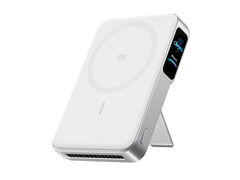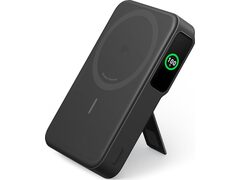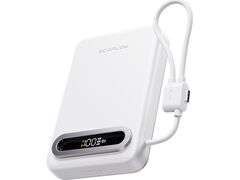


25W wireless and 45W USB-C: the real leap in this generation
On paper, the MagGo 2 Pro moves up a class from the original MagGo (10,000mAh, already in our catalogue): MagSafe/Qi2.2 wireless charging climbs from 15W to 25W, and the USB-C port goes from 27W to 45W, both as an input and an output. In both cases, that is a 67% increase claimed by Anker, widely echoed by the tech press present at the product's launch in early September 2026.
Anker also claims a doubled charging speed for the iPhone 17 Pro compared with the previous generation: 25% charge in 10 minutes and 50% in 25 minutes according to the manufacturer. That figure concerns the charge percentage shown on the phone, not the energy efficiency of the wireless conversion itself (see below): the two notions overlap partly, without being the same thing.
The problem this fan is really trying to solve
Every magnetic wireless charge dissipates part of the transferred energy as heat, a phenomenon that mechanically worsens with power: the more watts involved, the hotter the shell gets, until the protection circuitry throttles the delivered power itself to avoid overheating. That is the most commonly reported recurring flaw on classic MagSafe power banks, the original MagGo included.
Anker's answer combines three elements: a turbo fan with dual air channels, an algorithm that adjusts fan speed in real time based on measured temperature, and a three-layer graphene heat spreader. Anker claims a surface temperature kept under 36 °C throughout wireless charging, and states, for comparison, that a classic magnetic power bank can exceed 45 °C within about twenty minutes of continuous charging.
The underlying approach is nothing exotic: pairing a fan with a large heat spreader is a standard cooling solution in electronics, and its effectiveness depends mostly on execution quality (actual airflow, the spreader's thermal contact) rather than the principle itself. Two unknowns remain open at this stage: how loud the fan actually gets in Cool mode, with no decibel measurement available yet, and the mechanical lifespan of this part, unprecedented on this type of product from the brand.
What the claimed 25W is really worth: the efficiency question
The 25W figure states the power aimed for on the transmitting side, not the energy that actually reaches the phone's battery. Part of the energy is systematically lost crossing the coil, a phenomenon affecting all wireless charging regardless of brand, and one that generally worsens as power increases.
On the original MagGo (10,000mAh, 15W), the closest comparison point available on this site, the coil alone returned only 76.1% of the energy at full power, a figure that fell to around 60% once the losses specific to the iPhone's own charging circuit, screen and standby electronics were factored in over a full cycle. That is why, out of the original MagGo's real 38.5Wh, only 1.7 to 1.8 iPhone charges were actually available rather than the 3 charges a perfect transfer would allow.
| Product | Wireless power | Coil-only efficiency | Estimated end-to-end efficiency |
|---|---|---|---|
| MagGo (1st gen) | 15W | 76.1% | around 60% |
| MagGo 2 Pro | 25W | not measured yet | not measured yet |
Nothing indicates whether the MagGo 2 Pro performs better or worse than its predecessor on this specific point: the higher power could just as well benefit from better engineering (coil, more precise magnetic alignment thanks to the 12N magnet) as generate proportionally more losses at equal heat. Without an independent measurement, the question stays open, and the 37Wh nominal capacity stated on the product page should be read with this caveat in mind rather than as a settled figure.
52 minutes for 80%: a charging speed still to be confirmed
The MagGo 2 Pro's USB-C port runs up to 45W in both directions. As an input, to recharge the pack itself, Anker claims 80% in 52 minutes, a marked improvement over the original MagGo's 20W input and the roughly 2h45 (165 minutes) it took for a full charge. As with that figure, this one comes solely from the manufacturer's own documentation, with no independent confirmation available at the time of writing.
One question has no quantified answer: how much energy the fan itself consumes during an extended wireless charging session. That consumption is drawn from the same 37Wh meant to charge the phone, which necessarily reduces, by an uncommunicated amount, the energy actually available for the connected device. Silent mode, which switches the fan off at the cost of reduced charging power, exists precisely to limit this trade-off, but no precise figure accompanies either mode.
Magnetic alignment and kickstand: the proven and the new
The MagGo 2 Pro reuses the ring-magnet system of the Qi2.2 standard, the same physical principle as a native MagSafe accessory. Anker claims a 12N attraction force, compatible with any MagSafe iPhone from the 12 series onward. This alignment mechanism is already the one used on the original MagGo and the rest of the brand's Qi2 lineup, with no particular grip or slipping issue reported so far on those earlier products.
The built-in kickstand, on the other hand, genuinely improves: continuously adjustable from 0 to 80° and rated for 5,000 opening cycles, it replaces the original MagGo's fixed position. A continuous hinge generally holds up better over time than a fixed-notch catch, and lets you find a precise viewing angle rather than picking from a handful of preset positions.
Two caveats remain, though: no real-world feedback exists yet on how this kickstand holds up after months of repeated use, and the 12N attraction figure remains a value stated by Anker, without independent dynamometer verification.
Versus the original MagGo: what changes, what stays the same
The MagGo 2 Pro directly succeeds the original MagGo Power Bank (10,000mAh, 15W), still in our catalogue. The table below lists the official specifications of both products, along with prices as observed at the time of writing.
| Criterion | MagGo 2 Pro | MagGo (1st gen) |
|---|---|---|
| Capacity | 10,000mAh | 10,000mAh |
| Wireless | Qi2.2, 25W | Qi2, 15W |
| USB-C | 45W | 27W |
| Cooling | Active fan + graphene | Passive |
| Screen | Charge, health, temperature, mode | Charge and time remaining |
| Kickstand | Adjustable 0-80° | Fixed |
| Weight | 220g | 250g |
| Price observed | Not yet listed in the UK | £54.99 |
At the time of writing, the MagGo 2 Pro is not yet listed with a UK price, which makes a direct price comparison impossible on this market. On markets where it is already sold, it costs noticeably more than its predecessor, for wireless and wired power that is 67% higher on both counts, a fuller screen and an adjustable kickstand. Whether that trade-off is worth it still depends on real-world efficiency and fan reliability confirming the manufacturer's promises in actual use.
Who it suits, and the caveats to keep in mind
It suits anyone with a recent MagSafe-compatible iPhone who wants the highest wireless charging power currently available on this format of magnetic power bank, with a fully-featured status screen and a fast USB-C port as a wired backup.
It suits less anyone looking for a product with an already-established track record: the MagGo 2 Pro has only just gone on sale, with no verified review or extended real-world feedback available at the time of writing, and no certainty yet about the real efficiency of its 25W wireless charging or the long-term mechanical reliability of its new fan.