
72.6 Wh actually delivered out of 86.4 Wh advertised, about 84 %
The unit delivers 72.6 Wh out of the 86.4 Wh of advertised capacity, an efficiency of about 84 %.
Two other estimates place this efficiency between 75.5 and 89.4 %, and between 76 and 87 %, respectively, with no full methodological detail available for any of the three. Overall, the figures stay roughly between 75 and 90 %. A fourth estimate, at 95 %, is not used here: its method remains uncertain and not detailed enough to verify.
After about 4 years of use, a durability measurement at 57.21 Wh
A complementary measurement, taken on 25 August 2026 on a unit purchased in October 2022 (about 4 years of use), recorded 57.21 Wh delivered at a 5V/1A (5W) charging rate.
Two factors keep this figure from being directly comparable to the 72.6 Wh measured on a new unit above: battery age on one hand, since a 15 to 25% capacity loss is normal for a lithium cell after several years of use and does not indicate a product defect; the charging rate on the other hand, 5W being notably lower than the rate used for the as-new measurement, with conversion efficiency varying with the power drawn. This measurement therefore documents how one specific unit holds up over time rather than calling the as-new efficiency into question: it does not change this review's score.
140 W in practice reserved for the 16-inch MacBook Pro, over a specific cable
The 140 W figure printed prominently on the spec sheet requires specific conditions to actually be reached. A 16-inch MacBook Pro (2021 or later), plugged directly into its own Thunderbolt port over USB-C, caps at 100 W regardless of the charger used: only its MagSafe port, a proprietary magnetic connector separate from USB-C, unlocks the full 140 W. That is precisely the path Anker itself explicitly recommends on its own product page, using a USB-C-to-MagSafe cable sold separately.
Outside this specific case, very few other devices accept 140 W Power Delivery 3.1: a handful of recent gaming laptops with proprietary chargers, a list that is growing slowly but remains short. No measurement has so far exceeded 90 to 93 W over direct USB-C, since the MacBook Pro 16-inch plus MagSafe cable combination itself has not yet been verified.
Two USB-C ports, a 140 W budget genuinely shared between them
Both USB-C ports are identical in spec (140 W each, taken in isolation), but when used at the same time they share a combined 140 W budget, split according to each connected device's needs, a point confirmed directly by the manufacturer's own official documentation: it is never 140 W on each port at once. If the USB-A port (18 W) is also drawing power, the combined USB-C budget drops to 100 W.
About 48 minutes for a full charge, the fastest in its category
With a charger capable of 140 W, the battery recharges fully in about 48 minutes, a figure comparable to that of two direct rivals, both of which stay under the 2-hour mark. That is the clearest edge in this review in the product's favour.
This speed depends entirely on the charger and cable used, though: a charger limited to 100 W caps the input at around 90 W, and a cable limited to 60 W drops it to around 53 W, extending the charging time accordingly.
A full control display, often the real everyday advantage
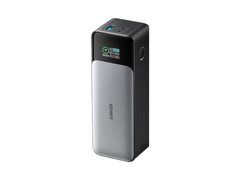
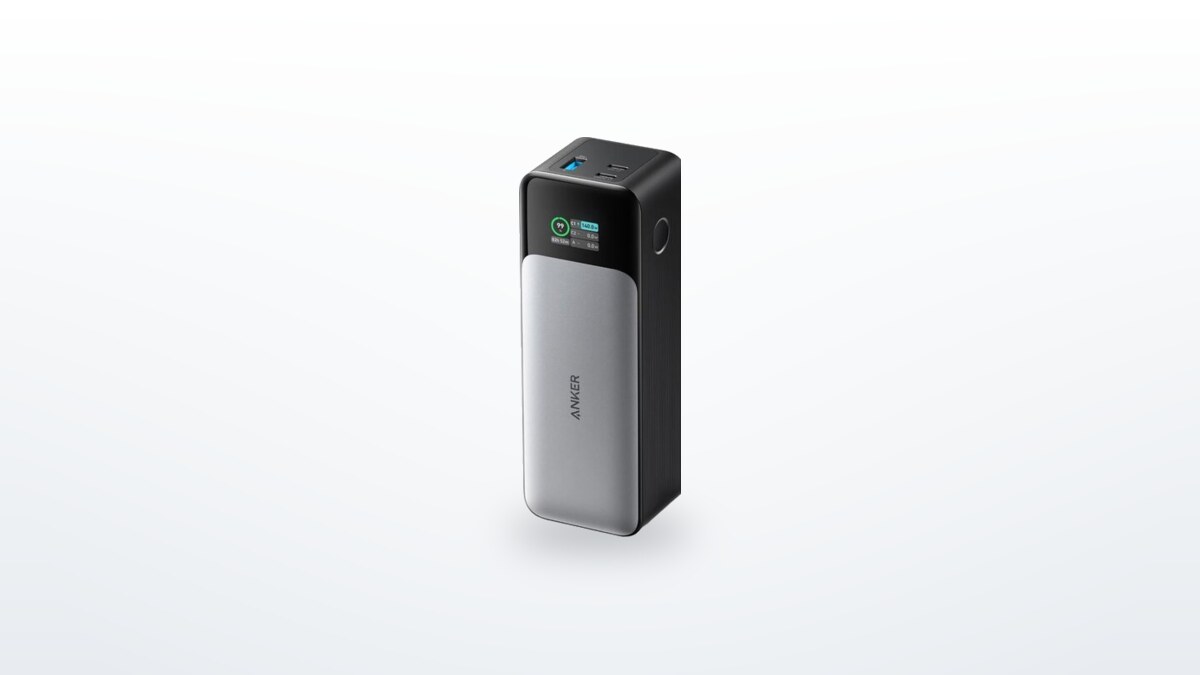
The digital display shows, in real time, the power delivered on each port, the power being drawn in during charging, the remaining charge percentage, and the estimated time to a full charge. It is the feature most consistently highlighted as the real everyday advantage, ahead of capacity or power themselves.
A few useful reference points for interpreting it correctly: on standby, the unit's own power draw stays low (around 0.4 W), with about a 15 % charge loss over 24 hours if the screen is left on continuously, which is normal behavior and not a sign of a fault. A USB-A port showing 0.1 W with nothing connected is also normal; the manufacturer simply recommends turning off trickle-charge mode if it has been switched on by mistake.
630 g, notably heavier than its main direct rival
At 630 g, it is noticeably heavier and bulkier than power banks of comparable capacity. The clearest point of comparison is its most frequently mentioned direct rival, with equal or slightly higher capacity and power: 505 g, about 20 % less for equivalent use. That is the most concrete trade-off to accept in exchange for the Anker 737's charging speed and connectivity.
No official recall for this specific model, two isolated failures worth knowing about
This manufacturer does have two separate product recalls on record for an overheating risk, but they cover other models in its power bank lineup: no official recall targets this specific model, a point checked directly against the manufacturer's own dedicated recall page and with a product-safety authority.
Two real, isolated failures exist: a safety shutdown after about a year of use (the display showed an incorrect charge percentage, then the unit powered off as soon as anything was plugged in, with no visible impact or water exposure, and the official reset procedure was attempted without success), and a complete failure after a year and a half to two years of heavy use, replaced under warranty within three days with no proof of purchase required. No widespread failure pattern has been identified beyond these two cases. On the other side, a case of regular use over two years with no drop in performance also exists.
Internally, the components are well-regarded: 21700-format cells from a specialised cell manufacturer, a dedicated protection chip, and a charge gauge and buck-boost controller sourced from recognised suppliers in the industry. A less reliable estimate puts forward older-format cells and a 1000-cycle lifespan, a figure incompatible with the components actually identified inside the unit, and it is not used here.
A warranty that varies by market, worth checking before buying
In the Japanese market, the official warranty is 18 months as a base, extended to 24 months only after free product registration: it is not, therefore, an automatic 24-month warranty, contrary to what some listings show. The exact structure for the European market could not be confirmed with certainty from the manufacturer's documentation alone. What remains guaranteed in Europe regardless of the manufacturer's commercial policy: the statutory legal warranty of conformity applies to any new consumer good for 24 months either way.
Still allowed in the cabin, but in-flight recharging banned by several airlines since 2026
At 86.4 Wh, it stays under the 100 Wh threshold that most airlines allow in the cabin without prior approval, always in carry-on luggage, never in checked baggage.
Limited new-unit availability in France, a shrinking sales channel
Checked directly at the time of writing: this model is no longer listed for sale at several major French general-retail chains, which now carry only accessories (cases, cables) or other products from the same brand. The price found on the main channel still carrying it is 89.99 €, against a reference price shown at 102.99 €.
The manufacturer has since moved its high-end power bank lineup toward newer, more recent series: worth keeping in mind for anyone comparing before buying, though that does not mean this specific model has disappeared from the market.
Against its main direct rival, lighter but slower to recharge itself
In this segment of 140 W-and-up power banks, the Anker 737 goes head-to-head with a rival offering slightly higher capacity and power.
| Criterion | Anker 737 | 145 W rival |
|---|---|---|
| Advertised capacity | 24000 mAh | 25000 mAh |
| Advertised power | 140 W | 145 W |
| Weight | 630 g | 505 g |
| Time to recharge itself | ≈48 min | <2 h |
With nearly equivalent capacity and power on paper, the rival wins clearly on weight. The Anker 737 keeps the edge on how fast it recharges itself and on support for the PPS protocol, useful for fast charging on some Samsung smartphones.
Laptops and life on the road, the two areas where it fits best
Beyond the MacBook Pro 16-inch case, other USB-C laptops reach a high charging power without needing a special cable: a 15-inch MacBook Air, for instance, accepts up to a full 70 W, a limit set by the laptop rather than by the power bank.
For regular life on the road, it suits frequent carry-on use well, on both domestic and international flights. Weight and bulk remain the main drawback cited for daily rather than occasional carrying.
Who it suits, and who it does not
It suits anyone with a recent 16-inch MacBook Pro who genuinely wants to make use of the full 140 W over a MagSafe cable, anyone charging several demanding mobile devices who values fast self-recharging, and anyone who values a full control display.
It does not suit anyone looking above all for lightness for daily carrying (the direct rival does better on this specific point), nor anyone counting on the 140 W with a laptop other than a 16-inch MacBook Pro, a case that remains rare in practice.