
10,000mAh claimed, about 29Wh that actually come out
One number dominates the box: 10,000mAh. Converted at the conventional 3.6 to 3.7V most makers use for this kind of calculation, that works out to 36 to 37Wh on paper, a range that comes down to which voltage is chosen rather than a precise measurement of the pack. That headline figure still says nothing about what actually reaches a connected device.
The step down to a USB port has a cost, as on any power bank. Depending on the load applied, the energy leaving the case sits between 28.3 and 29.6Wh, roughly 79 to 82% of the 36Wh nominal figure. That is neither a great nor a poor number for a 10,000mAh pack of this kind, it is a perfectly ordinary conversion for the category, close to what other Anker packs of the same capacity deliver.
In practice, those 29Wh charge a modern smartphone a little under two full times, cover about half a tablet charge, or top up a light laptop for a meeting. With 36 to 37Wh on board, the 533 PowerCore stays well under the 100Wh cabin limit set by nearly every airline, with no special permit needed.
The real weak point: recharging the pack itself
The ‘30W’ printed on the case describes what the pack gives out, not what it takes in. To recharge itself, the official spec sheet caps the USB-C input at 12V and 1.5A, 18W at best, a much more modest figure than the one shown large on the box.
Even that 18W ceiling proves hard to reach in practice. Depending on the charger and cable paired with it, input power most often tops out around 6 to 7W, with rare spikes climbing to 17W with no identifiable pattern. The result is a full charge time that swings wildly from one session to the next: one full charge ran its course in a little over two and a half hours, while another stayed connected for close to six hours before reaching 100%.
The pattern persists across different charging gear, which rules out a simple bad-cable explanation: input power generally stays under 7W regardless of the equipment paired with it. For anyone travelling light where every recharge minute counts, this unpredictability is the main thing to know before buying.
30W out, 24W once two devices share the case
On its own, a single USB-C output genuinely reaches its claimed 30W: on a tablet or a light laptop, output power reaches 27.3W and around 24W depending on the device, close to the ceiling. On a smartphone it naturally sits lower, between 14 and 15W, the limit coming from the device being charged rather than the port.
The USB-A port deserves a separate note: its spec sheet claims up to 22.5W, but on the phones and tablets tried, it never exceeded 7W. The gap likely owes as much to the devices charged, which do not all negotiate the same fast-charging protocols, as to the port itself, but the figure is worth knowing before relying on this port for a fast top-up.
A real heat issue, but only with two devices at full power
No bothersome heat shows up in simple use, one device at a time, even over a long session. The picture changes once both USB-C ports are pushed together at high power: output current then steps itself down, dropping from 20V and 1.5A to 9V and 1.5A once the pack's own charge falls under roughly 40%.
This is not a fault, it is a thermal safeguard that lowers output voltage to limit internal heat build-up. It also explains the gap between single-device use, which does not run uncomfortably hot, and a sustained dual USB-C session at full power, which is far more demanding on the case.
The colour screen, the product's real signature
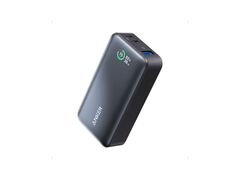
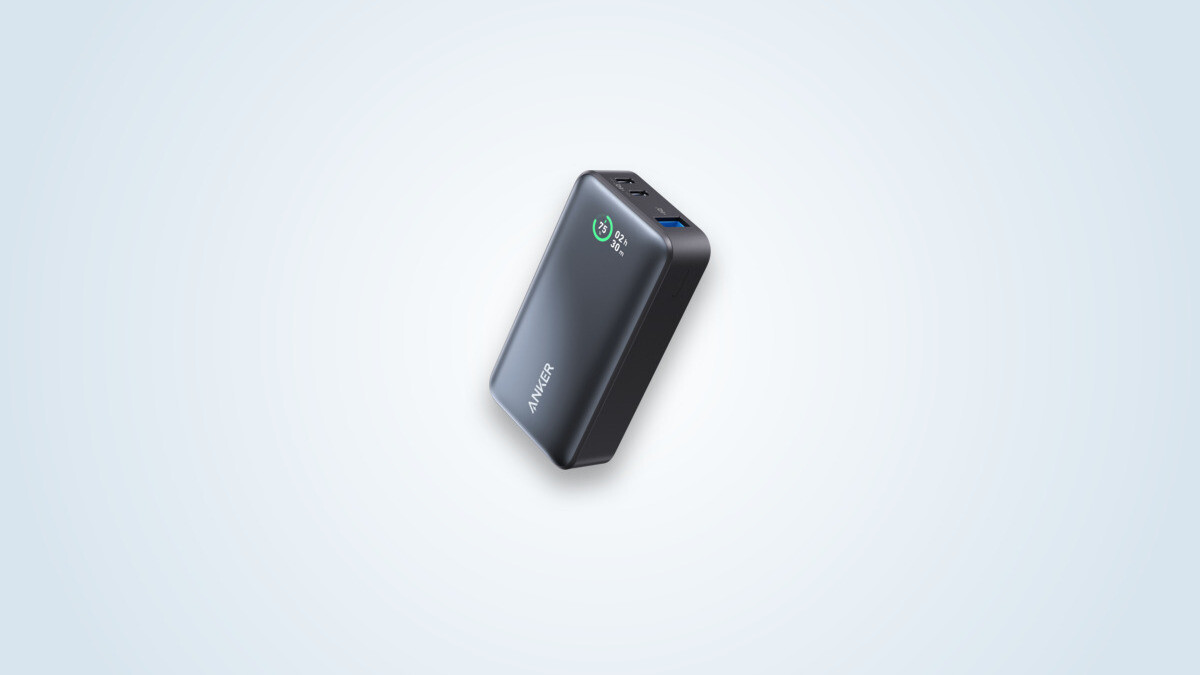
Rather than a simple row of indicator lights, the 533 PowerCore has a small colour screen that shows the remaining charge percentage and an estimated time to full, whether the pack is recharging or powering a device. That is a real advantage over same-tier models that make do with four LEDs, unable to tell 24% from 49%.
One small quirk: on power-up, the brand logo shows briefly on its own before the real percentage appears. A detail with no bearing on actual use, but one that can catch out a first-time owner.
Three classic ports instead of a built-in cable: betting on repairability
Unlike several packs in the same range, the 533 PowerCore does not rely on a cable built into the case. It offers three independent ports (one USB-A and two USB-C) and a standard USB-C cable supplied separately. The difference looks minor out of the box; it matters far more over the long run: a built-in cable that stops working usually takes the whole device down with it, while a separately supplied cable can be swapped for a few pounds.
All three ports also support USB PD, PowerIQ 3.0 and QC3.0, broad compatibility that covers nearly every current smartphone, tablet and small laptop with no special adapter.
The reverse trade-off exists too: no cable dangling off the case, so nothing to forget in a drawer before heading out, but also nothing that saves you from remembering to pack a cable. It is a deliberate choice, not a failed compromise.
Against the Anker Nano 30W and Zolo 10000: same family, three different bets
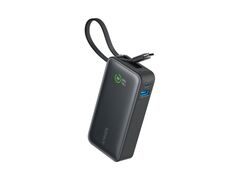
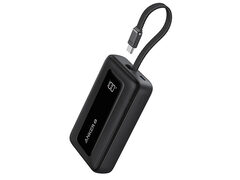
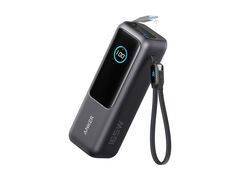
Within Anker's own range, the 533 PowerCore shares its capacity and output power with two close relatives: the Nano 30W (built-in USB-C cable, colour screen) and the Zolo 10000 (built-in cable too, but no screen). All three target the same everyday use, with different trade-offs.
| Criterion | 533 PowerCore | Nano 30W | Zolo 10000 |
|---|---|---|---|
| Cable | Supplied separately, replaceable | Built in, not replaceable | Built in, not replaceable |
| Screen | Colour, percentage and time | Colour, percentage and time | None, LEDs only |
| Energy delivered | ≈ 29Wh | 28.2Wh | 29 to 35Wh depending on voltage |
| Recharging the pack | 18W claimed, erratic in practice | 30W claimed, 90 to 100 min measured | 20W, several hours |
The pattern is clear. The Nano 30W offers the fastest and most reliable recharge of the three thanks to a 30W input that holds up to its claim, at the cost of a cable that cannot be swapped if it fails. The Zolo makes do with LEDs and an output that drops under sustained load. The 533 PowerCore takes the opposite bet: a screen as precise as the Nano's, a cable you can replace, but the least predictable recharge of the three.
Recalls, warranty and what to know before buying
The 533 PowerCore does not appear among the references covered by the voluntary recall Anker launched in 2025 over an overheating risk on several power banks: the recalled models carry different part numbers (A1257, A1647, A1652, A1681, A1689), sold between August 2023 and June 2025. This point is worth stating explicitly, since the question comes up fairly for any recent Anker power bank.
The manufacturer's warranty runs 18 months, shorter than several direct rivals that offer 24 months on comparable products. Whatever additional protection consumer law provides in the buyer's own country sits on top of that, regardless.
On accessories, the supplied pouch tends to shed a few fibres onto the case with prolonged contact, a minor but real detail that has no bearing on how the pack itself performs.
Who it suits, and who should look elsewhere
It suits anyone after a compact backup pack, with a screen that tells the truth about remaining charge and a cable that can be swapped the day it fails. The three separate ports also mean never having to choose between charging a phone and a pair of earbuds at the same time.
It suits less well anyone who tops up their power bank at the last minute before heading out: the slow, unpredictable input charging makes any ‘twenty more minutes and I'm off’ calculation a gamble. For that specific use, a model with a fast, reliably measured recharge, such as the same brand's Nano 30W, will serve better.
It is not the right pick either for anyone planning to charge two power-hungry devices at once expecting 30W on each: past a single active output, total power drops back to 24W to share.