
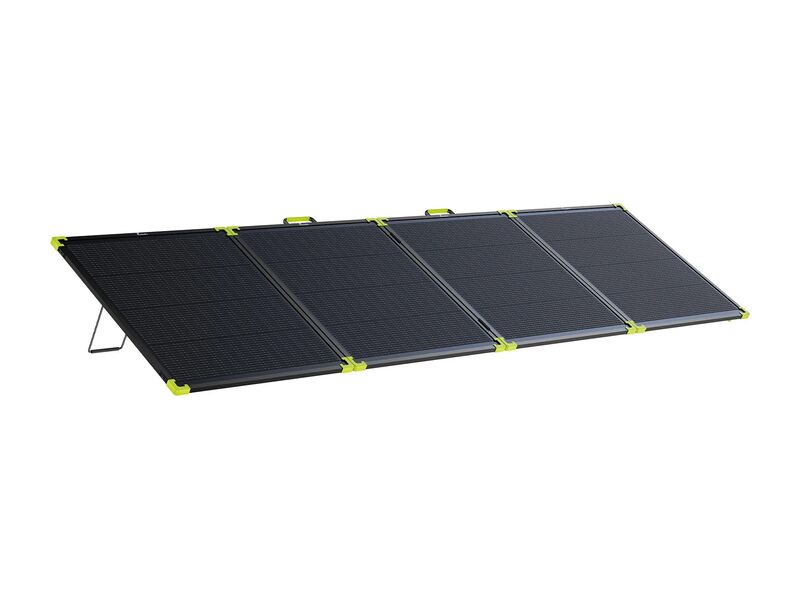
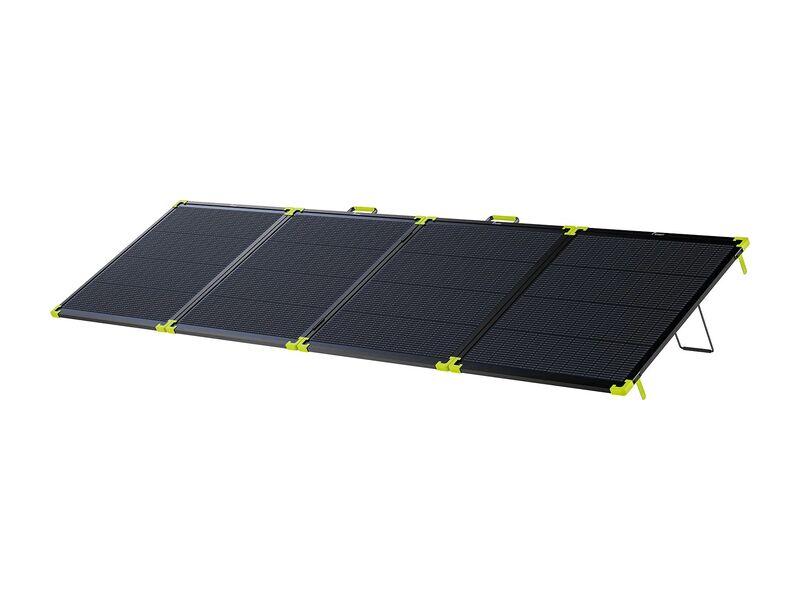
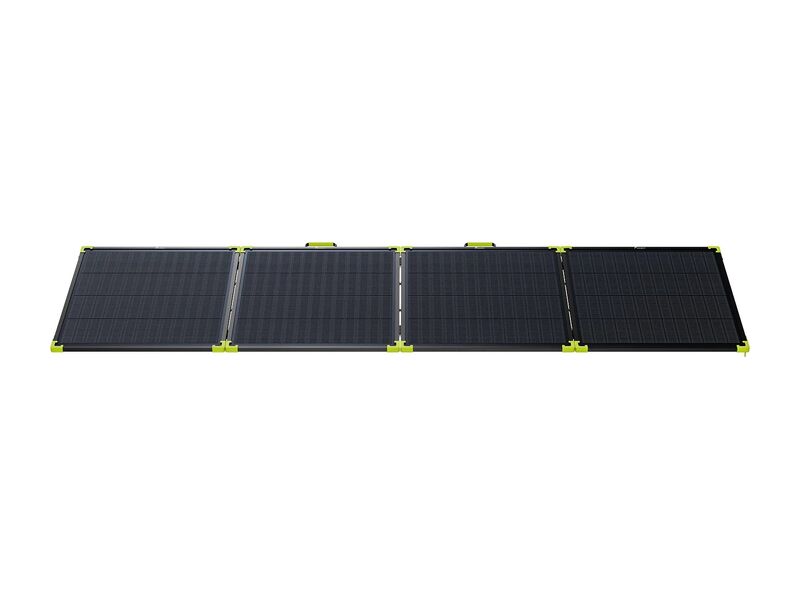
Fossibot SP400 Pro
Foldable, bifacial and IP67 rated, the Fossibot SP400 Pro solar panel captures up to 15% more power thanks to its active rear side, at just 9kg.
Characteristics
- Power: 400W bifacial (+10 to 15%)
- Efficiency: 25%
- Waterproofing: IP67
- Weight: 9kg
- Bifacial +15%, IP67, just 9kg
Detailed overview: Fossibot 400W bifacial foldable solar panel
The Fossibot SP400 Pro is a 400W portable solar panel built around a genuine technical edge: bifacial power generation. Both sides capture sunlight, the front panel directly, the rear panel through light reflected off bright surfaces such as snow, sand or concrete, for a claimed gain of 10 to 15% extra power in those conditions.
Its advanced solar cells reach a 25% conversion efficiency, a very good figure for a nomadic panel, keeping output strong even in high heat. Electrically, it shows an open-circuit voltage (Voc) of 39.1V, a maximum power voltage (Vmp) of 32.6V and a maximum current (Imp) of 12.3A. Built-in bypass diodes protect the panel from overheating whenever part of it falls into shade.
Its build is designed to last: a reinforced aluminium frame, impact-resistant materials and IP67 certification against dust and water, with an extended -10 to 70 °C operating range. Unfolded, it measures 276.5 x 79cm at 21.4mm thick, folding down to a compact 69.1 x 79cm (8.7cm folded). At 9kg on the scale, it is 36% lighter than the previous generation of the panel, a real improvement for hiking, van life or travel.
The standard MC4 connector is paired with an included 1.5m MC4-to-XT60 cable, allowing a direct connection to Fossibot stations and to most solar generators on the market accepting an MC4 or XT60 input. As with any panel of this power class, real output depends heavily on sunlight, orientation and the ground beneath it for the bifacial gain to matter. Backed by a 2-year warranty, the SP400 Pro suits anyone looking to boost solar autonomy for a van, a job site or a power cut, without adding a second panel.
Full specifications
Detailed characteristics
Panel
| Peak power?Rated panel power in full sun (STC conditions). | 400 W |
|---|---|
| Conversion efficiency?Share of solar energy converted to electricity; higher means a more compact panel for the same power. | 25 % |
| Panel type?Foldable (portable), rigid framed (fixed install) or flexible (curved surfaces). | Foldable |
| Bifacial?Also captures reflected light on its rear side, for extra output. | Yes |
Durability and format
| Ingress protection?Water and dust resistance (IP rating). | IP67 |
|---|---|
| Weight?Weight of the panel. | 9 kg |
☀ How fast does this panel recharge a power station?
The Fossibot SP400 Pro panel (400 W) recharges a Jackery Explorer 1000 v2 (1070 Wh) in ~3h50 or an EcoFlow Delta 2 Max (2048 Wh) in ~7h20, in full sun.
| Compact / mid | Recharge |
|---|---|
| EcoFlow Trail 200 DC (192 Wh) | ~40 min |
| Bluetti EB3A (268 Wh) | ~55 min |
| EcoFlow River 2 Max (512 Wh) | ~1h50 |
| DJI Power 1000 (1024 Wh) | ~3h40 |
| High capacity | Recharge |
|---|---|
| Anker Solix F2000 (2048 Wh) | ~7h20 |
| Jackery Explorer 3000 v2 (3072 Wh) | ~11h |
| Allpowers R4000 (3456 Wh) | ~12h |
| EcoFlow Delta Pro 3 (4096 Wh) | ~15h |
Estimate in full sun (ideal conditions). In practice, count on 3 to 5 hours of truly useful sunlight per day, so a full recharge may span several days depending on weather and orientation.
Comparison
In the £343 to £557 range, the Fossibot SP400 Pro competes with several sought-after 400W foldable panels, via searches like "Fossibot SP400 Pro vs EcoFlow 400W" or "SP400 Pro vs Anker Solix PS400". Here is how it stacks up against three references in the segment: the EcoFlow 400W bifacial panel, the Anker Solix PS400 and the Renogy lightweight 400W solar suitcase.
| Criterion | Fossibot SP400 Pro | EcoFlow 400W bifacial | Anker Solix PS400 | Renogy 400W suitcase |
|---|---|---|---|---|
| Peak power | 400W | 400W | 400W | 400W |
| Bifacial | Yes (+10 to 15%) | Yes | No | No |
| Efficiency | 25% | ≈ 25% | ≈ 23% | ≈ 23% |
| Weight | 9kg | 10.2kg | 15.9kg | 13.7kg |
| Waterproofing | IP67 | IP68 | IP67 | IP67 |
| Observed price | ≈ £393 | ≈ £556 | ≈ £429 | ≈ £385 |
In short, the Fossibot SP400 Pro combines the EcoFlow 400W's bifacial technology (at a noticeably higher price) with a record-low 9kg weight, the lightest of the four. The Anker Solix PS400 and the Renogy suitcase remain excellent non-bifacial alternatives, but noticeably heavier (15.9kg and 13.7kg). For a light, bifacial and affordable 400W panel, the SP400 Pro holds a rare position in this segment.
Our tester's review: Julien De Jurquet
We set up the SP400 Pro on a temporary job site, propped against a light concrete wall, the perfect terrain to judge the bifacial gain. The difference shows most in early morning and late afternoon, when the sun sits low and the rear panel picks up a real bonus from ground reflection. The first thing that stands out is the weight: at 9kg, it carries and unfolds with barely any effort, well below the 13 to 16kg solar cases common in this segment. The aluminium frame feels reassuring, and the bypass diodes did their job without a hiccup the day a branch cast partial shade over one panel. Two honest caveats: the included 1.5m MC4-to-XT60 cable is on the short side if the station stays sheltered, and like any bifacial panel, the real gain depends heavily on what is underneath it, on grass or dark soil the difference against a regular panel stays marginal. For anyone after a light, sturdy 400W panel that outperforms average, the SP400 Pro earns its place.
Frequently asked questions: Fossibot 400W bifacial foldable solar panel
Both sides capture light: the front directly, the rear through reflection off bright surfaces (snow, sand, concrete). Fossibot claims a 10 to 15% power gain in those conditions, with almost no benefit on grass or dark ground.
It uses a standard MC4 connector, paired with an included MC4-to-XT60 cable. It works with the entire Fossibot range as well as most power stations on the market that accept an MC4 or XT60 input.
Yes. Its IP67 rating protects it from dust and water splashes, and it operates from -10 to 70 °C thanks to its reinforced aluminium frame. It is not designed for prolonged submersion, though.
It weighs 9kg, 36% less than the previous generation of the panel. Folded down (69.1 x 79 x 8.7cm), it is easy to carry in a van, while hiking or on a job site.
Its advanced cells reach a 25% conversion efficiency, a very good figure for a nomadic solar panel, limiting losses even in high heat.
The SP400 Pro stands out with bifacial technology (+10 to 15% power on reflective ground) and a reduced 9kg weight, two advantages missing on regular Fossibot panels like the SP200.
Need help choosing?
Other products in the "Portable solar panels" category
Allpowers Solax SE200
See price (3)
Foldable, IP68 waterproof and up to 25% efficient, the 200 W Allpowers Solax SE200 solar panel recharges your power stations anywhere.
Allpowers Solax SE60
See price (2)
60W of light, foldable solar power: the portable panel that recharges phone, power bank and small station in the sun, with up to 25% efficiency.
Allpowers SP001 21W
£47.49 (3)
21W foldable and just 610g: the little USB solar panel that charges a phone, tablet or power bank in the sun, with no socket or bulk.
Allpowers SP012 100W
See price (3)
100W of foldable solar with a dual USB output: the nomadic panel that directly charges your devices AND your power station, camping or on the road.
Published on 02/09/2026