
The 37Wh on paper versus the 27.5Wh actually available
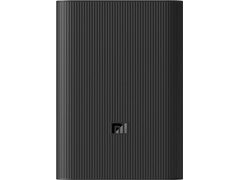
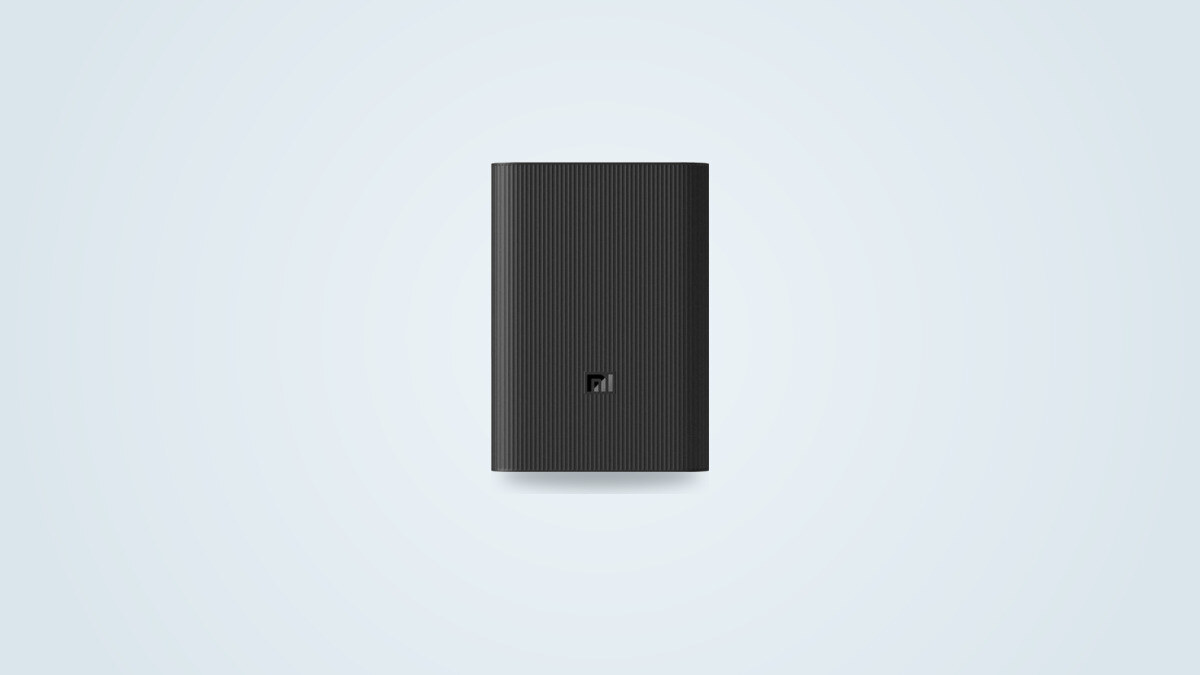
The Xiaomi Mi Power Bank 3 Ultra Compact (reference PB1022ZM) shows 10,000mAh on its casing, a figure that matches the nominal energy of its two 5,000mAh Lishen cells wired in parallel inside, or 37Wh at their nominal 3.7V. That raw number is never what the unit actually delivers to a smartphone plugged in over USB.
Xiaomi states this conversion itself on its official spec sheet: the rated output capacity is 5,500mAh at 5V and 3A, or around 27.5Wh, for a stated conversion rate of 74%. That roughly one-quarter gap between the energy stored at 3.7V and the energy delivered at 5V is nothing unusual: it is the same conversion mechanics that explain why no power bank ever hands back its printed mAh figure as is, and this rate sits toward the higher end for its category.
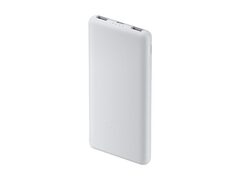
In practice, those 27.5Wh charge a recent smartphone, whose battery typically holds between 12 and 18Wh depending on the model, a little under two full charges. For a weekend or a long day away from a socket, that is a decent reserve for this size, without being exceptional: it lines up closely with what rival power banks of the same rated capacity offer, whether the newer Xiaomi 10000 Lite or the Anker models of similar size covered later in this review.
22.5W solo, 15W shared: the real output
The headline figure on the box, 22.5W, is real: it is the maximum output that either the USB-C port or either of the two USB-A ports can deliver, provided only one device charges at a time and the cable and phone can negotiate the voltage steps needed to reach it (9V).
Xiaomi's official spec sheet sets a much less advertised limit, though: as soon as several ports charge devices at the same time, the total output is shared between them and drops to 15W overall, at 5V and 3A. That is not a fault or a hidden defect, it is a physical limit of the internal conversion circuit, but it does undercut the "charge 3 devices at once" marketing claim: all three ports do work at the same time, but on a shared budget of 15W split three ways, barely 5W per device on average, well below a fast charge.
In practice, this limit mostly affects multi-device use. For charging a single phone at a time, which remains the most common use for a top-up battery this size, the full 22.5W stays available from start to finish, with no further hidden step-down.
Recharging the battery itself: fast with the right charger, slow otherwise
On input, the Mi Power Bank 3 Ultra Compact accepts up to 22.5W through its USB-C port (9V, 2.5A) or up to 18W through its Micro-USB port (9V, 2A), the latter being input-only and unable to charge an external device.
With a USB Power Delivery charger of 24W or more and a USB-C to USB-C cable, Xiaomi states a full recharge in around 3.5 hours. With a more ordinary charger limited to 5V and 2A, whether an old phone charger or the bare minimum bundled by some sellers, that time stretches to around 6 hours. The difference comes down entirely to the charger used: since a fast charger is not automatically included in the box depending on the seller, some buyers end up living the slow version of that promise without ever realising it.
A low-current charging mode, triggered by double-pressing the battery-level button while idle, lets you safely charge wireless earbuds or a smartwatch, devices that most top-up power banks refuse to recognise below a certain current threshold. This mode switches off automatically after two hours or can be exited with a single press of the same button.
200g for 10,000mAh: the format behind its reputation
At 90 x 63.9 x 24.4mm for around 200g, the Mi Power Bank 3 Ultra Compact fits in the palm of a hand and disappears into any pocket. Xiaomi itself describes it as 16% smaller and 20% lighter than the previous generation, a real reduction that justifies the "Ultra Compact" tag attached to its name since its October 2020 launch.
Compared with the Xiaomi 33W Magnetic Power Bank 10000, released five years later at the same rated capacity, it is both lighter (200g versus 238g) and smaller in length and width, at the cost of a slightly thicker body (24.4mm versus 19.8mm, largely explained by its cousin's magnet and wireless charging coil). Weighed against the energy it actually delivers, it posts a more favourable weight-per-watt-hour figure than that newer magnetic cousin, making it one of the most compact power banks in its capacity class, magnet and integrated cable aside.
With 37Wh of cells, it sits well under the 100Wh threshold above which airlines require authorisation, or refuse cabin transport altogether. It therefore travels with no special paperwork, like the vast majority of consumer power banks in this capacity range.
Three real ports, and a low-current mode that actually helps
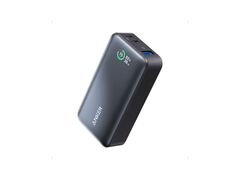
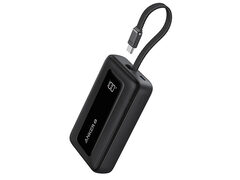
The port selection keeps to the essentials but works with no surprises: two USB-A ports, a bidirectional USB-C port that both charges a device and recharges the battery itself, and a Micro-USB port reserved for input. Four LED indicators show charge level in 25% steps, without the exact percentage that a numeric display offers on the Anker 533 PowerCore or the Zolo 10000, two alternatives covered later in this review.
The low-current charging mode described in the previous section is the real pleasant surprise in an otherwise basic port selection: it is not a given on power banks at this price point, and it avoids the frustrating automatic cutoff that earbuds or a smartwatch suffer when plugged into a port designed for a smartphone.
The Micro-USB port, missing on newer power banks, might look dated in 2026, but it keeps a real advantage: it lets you use whatever old charger or cable is lying in a drawer as a backup, where an all-USB-C power bank forces you to have the right cable on hand. Pass-through charging, which lets a connected device keep charging while the battery itself recharges from a wall socket, is also present, a genuine plus for anyone travelling with few sockets to spare.
Under the hood: cells, protection and build
Inside the casing, two soft-pack Lishen (力神) cells of 5,000mAh wired in parallel, certified under China's mandatory 3C standard, pair with a dedicated protection chip and independent protection transistors on each output port. Port management, charging-protocol detection and LED control run through a Hyundai microcontroller referenced A94B458, while the voltage conversion itself, stepping 3.7V up to 5, 9 or 12V depending on the port in use, is handled by a SouthChip SC8934 synchronous converter, a chip that integrates its own power transistors along with protection against overvoltage, undervoltage, overcurrent and overheating.
The internal assembly combines foam, insulating plates and thermal pads for mounting and heat dissipation, with a high level of integration that cuts down on peripheral components compared with a less refined design. The outer shell, though, remains ribbed plastic: a material that does its job but scratches and marks fairly easily after a fall, a feel closer to entry-level than premium, with no impact on how the electronics actually work.
On sale continuously since October 2020, the Mi Power Bank 3 Ultra Compact has racked up six years on the market with no safety recall under its name, a rare stretch for judging how a mainstream electronic product holds up over time, and a sharp contrast with newer generations that still only have a year or two of track record.
A market flooded with copies: check authenticity before buying
The success and low price of the Mi Power Bank 3 Ultra Compact have made it one of the most copied Xiaomi power banks around. A genuine unit weighs around 200g; counterfeits found on the market are noticeably lighter and often limited to plain 5V on input and output, without any of the 9V or 12V fast-charge steps advertised on the counterfeit packaging.
This caution at the point of purchase does not call into question the reliability of the genuine product: it simply serves as a reminder that an unofficial sales channel, for a product copied this widely, deserves a check before the first charge rather than blind trust in the packaging alone.
Xiaomi's 2025 recall does not concern this model
In September 2025, Xiaomi issued an official recall of more than 100,000 power banks, following a fire and overheating risk tied to a quality defect in raw materials from a cell supplier. The model affected is the Xiaomi 33W Power Bank 20,000mAh with integrated cable, reference PB2030MI, and only for units manufactured between August and September 2024, in blue and white finishes.
This precedent is still worth knowing to gauge the brand's recent reliability as a whole, even though it has no direct bearing on this older, simpler model, which shares neither the integrated cable nor the same charging electronics as the recalled reference.
Against its own range and the direct competition
How does the Mi Power Bank 3 Ultra Compact stack up against its closest alternatives, from Xiaomi itself and from the competition?
| Criterion | Mi Power Bank 3 Ultra Compact | Xiaomi 10000 Lite | Anker 533 PowerCore | Anker Zolo 10000 |
|---|---|---|---|---|
| Capacity | 10,000mAh | 10,000mAh | 10,000mAh | 10,000mAh |
| Power | 22.5W | 22.5W | 30W | 30W |
| Display | 4 LEDs (25% steps) | 4 LEDs (25% steps) | Colour screen, exact percentage | LCD screen, exact percentage |
| Integrated cable | No | No | No, but replaceable | Yes, integrated |
| Weight | ≈ 200g | ≈ 227g | ≈ 200g | ≈ 215g |
| Typical price | ≈ £17 | ≈ £11 | ≈ £31 | ≈ £26 |
Both Anker models stand out with a display showing the exact percentage and 30W rather than 22.5W, at a typical price nine to fourteen pounds higher. The newer Xiaomi 10000 Lite matches the same output in a slightly heavier body, for a lower price. The choice then comes down to budget and priorities: pay more for a precise display and extra watts, or take the lowest price in the comparison for a top-up use case that needs neither.
Who it suits, and who it does not
This power bank suits anyone after a simple, compact, budget-friendly backup charge for a smartphone, without needing to charge two devices at full speed at once or read an exact percentage on a screen. Its size, among the most compact in its capacity class, its low-current mode for small devices, and the lack of any documented manufacturing fault across six years on sale make it a purchase that is hard to get wrong.
It suits less well anyone planning to regularly charge two or three devices at full power at the same time, since the 15W total shared output sharply limits the appeal of the extra ports, anyone wanting to track the exact remaining percentage on a screen, or anyone after peak output above 22.5W for devices hungrier than a smartphone.