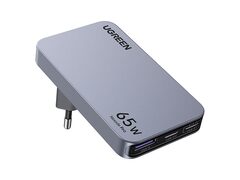

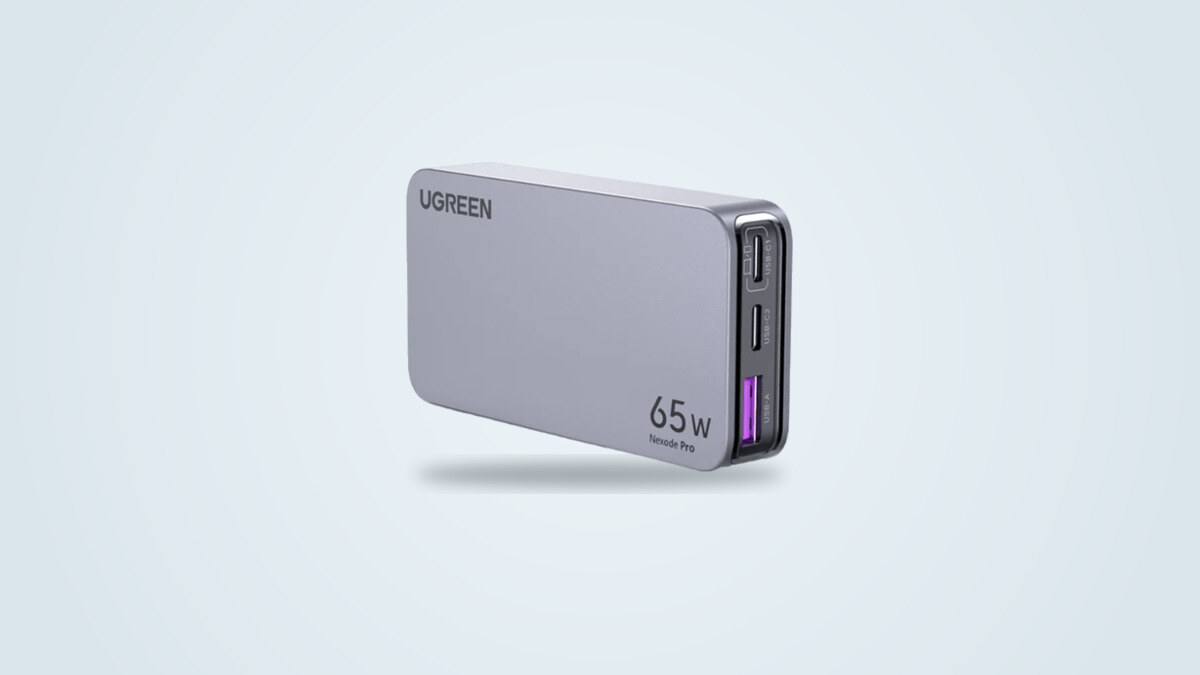
84 x 48 x 14 mm: the thinnest case in the Nexode Pro range
The Ugreen Nexode Pro 65W Slim is a three-port GaN wall charger that pushes compactness further than anything else in the Nexode Pro range: a flat case, claimed 55% smaller than a conventional 65W charger, designed to slip into a laptop sleeve without adding any bulk. It is the flattest variant in the lineup, distinct from the cube-shaped Nexode Pro 65W and the standard Nexode 65W, both noticeably thicker for the same rated power.
The bare case weighs 104 grams for 84 x 48 x 14 mm. Once the interchangeable mains plug is clipped into place, the whole unit gains a little bulk and weight: with a plug fitted, it climbs to around 120 grams for a thickness close to 1.5 cm. The two figures do not contradict each other, they simply describe the same case in two different states, bare on one hand, with its interchangeable plug fitted on the other.
The chip inside is GaN Infinity, a gallium-nitride design specific to the Pro series, paired with the ThermalGuard thermal-monitoring system. Ugreen also claims an energy density up to 117% higher than a conventional silicon charger of the same power, the technical argument that lets it pack 65W into such a thin case.
The main port's 65W: a promise kept
Each port has its own ceiling when used alone: 65W on the main USB-C port, 30W on the second USB-C port, 22.5W on the USB-A port. The first of these three figures is the product's headline argument, and it is also the only one the brand really puts front and centre.
On a laptop, the promise holds up: a MacBook Air M2 plugged into this port goes from 0 to 51% charge in 30 minutes according to Ugreen. On a 13-inch MacBook Air, charging also reaches around 70% after a full hour, a progression consistent with a fast charge that naturally slows down past the halfway point.
Two devices, full budget; three devices, a real pinch
The question that really matters for a multiport charger is not the ceiling of each port in isolation, but what happens once several devices are plugged in at the same time. Here, the Nexode Pro 65W Slim pulls off a remarkable split with two devices: the two USB-C ports used together share 45W and 20W, 65W in total, the entire rated budget, with no loss at all.
The nuance appears with three devices, just as on other multiport chargers from the same brand: the main port keeps priority at 45W, but the two secondary ports (USB-C2 and USB-A) then drop to around 7.5W each. A third device keeps charging, but very slowly: 7.5W is barely enough to hold a battery level rather than fast-charge a phone. The total budget slips from 65W to around 60W, proportionally a smaller loss than on other multiport chargers in the same segment, where the three-device drop can exceed 15% of the rated total.
USB PD, PPS, Quick Charge, SCP: solid coverage, not the widest in its class
The Nexode Pro 65W Slim handles the main fast-charging protocols: USB Power Delivery 3.0, PPS (the protocol behind fast charging on Samsung Galaxy phones up to 45W), Quick Charge 4 and SCP, Huawei and Honor's own protocol. That combination covers a large share of the current Android and Apple fleet with no special setup.
That list still sits a notch below what some of the brand's direct competitors advertise on other charger segments, where broader coverage (adding AFC for Samsung and FCP for Huawei) sometimes gets top billing. In practice, the gap mostly concerns secondary edge cases: the PD, PPS, QC and SCP base already covers the vast majority of current USB-C phones, tablets and laptops, iPhone and Android alike. The general limit stays the same as on any non-proprietary charger: the fastest, most exclusive charging modes from certain brands, such as SuperVOOC on Oppo or Warp Charge on OnePlus, only kick in with that manufacturer's own brick.
The cost of thinness: heat, efficiency and whine
Shrinking a 65W charger down to 14 mm mechanically leaves less room to dissipate heat than a classic cube-shaped case. That is the angle the product page never raises, and it deserves to be stated plainly.
None of this calls the product's safety into question: 68.6 °C is a high surface temperature to the touch but far from any dangerous threshold, and the ThermalGuard system is built to monitor and cap internal temperature continuously. It does, however, put a real dent in the promise of a record-thin format with no compromise: the extreme thinness of this case comes at the cost of less generous thermal headroom and efficiency than a thicker GaN charger of the same power, a trade-off buyers deserve to know about before picking this format over a more conventional cube-shaped model.
Weight and interchangeable plugs: the case for travel
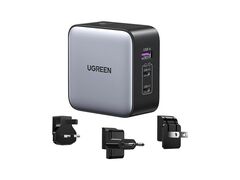
Beyond its thinness, this charger is built as a travel companion. It accepts a 100 to 240V input, covering nearly every mains supply in the world, and it ships with three interchangeable plugs, US, UK and EU, that clip in and out with no tools needed. On a multi-country trip, that removes the need to carry a separate travel adapter alongside the charger itself.
| Configuration | Weight | Thickness |
|---|---|---|
| Bare case, no plug fitted | 104 g | 14 mm |
| Interchangeable plug fitted | ≈ 120 g | ≈ 15 mm |
This gap in weight and thickness stays minor for day-to-day use, but it is worth knowing before comparing this figure to a competitor's, which may correspond to a different state of the case, bare or with its plug fitted. Either way, the case remains noticeably thinner than an equivalent cube-shaped charger, and genuinely slips into a laptop bag's pocket without adding any noticeable bulk.
Build quality, finish and electrical safety
The Pro series finish gives an impression of quality above the segment average, with a case that looks almost metallic despite being plastic. No recall or recurring manufacturing defect has come up on this specific model to date.
On the electrical safety side, the ThermalGuard system provides continuous thermal monitoring, a baseline expected on a device that stays plugged into the mains for the whole duration of a charge. One detail is worth flagging without treating it as a flaw: on the US-plug version, the mains prongs are a two-pin design with no ground pin, a standard choice for this type of small charger but one that can make the fit in some wall outlets slightly less snug.
The product has been on the market too briefly to judge its long-term durability the way a product available for several years could be judged: that is a reasonable caveat to flag, not an observed flaw. The one moving mechanical part worth watching over time is the latch that holds the interchangeable plug in place, used every time the plug is swapped.
Against the standard Nexode 65W, the Nexode Pro 100W and the Anker Nano II 65W
How does this Slim format compare with the rest of the Ugreen range and with a direct competitor?
| Criterion | Nexode Pro 65W Slim | Standard Nexode 65W | Nexode Pro 100W | Anker Nano II 65W |
|---|---|---|---|---|
| Total power | 65W | 65W | 100W | 65W |
| Format | Ultra-thin (flat, 14 mm) | Compact (cube) | Compact (cube) | Compact (cube) |
| Ports | 3 (2 USB-C + USB-A) | 3 (2 USB-C + USB-A) | 3 (2 USB-C + USB-A) | 3 (2 USB-C + USB-A) |
| Interchangeable plugs | US / UK / EU | US / UK / EU | Not specified | No |
| Observed price | £33.34 | £30.78 | £56.43 | £25.31 |
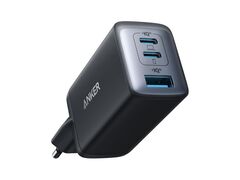
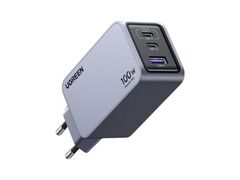
Against the standard Nexode 65W, the Slim offers exactly the same power and the same travel plugs for a limited price gap: the choice then comes down purely to case thickness, at the cost of the thermal trade-off covered above. Against the Nexode Pro 100W, more powerful and sized for the most demanding laptops, the Slim stays plenty for a MacBook Air, iPad or phone that does not need that extra headroom. Against the Anker Nano II 65W, cheaper and without interchangeable plugs, the Slim justifies its higher price through its distinctive format and travel case, not through any power advantage.
Who it suits, and who it does not
This charger suits anyone travelling with a laptop (MacBook Air, iPad, Windows ultrabook) and a phone to charge at the same time, who genuinely values minimal bulk in a bag or sleeve. The interchangeable US, UK and EU plugs make it a sound pick for anyone who regularly moves between different regions.
It suits less well anyone who regularly charges three demanding devices at once, a scenario where the real budget drops to 60W with a trickle of power on the two secondary ports, or anyone chasing the lowest possible efficiency loss and temperature regardless of format, a case where a thicker, cheaper GaN charger, such as the standard Nexode 65W from the same brand, stays the more sober choice. For anyone who needs to charge a laptop hungrier than 65W, the Nexode Pro 100W from the same range fits better.