
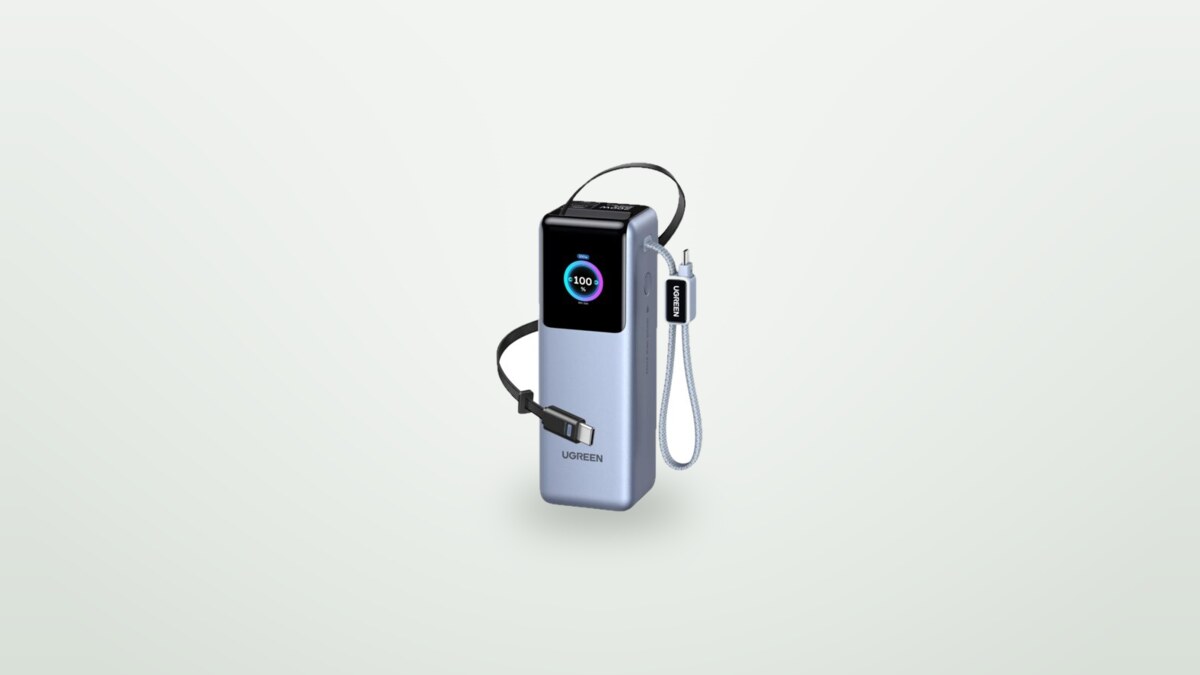
Careful: do not mix up these two Ugreen references
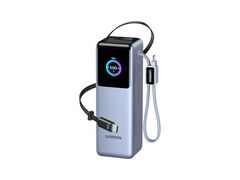
Before getting to performance, one point of caution matters, and it is more serious than it looks: Ugreen also sells another model with an almost identical name, no integrated cable, and a different power split between its two USB-C ports. This mix-up is real enough that it affected our own product page until this review, which carried a weight, a purchase link, and a power split that in fact belonged to that other model.
| Feature | Nexode Pro 200W (this review) | Model without an integrated cable |
|---|---|---|
| Integrated cables | 2 (retractable USB-C + USB-C on a wrist strap) | None |
| USB-C split | 100 W + 100 W (symmetric) | 140 W + 100 W (asymmetric) |
| Charging input | ≈ 100 W | 65 W |
| Weight | 631 g | 595 to 609 g |
Before buying through an external link, it is always worth checking that both integrated cables are visible in the product photos: it is the simplest way to tell the two models apart.
A 100 + 100 W split, finally symmetric
The two USB-C ports on the Nexode Pro 200W each deliver up to 100 W of Power Delivery, for a combined total of 200 W. This is a symmetric split: each cable is capable of delivering 100 W, with no hierarchy between a main port and a secondary one. In practice, this means one port can charge a 16-inch MacBook Pro at full speed while a second laptop charges just as fast on the other, with neither one penalised relative to the other.
The recharge lives up to its promise
The battery itself accepts up to about 100 W of input on its USB-C ports, for a full charge in a little over two hours. This is a genuine strength: unlike other products in this category where the advertised input does not match what is actually accepted, no gap shows up here between the claim and reality.
A 65 W or higher mains charger is enough to reach this speed; it is not included with the battery.
Advertised capacity and real-world usable energy
The nominal 25000 mAh work out to 92.5 Wh in strict terms (25 Ah at 3.7 V), a figure Ugreen sometimes rounds down to 90 Wh on certain listings, likely to stay comfortably under the 100 Wh cabin-baggage limit. Both figures describe the same battery; it is not a discrepancy between conflicting values.
Throttling late in a discharge cycle
Under a sustained load near 100 W, delivered power begins to decrease at around 29 % of remaining charge. By comparison, a rival model with 25000 mAh and 165 W does not begin to throttle until around 25 % remaining. The gap is not huge, but it concretely means the Nexode Pro 200W starts losing power a little earlier late in a discharge than this particular rival.
A format that owns its size
At 631 g, the Nexode Pro 200W does not try to disappear into a bag: that is the logical cost of 25000 mAh, two integrated cables, and 200 W of output power. This weight and size fit a professional work-tool positioning rather than a discreet everyday accessory.
For anyone who only recharges a smartphone occasionally during the day, this format is disproportionate. It makes full sense for anyone who genuinely needs to power one or two laptops on the move, a use case where the weight is justified by the power on tap.
What is not yet known about this specific model
It is worth being honest about the limits of what is verifiable today. Launched in February 2026, the Nexode Pro 200W is still too recent to have accumulated much independent coverage: no comprehensive independent review has been published to date, long-term usage feedback remains scarce, and no independent thermal measurement under sustained load has been found.
The protection features the manufacturer advertises (thermal monitoring, a fire-resistant shell, a claimed 25000 flex cycles for the retractable cable) remain manufacturer data not yet verified by a third party. These are not negative signals, just blind spots that limit what can be stated with certainty about this specific model.
Against the competition
Against the Anker Prime 27650 250W, the comparison on paper favours the Anker (250 W, 27650 mAh). But as a charging source with two USB-C ports drawing power at the same time, it actually caps out around 170 W of the advertised 250 W, or 68 % of the promise. No equivalent measurement exists for the Nexode Pro 200W in simultaneous use, which makes a direct comparison impossible on this specific point: it is a data gap shared by the whole category, not a weakness specific to either product.
Against a more affordable model like the Baseus Blade H1 (20000 mAh, 100 W, digital screen), the Nexode Pro 200W stands out for its higher capacity and its two integrated cables, for a use case that genuinely justifies 200 W rather than 100 W.
Who this model suits
This product suits anyone who needs to recharge one or two laptops on the move, without having to hunt for a compatible cable thanks to the two built-in USB-C cables. The symmetric 100 + 100 W split and the charging speed matching the claim make it a work tool consistent with its premium positioning.
It suits less well anyone looking for a lightweight format for everyday smartphone charging: in that case, a more compact and less powerful battery remains a better fit. And as with any purchase in this Ugreen range, checking that you are ordering the cabled model, not its cable-less near-twin, is not optional.