
160W, four outputs and a cable you'll never misplace
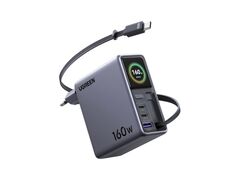
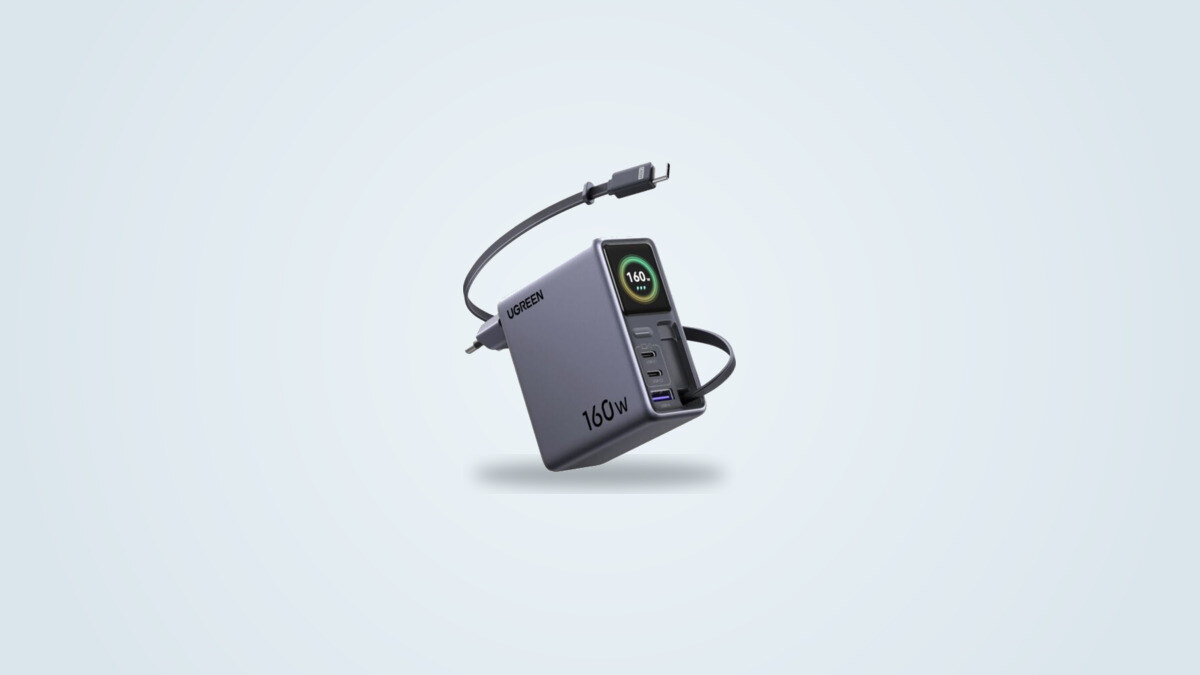
The Ugreen Nexode Pro 160W (model X776) is a four-output GaN wall charger: a built-in retractable USB-C cable, a USB-C1 port, a USB-C2 port and a USB-A port. This exact version stands apart from other Ugreen chargers that also carry the "Nexode Pro 160W" name but lack a built-in cable, offering three or four fixed USB-C ports instead: the retractable cable is what defines this particular model, not just one feature among others.
The front-facing TFT screen shows live power, voltage and charging protocol for each port, with the display automatically adjusting orientation to match how the charger is plugged in. Connected over Wi-Fi and Bluetooth to the UgreenConnect app, it adds remote monitoring, customisable port priority and firmware updates, a rare combination at this price point.
140W on the cable AND on the main port: a double promise kept
Each output has its own ceiling when used alone: up to 140W on the retractable USB-C cable, up to 140W on the USB-C1 port, up to 100W on the USB-C2 port, and up to 22.5W on the USB-A port.
The notable point is the cable: most retractable cables built into a charger cap out at 60W, as is the case on lower-power Ugreen chargers with a built-in cable. This one reaches 140W, enough to charge a laptop straight from the cable without ever needing a separate cord. Ugreen states that this port, like the cable, can take a 14-inch MacBook Pro from 0 to 56% charge in 30 minutes.
The charger also offers a dedicated mode for charging two laptops at once: in the example given by the brand (a MacBook Pro and a MacBook Air), the advertised split is 100W plus 60W, for 160W total, reaching 50% charge on both devices in 31 minutes.
Four devices at once, without a trickle-charge penalty
On a multiport charger, the ceiling of each output taken in isolation matters less than what happens once several devices are plugged in together: that's usually where marketing claims fall apart. On this point, the Nexode Pro 160W performs noticeably better than lower-power Ugreen chargers with a built-in cable.
Even when all four outputs are used at the same time, each port keeps delivering a substantial amount of power, around 45W, plenty for most smartphones, tablets and even some less demanding laptops.
| Charger | Total budget | Outputs | Power left per secondary port |
|---|---|---|---|
| Nexode Pro 160W | 160W | 4 | ≈ 45W |
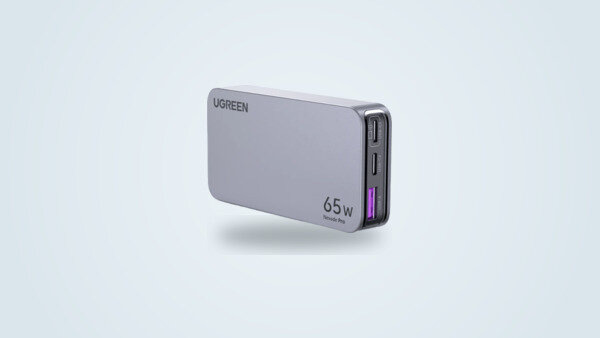
| Nexode Pro 65W Slim | 65W | 3 | ≈ 7.5W |
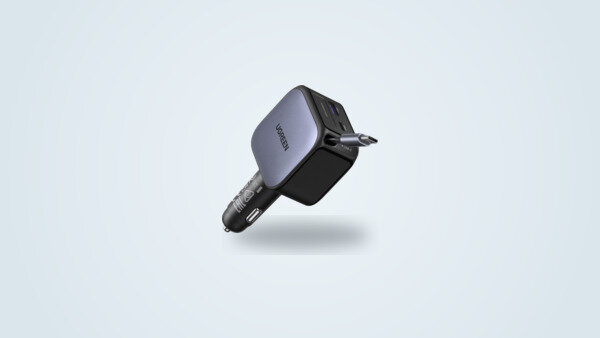
| 90W car charger | 90W | 3 | ≈ 7.5W |
The more generous total budget explains the gap: spread across four outputs, the 160W budget leaves headroom that 65W or 90W simply doesn't allow. The charger also offers a dedicated dual-laptop charging mode, absent from the two other Ugreen chargers cited for comparison.
The TFT screen and the UgreenConnect app: control on top
A colour TFT screen sits on the front of the case and shows live power, voltage, current and charging protocol for each port, with a graduated ring that visualises the total charge in progress. The display orientation automatically adjusts to whichever way the charger is plugged in, a useful detail since the mains plug can sit either way round on a power strip.
Linked over Wi-Fi and Bluetooth to the UgreenConnect app, the charger adds remote monitoring of the ongoing charge, per-port priority customisation and firmware update delivery. None of this is required for normal operation, and the charger works flawlessly without ever opening the app, but it's a rare combination next to equivalent competing chargers, which mostly settle for a simple LED or, at best, a small fixed-digit display.
Heat: cool in multi-device use, one shutdown case at full power
Packing 160W into a 323-gram case inevitably raises the question of heat. The available evidence diverges depending on how the charger is used, and that divergence comes down to different usage conditions rather than a contradiction.
In multi-device use, with the case busy on all four outputs at once with everyday devices (smartphone, tablet, a less demanding laptop), nothing points to noticeable heat: the case stays cool to the touch regardless of the charging mode in use. GaNInfinity technology, paired with the Thermal Guard system that monitors temperature continuously, explains this: the total power stays spread across several paths, each running well below its individual ceiling.
This nuance is worth knowing before buying without being overly alarming: the shutdown described is a protection working as intended rather than a fault, and it only concerns an extreme scenario, far removed from charging a smartphone or a tablet. For everyday use, including multi-device charging, no such issue shows up.
USB PD 3.1 and PPS: broad compatibility, with a Samsung caveat
The Nexode Pro 160W supports USB Power Delivery 3.1, currently the broadest standard for USB-C fast charging, as well as PPS, the protocol behind fine-grained fast charging on Samsung Galaxy phones, here up to 45W on compatible ports. This base covers the large majority of recent USB-C laptops, tablets and smartphones, iPhone and Android alike.
One caveat exists on this last point: fast-charge negotiation with some Galaxy models is occasionally inconsistent depending on the port used, a behaviour that doesn't affect standard charging but can occasionally deny the device its full PPS speed. As with any non-proprietary charger, the fastest, brand-exclusive charging standards (SuperVOOC on Oppo, Warp Charge on OnePlus) only kick in with the manufacturer's own block, whatever third-party charger is used instead.
323 grams and a 70cm cable: trading size for power
At 323g for 82 x 73 x 36mm, the Nexode Pro 160W is noticeably bulkier than a typical mobile charger, and the comparison with other Ugreen chargers already reviewed on this site makes that clear.
This gap is nothing unusual: it maps directly onto the extra power on tap (160W versus 65 to 90W) and the presence of a retractable cable mechanism capable of the full 140W, a technical feat that inevitably takes up more room than a simple block of fixed ports. GaNInfinity technology still keeps the case's bulk in check: without it, an equivalent-power silicon charger would be noticeably bigger and heavier. The foldable mains plug makes it easier to pack for travel.
The retractable cable itself, once extended, reaches about 70cm with eight length-lock positions. That's enough to reach a laptop sitting next to the charger on a desk, but some setups with a device further from the outlet will find this length a bit short, a limitation inherent to any non-replaceable built-in cable, unlike a standard detachable cable that can simply be swapped for a longer one.
Build quality, protections and electronic safety
The Nexode Pro 160W's finish is solid, with a grey matte-textured case that gives an above-average impression of sturdiness for the segment. No recall or recurring manufacturing defect has been identified for this specific model to date.
The charger packs nine electronic protections (overcharge, overvoltage, short-circuit, overheating, among others), a fire-resistant plastic casing and the Thermal Guard system, which the manufacturer states checks temperature up to 200 times per second. The retractable cable mechanism is rated for 25,000 retraction cycles and 10,000 flex cycles, the same thresholds as on the brand's own 90W car charger with a built-in cable, a consistent durability baseline across the whole retractable-cable line-up.
The product has been on the market too briefly to judge its long-term reliability the way an accessory available for several years can be judged: that's a reasonable caution to flag, not a fault with the product. The cable retraction mechanism, the product's only moving mechanical part, is the one thing worth watching most closely over time.
Against the Ugreen line-up and the direct competition
How does this 160W model compare against the rest of Ugreen's screen-equipped range, and against a direct competitor in the same category?
| Criteria | Nexode Pro 160W | Nexode Pro 100W | Nexode Pro 65W Slim | Anker Prime 100W |
|---|---|---|---|---|
| Total power | 160W | 100W | 65W | 100W |
| Built-in USB-C cable | Yes, retractable 140W | No | No | No |
| Real-time screen | Yes, TFT | Yes, TFT | No | Yes, LED |
| Monitoring app | Yes, UgreenConnect | Not specified | No | No |
| Weight | 323g | Not specified | 104g | Not specified |
| Price observed | £89.99 | £56.43 | £33.34 | £50.44 |
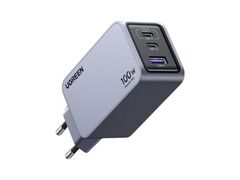
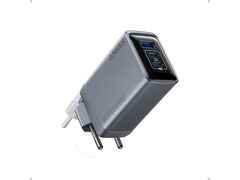
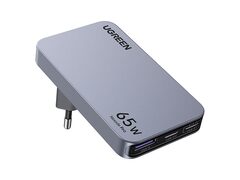
Against the Nexode Pro 100W from its own line-up, the 160W adds 60W of extra budget and, above all, the retractable cable, for a bit more than double the price: a sound choice only if that extra budget or the built-in cable genuinely matter, otherwise the 100W already covers fast-charging a typical laptop. Against the 65W Slim, the same line-up's ultra-thin format, the 160W targets a different use case entirely: power and multi-device versatility against pocket-friendly discretion. Against the Anker Prime 100W, a well-regarded multiport charger in the same segment but without a built-in cable or monitoring app, the Nexode Pro 160W justifies its higher price with features none of the other three combine at once.
Who it's for, who should look elsewhere
This charger suits anyone who wants to replace several wall chargers with a single unit able to power a demanding laptop, a tablet and one or two smartphones at the same time, without ever hunting for an extra cable thanks to the built-in retractable one. The dual-laptop mode also makes it a good fit for anyone juggling two machines, a personal computer and a work computer for instance.
It's a weaker fit for anyone prioritising compactness or light weight for occasional travel use: the same brand's Nexode Pro 65W Slim, noticeably thinner and lighter, serves that need better for someone who only needs to charge a smartphone and a less demanding laptop. It's also a weaker fit for anyone planning to push a single port continuously at its maximum power over long sessions on a very power-hungry laptop, the scenario where the heat is felt most.