
Noco GB150 Boost Pro: our full review

The Noco GB150 Boost Pro promises 3000 A to restart a diesel engine up to 7 L. The official spec sheet confirms this figure and most of the promise, along with a genuine advantage rarely highlighted: it is the only model in the range to include a voltmeter.

Our rating
4.1/5
Current actually delivered: 4.0 out of 5 (weighting 30%)Current4.0Capacity and versatility: 4.3 out of 5 (weighting 20%)Capacity4.3Safety and protections: 4.4 out of 5 (weighting 15%)Safety4.4Build and endurance: 3.8 out of 5 (weighting 10%)Build3.8
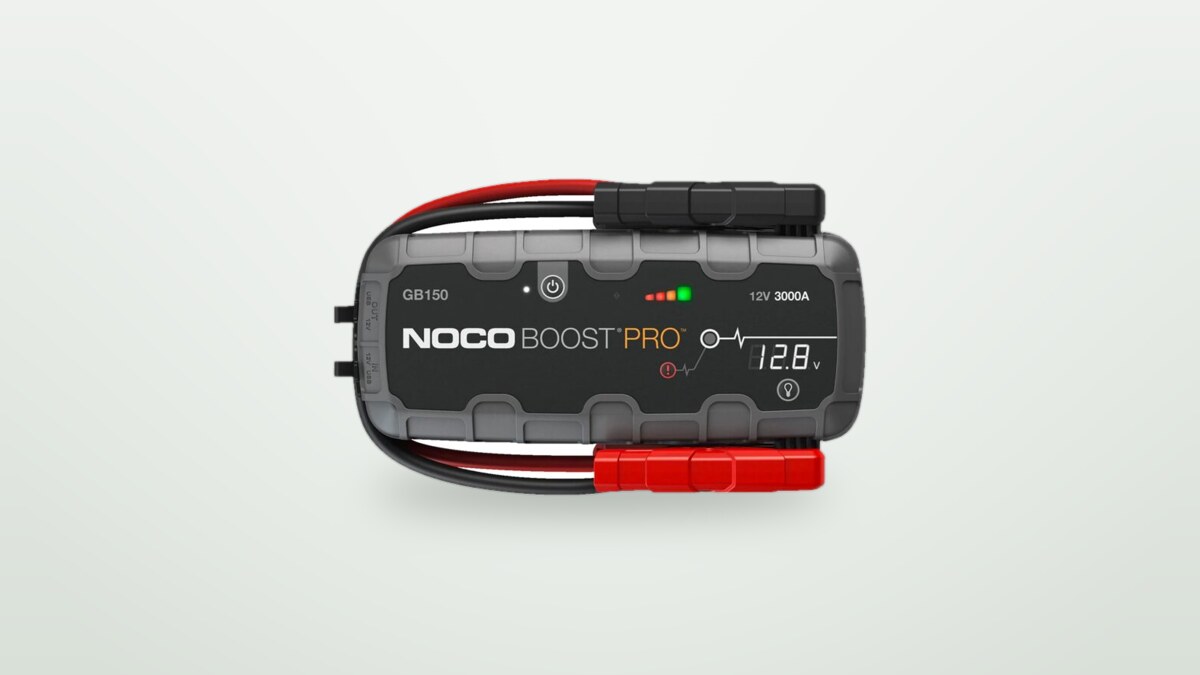
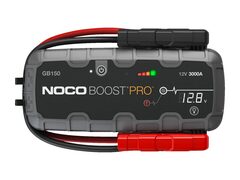
Noco GB150 Boost Pro jump starter with its clamps on a light background

The essentials

The GB150 lives up to its flagship promise. The 3000 A peak current and the stated compatibility (petrol up to 9 L, diesel up to 7 L) match the official spec sheet, consistent with its position at the top of the Boost range. One detail deserves to be highlighted: it is the only model in the range to include a voltmeter, which shows the real voltage of the vehicle's battery, a genuine diagnostic tool on top of the jump-starting function. The 80 claimed starts per charge and the 500-lumen light confirm a positioning as a workshop tool rather than an occasional backup. As with the rest of the range, two marketing figures deserve the usual caution: no protocol-tested data is available for cold-weather performance, and the internal battery's long-term reliability remains anecdotal, with mixed signals from user to user. At over 3 kg and 250 €, this is a tool for anyone who genuinely needs this much power, not a just-in-case purchase.

Strengths

  • 3000 A peak current matching the official spec sheet, consistent with the stated engine range (petrol 9 L, diesel 7 L)
  • The only model in the Noco range to include a voltmeter, for diagnosing the vehicle battery's real voltage
  • Up to 80 claimed starts per charge, a genuine workshop tool rather than an occasional backup
  • Confirmed UltraSafe protection (spark-proof, reverse-polarity), IP65-rated casing
  • 500-lumen flashlight with 7 modes, noticeably more powerful than on lower models in the range

Limitations

  • No protocol-tested data on cold-weather performance has been found for this model
  • Long-term reliability of the internal battery remains anecdotal, with mixed feedback from user to user
  • Recharging via a standard USB port, taking several hours for a battery of this capacity
  • Weight and bulk (about 3.4 kg) that make it more of a workshop tool than a glovebox accessory
  • Peak current was revised from 4000 A to 3000 A on the most recent spec sheets, which can be confusing next to older product pages still online
Noco GB150 Boost Pro: see the full details and price →

What the 3000 A figure is really worth

The GB150's 3000 A peak current and its stated engine compatibility (petrol up to 9 L, diesel up to 7 L) match the official spec sheet, consistent with its position as the most powerful model in the 12 V range.

3000 A
Peak current
88 Wh
Internal battery
80
Claimed starts per charge
3.4 kg
Weight with accessories

From 4000 A to 3000 A: not a step down in power

Older, unrevised product listings still advertise a GB150 at 4000 A. The current official spec sheet and the manufacturer's own website now show 3000 A for the same product in production.

Worth knowing: this change in labeling appears to reflect a revision to how peak amperage is measured, rather than an actual drop in the product's power output. This explanation comes from a single unofficial source, so it should be treated with the usual caution, but it is consistent with the broader pattern in this product category, where the peak figures quoted vary considerably from one brand to another depending on the measurement method used.

The built-in voltmeter: a genuine differentiator

Unlike the rest of the Boost range, the GB150 includes a voltmeter that shows the real voltage of the connected vehicle's battery. It is a genuine diagnostic tool in its own right: instead of just seeing that a battery is flat, you can read its exact voltage before and after the jump start, useful for judging whether the vehicle's battery deserves to be replaced rather than recharged indefinitely.

UltraSafe protection, the same as the rest of the range

UltraSafe technology protects against reverse polarity and sparking: the clamps stay inert until the connection is correctly made. The casing is IP65-certified, with an overmolded rubberized shell, and the product carries FCC, RoHS, ETL and UN38.3 certifications (lithium battery transport).

No safety recall has been identified for this model to date.

What is not yet known

The claimed operating range runs from -20 °C to +50 °C, a manufacturer figure. No protocol-tested measurement of cold-weather starting performance (an actual start at a controlled temperature) has been found for this model, a limitation shared with the rest of the Boost range.

Worth qualifying: the internal battery's long-term reliability remains anecdotal: available feedback is mixed, with no quantified failure rate or large-sample study. The self-discharge rate, claimed to be low (lithium chemistry), has not been independently measured for this specific model either.

Against the Noco range

Technical comparison: GB70, GBX75 and GB150 in the Noco range (official spec sheets)
CriterionGB70GBX75GB150
Peak current2000 A2500 A3000 A
Max diesel6.0 L6.5 L7.0 L
Starts per charge≈ 40≈ 50≈ 80
Booster rechargeUSB-CFast USB-CUSB, slower

The GB150 outperforms the GBX75 on amperage, diesel compatibility and the number of starts, and yet costs less. What the GBX75 keeps in return is a noticeably faster USB-C recharge for the booster itself, a real convenience for anyone who recharges the unit often. For everyday use on a typical diesel, the GB70 remains the sensible choice: cheaper, and enough for the vast majority of vehicles.

Price and availability

The GB150 is priced at around 250 to 275 € depending on the retailer, with no sign of widespread stock shortages at the time of writing.

Who this jump starter suits

This product suits anyone who regularly needs to restart large diesel engines (camper van, tractor, boat) or assist several vehicles in a professional or community setting, where the 80 starts per charge and the diagnostic voltmeter really earn their keep.

It is a much poorer fit for typical home use: for a private car, a GB50 is more than enough, for a fraction of the price and weight. For a 24 V heavy truck, no model in this range is suitable.
The product and its alternatives

Noco GB150 Boost Pro

Noco GB150 Boost Pro

See price (53)

The most powerful 12 volt Noco: 3000 amps, a seven-litre diesel restarted without hesitation, and eighty jump starts on a single charge.

View product

Frequently asked questions

The most recent spec sheets show 3000 A, which should be taken as the current figure. This change appears to reflect a revision to how the peak is measured, not an actual drop in the product's power output.

It shows the real voltage of the connected vehicle's battery, a diagnostic tool that helps judge whether a battery deserves to be replaced rather than recharged indefinitely. It is the only model in the Noco range to include one.

Not really. For typical home use, the GB50 or the GB70 are more than enough, cheaper and lighter. The GB150 targets large diesel engines and professional or community use with several jump-starts in a row.

Several hours, since recharging goes through a standard USB port. The less powerful GBX75 recharges noticeably faster thanks to its USB-C port.

The rating in detail

Our rating
4.1/5
Current actually delivered 4.0
Cold-weather performance not measured
Capacity and versatility 4.3
Safety and protections 4.4
Build and endurance 3.8
Noco GB150 Boost Pro: see the full details and price →