
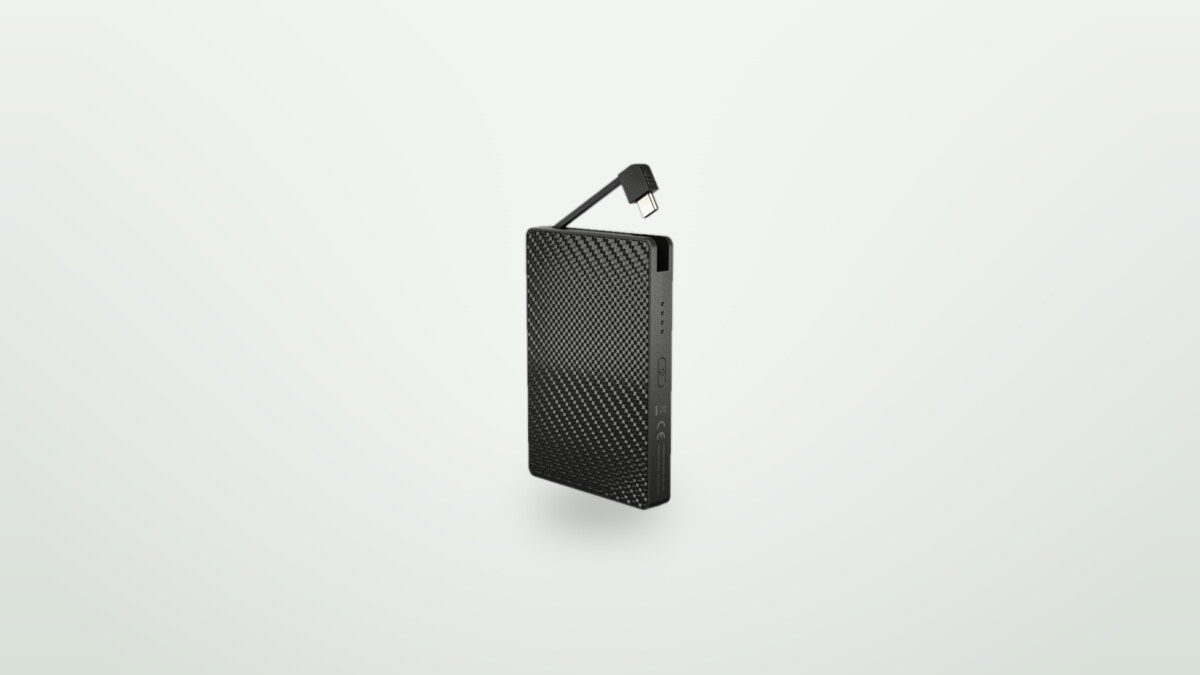
What 10000 mAh of energy is really worth
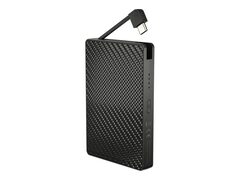
The Pocket 10000 packs a 10000 mAh cell at 3.85 V, or 38.5 Wh nominal. Converted to a standard 5 V USB-C output, the actually available energy drops to 6200 mAh, a figure the manufacturer itself publishes in its technical documentation rather than a simple rounded marketing value.
This ratio puts the Pocket 10000 behind the other 10000 mAh batteries from the same brand, an interesting comparison since it involves products that share the same design philosophy and the same distribution network.
| Model | Pocket 10000 | NB10000 (lineup) | Carbo 10000 |
|---|---|---|---|
| Advertised usable energy | 6200 mAh | up to 6800 mAh depending on generation | 7000 mAh |
| Built-in cable | Yes | No (separate cable included) | No |
| Price found | 73.90 € | 76 to 85 € depending on generation | 133 to 151 € |
The difference in efficiency comes down to form factor: thinner and lighter, with a built-in cable to fit inside the shell, the Pocket 10000 accepts this efficiency trade-off in exchange for its compactness, the central argument behind its design. The Carbo 10000, noticeably more expensive, targets a completely different positioning.
The real trap: 15 W total, not 42.5 W
This is the least visible point on the spec sheet, and the most important one to know before buying. Separately, the built-in USB-C cable delivers up to 20 W and the USB-C port up to 22.5 W. A reader in a hurry might conclude that the two together approach 40 W. The manufacturer's own official documentation states exactly the opposite: used at the same time, the cable and the port are capped at 15 W combined (5 V/3 A), not their sum.
| Output | Power alone | In combined use |
|---|---|---|
| Built-in USB-C cable | 20 W | 15 W total (5 V/3 A) |
| USB-C port | 22.5 W |
This ceiling is not an isolated spec-sheet error: the same figure appears identically on the manufacturer's own official product pages across several markets. The most likely mechanism is a shared maximum discharge current from the cell split between the two outputs, rather than an artificial restriction. In practice, that remains plenty for two smartphones charging at the same time, but clearly not enough to expect two more power-hungry devices to charge quickly at the same time.
Size and weight: the real strength
On this point, the finding is clear: at 105 x 70 x 12.5 mm and 160 g, this is a size that genuinely fits in a jacket or trouser pocket. It is the most emphasized selling point of this product, including within ultralight hiking gear.
The carbon shell gives a perceived rigidity above standard plastic, and the IP65 rating protects against dust and water splashes, a real plus for outdoor use. At 38.5 Wh, it stays under the 100 Wh limit imposed for airplane cabins, a concrete argument for anyone who travels frequently.
No USB-A port
Connectivity is limited to the built-in USB-C cable and a single USB-C port, with no USB-A socket. That is a real limitation next to competitors that keep at least one USB-A port for compatibility with older cables and chargers.
For anyone who only has USB-C devices left, this is not an issue. For anyone who still has earbuds, a smartwatch, or an old USB-A smartphone, an adapter becomes necessary.
The built-in cable: convenience and mechanical durability over time
The USB-C cable that coils into the shell is precisely the product's central selling point: nothing separate to carry, nothing to forget. The trade-off of this design is a mechanical hinge that has to withstand hundreds of flexes over time.
Can it really recharge a laptop?
With 22.5 W maximum on its USB-C port, the Pocket 10000 can help an energy-efficient laptop hold on, but certainly cannot recharge it at full speed: most modern ultrabooks need 45 to 65 W for a fast charge. This limit is consistent with the product's positioning, designed first and foremost for small portable electronics.
For occasional emergency use (holding the charge level rather than raising it), 22.5 W remains usable. For regularly recharging a laptop from empty, a dedicated higher-power battery remains the more sensible choice.
Real-world price and availability
The price found has stayed remarkably stable since the product's launch in early 2025: around 70 € in Germany, close to 74 € in France at the official distributor and at a specialised outdoor retailer alike, roughly the equivalent of $60 in the United States and £63 in the United Kingdom. No aggressive promotion or price drift has occurred over that period.
| Market | Price found |
|---|---|
| France | 73.90 € (official distributor and specialised retailer) |
| Germany | 69.90 € (stable since launch) |
| United States | $59.95 |
| United Kingdom | £62.95 |
Distribution remains limited, though: this model is absent from major French general retailers and from the main German price comparison sites, available mostly through the manufacturer's own site and a handful of specialised retailers.
Warranty and reliability: what is known, what is not
The standard manufacturer warranty is one year, a duration in line with the industry average. No recall or safety alert has been identified for this model to date.
Beyond that point, plenty of blind spots remain: no independent test lab has published a complete protocol for this specific product (calibrated discharge, accelerated cycling, drop resistance), and no teardown has identified the exact brand of the cell or of the management circuit. These are not negative signals, just blind spots that limit what can be said about long-term reliability.
Who the Pocket 10000 is for
This product suits anyone looking for a backup battery for a smartphone and small electronics, with a clear priority on size and the simplicity of always having a cable on hand: daily pocket use, business trips, travel with carry-on luggage.
It suits less well anyone who needs to regularly recharge a laptop at full speed, plug in two power-hungry devices at the same time, or who still has USB-A accessories without an adapter. In those cases, a battery more generous in power and connectivity remains the more sensible choice, at the cost of a bulkier format.