
Real-world efficiency: 90 to 93 %, consistent with the manufacturer's figures
Overall conversion efficiency sits between 90 and 93 % in real-world use. That's a defensible figure: the manufacturer's own official spec sheet distinguishes an MPPT efficiency of 99.8 % (the regulator's ability to track the panels' maximum power point) from a battery-to-AC conversion efficiency of over 96.5 %. Combining these two stages, the expected mathematical order of magnitude lines up closely with what was measured in the field, a rare and rather reassuring sign of consistency about the power electronics' design quality. The DC coupling, which avoids a double AC-DC-AC conversion unlike some AC-coupled competitors, accounts for part of this advantage.
The real weak point: firmware and BMS reliability
This is the most clear-cut weak point of this device. A firmware update left several devices temporarily unusable. Random BMS resets also occur, including one case where the problem could not be fixed with a simple reflash and required a replacement. The battery extension module suffers from recurring non-recognition after several weeks of normal operation, with a specific threshold around 54 % charge that keeps coming up as the point where switching between the main battery and its extension gets stuck.
A bug that cuts all four panel inputs to 0 W in full sun also exists, with production losses reaching around 80 % in one specific case. One explanation, an intentional charge plateau above 94 % charge, doesn't match another case showing the same symptom at only 54 % charge: whether this is a software bug or intentional behavior remains unresolved to date.
Complete hardware failures, documented but few in number
Beyond the software bugs, at least two devices failed completely within weeks to months of use: one unit showing 0 W across all four MPPT channels after six months of use, and a second device failing after just three weeks, with no quick response from support in the latter case. These two cases remain a limited sample, with the usual bias of online forums, where people mostly post when something has stopped working, but they represent a genuine mid-term reliability signal that most newer products in this category lack, simply for want of enough time in the field. No product recall or structural safety defect has come to light, however.
The 4 MPPT trackers: real voltage limits worth knowing
The four independent MPPT trackers accept an input voltage of 16 to 60 V per input, for a stated total solar input of 2400 W. In real-world use, maximum power per input varies noticeably from one reading to the next, between around 500 and 700 W, a gap that has no certain explanation and likely depends on sunlight and temperature conditions at the time. Two voltage quirks are worth knowing before buying: below 30 V, current limiting can fail and let through up to 17 or 18 A before cutoff, with no visible warning; above 53 V, power limiting can also fail and let a single input deliver up to 800 W at 54 V. In practice, the four inputs appear to behave independently under partial shading, but no controlled, quantified test of this behavior exists to date.
Zero-export: accurate and responsive once configured
The zero-export function, which adjusts output power to avoid sending energy back to the grid, behaves well once properly configured. With a DSMR 5.0 P1-type metre, the most rigorous method available, total residual import reaches just 0.196 kWh against 0.057 kWh exported over six hours, with nighttime loads of 70 to 150 W. With a Shelly Pro 3EM metre, the dynamic response happens within 2 to 5 seconds, though around 10 W of residual import is never fully eliminated. The manufacturer states 1 % accuracy for its own CT002 metre in a DIN-rail installation, a figure not independently verified to date. Compatibility with third-party metres remains broad on paper (CT002, CT003, Shelly, HomeWizard P1), but a standard Shelly 3EM was not recognised in one instance, while a Shelly Pro 3EM worked in two other instances, a model-level nuance worth checking before buying.
Expandable to 10240 Wh, real usable capacity around 85 %
The base LiFePO4 battery is stated at 2560 Wh, for a real usable capacity measured at around 2184 Wh, or about 85 % of the stated figure once the battery's charge-management reserve is deducted. That ratio stays within the norm seen across this product category. Up to three additional battery modules can be added to the main unit, bringing total capacity to 10240 Wh, with a usable capacity measured at around 4290 Wh out of the stated 5120 Wh once a first module is added, consistent with that same roughly 85 % ratio. More than 6000 charge cycles are stated at 25 °C, a temperature detail rarely disclosed by competitors.
A spring-and-summer device, not a year-round solution
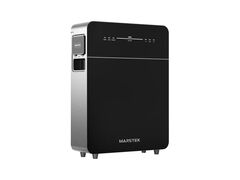
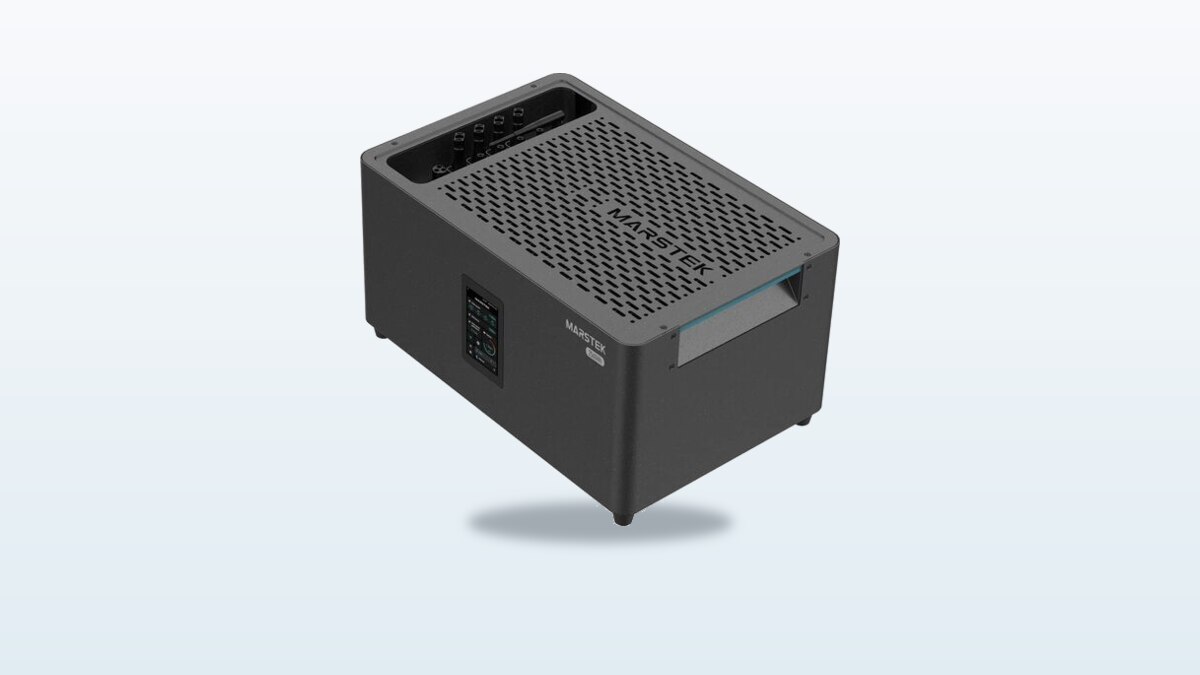
The Jupiter C Plus has neither backup power for a mains outage nor a way to recharge from the grid: its battery charges only from solar panels. This is a structural limitation built into its design, one that sharply reduces its usefulness in winter, when solar output drops. Another concrete limit during peak season: the output cap of 800 W doesn't allow full use of the stated 2400 W of solar input, power that regularly exceeds what a full battery and the output combined can absorb in good weather.
Price and availability: still a young market in France
In France, the unit is available for 599 € through a third-party retailer on Amazon, a price including tax and consistent with the rest of the catalogue. This retailer has been active since June 2025, but the device has only three ratings and no written comments to date, a sign of a still-young market rather than a flaw in the product itself. No localized official store or well-established mainstream retailer exists in France at the time of writing, which contrasts with Italy, where several chains (including a general home-improvement retailer) actively carry the device. The manufacturer's official after-sales service does exist in France, with dedicated technical support and a 10-year battery warranty on top of the standard 2-year legal warranty, but buying through a third-party retailer on Amazon doesn't go directly through this official channel, a nuance worth knowing before buying.
Regulatory compliance in France: CACSI mandatory, Consuel still unclear
Filing a no-injection self-consumption declaration (CACSI) with Enedis remains necessary regardless of the installation's power output, a free process that can be completed online. Whether a Consuel certificate is required remains more uncertain: it normally depends on whether the installation requires modifying the home's internal electrical circuit, with the presence of a storage battery mainly changing which type of certificate is needed rather than automatically triggering an inspection on its own. A stricter reading also circulates, holding that a storage battery always requires Consuel sign-off; it could not be confirmed against a top-tier regulatory source at the time of writing: it's best to check directly with Enedis and a local Consuel-approved inspector before buying. It's also worth noting that this type of plug-and-play balcony battery is not eligible for photovoltaic self-consumption subsidies in France.
Against the competition: Growatt NOAH 2000 and Indevolt BK1600 Ultra
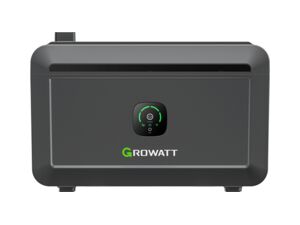
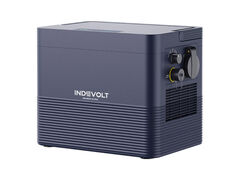
Against the Growatt NOAH 2000, already covered on this site, the Jupiter C Plus offers higher base capacity (2560 Wh versus 2048 Wh) and a more generous solar input (2400 W across 4 MPPT trackers versus 1800 W across 2), plus a micro-inverter built directly in, where the NOAH 2000 requires a separate micro-inverter to install. Against the Indevolt BK1600 Ultra, also DC-coupled with a built-in micro-inverter but with more modest capacity (1636 Wh, 2 MPPT trackers), the Jupiter C Plus stands out with clearly higher solar input and expandability, while the Indevolt keeps a backup power function (EPS) that Marstek lacks. No direct independent editorial comparison between these two devices exists to date, only spec sheets compared side by side.
Who the Jupiter C Plus is for, and who should look elsewhere
The Jupiter C Plus suits anyone looking for genuinely high conversion efficiency and generous solar input across four independent MPPT trackers, and who is willing to keep an eye on firmware updates and put up with inconsistent support if something goes wrong. It's a riskier choice, on the other hand, for anyone wanting a hands-off solution or year-round coverage: the lack of backup power and grid recharging makes it primarily a sunny-season device. In France, the absence of a well-established mainstream retailer and the very small volume of customer reviews available to date call for caution, especially for a purchase involving a significant outlay through a third-party retailer rather than a local official channel.