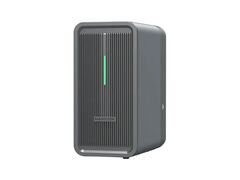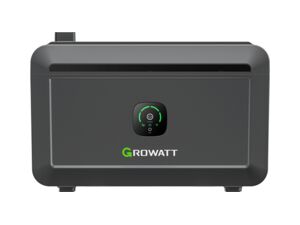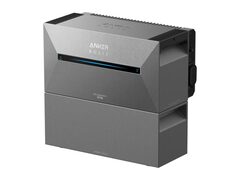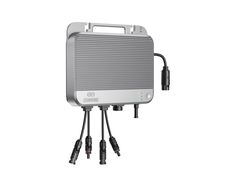

The 2240 Wh base and the expansion up to 8960 Wh
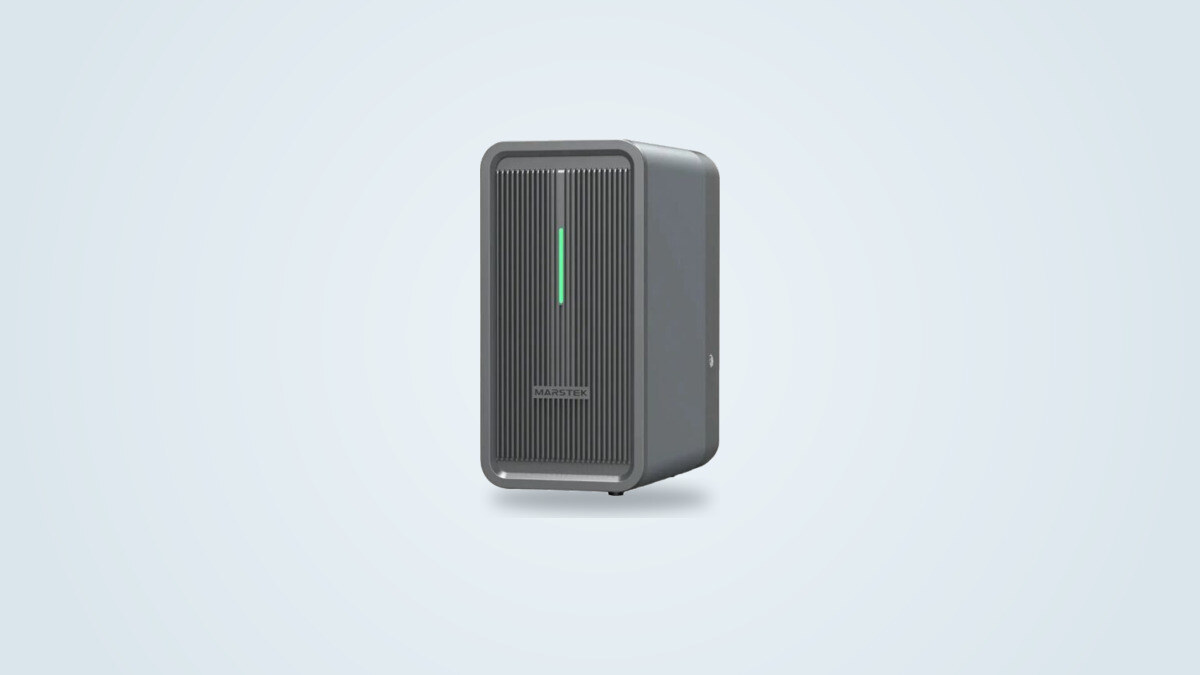
The B2500-D is built around a 2240 Wh LiFePO4 battery. The manufacturer states that the actually usable capacity is about 90% of that nominal figure, roughly 2016 Wh available in practice, a reserve that protects the cells from a full charge or a full discharge. That is one of the best ratios among the balcony storage kits recently reviewed on this site.
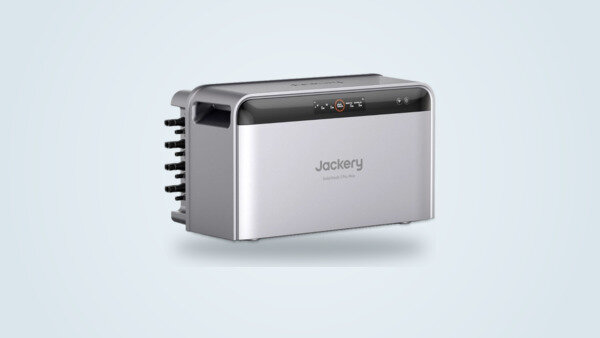
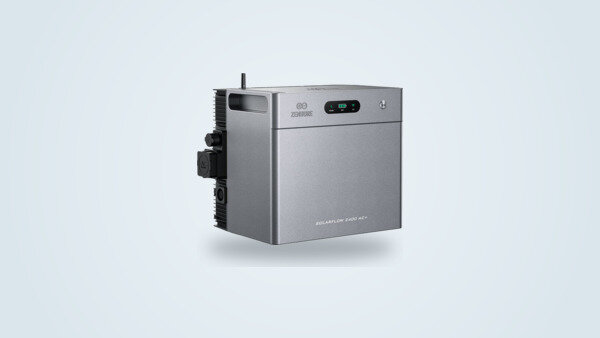
This 8960 Wh ceiling, spread across 4 units in total, is nonetheless the lowest among the balcony storage kits recently compared on this site: the Hoymiles HiBattery 1920 AC climbs to 11.52 kWh, the Jackery SolarVault 3 Pro to 15.12 kWh on a single tower (45.36 kWh when coupling several units), and Zendure's AB3000X to 17.28 kWh. Each module still connects in a few minutes with no complex wiring between units, letting the system grow gradually instead of tying up the whole budget on day one.
Real round-trip efficiency: between 85 and 90%
The B2500-D's round-trip efficiency, meaning what the user actually gets back after a full charge-then-discharge cycle, generally sits between 85 and 90% depending on the power drawn. This gap against per-stage conversion figures, usually well above 95% for this kind of electronics when charging and discharging are quoted separately, comes from a stack of successive losses: the internal DC-to-DC conversion, estimated at around 4%, followed by the inverter stage that delivers alternating current on the output side.
This figure is in line with what other balcony storage kits coupled directly to the panels show once brought back to the same round-trip math rather than to the manufacturer's isolated conversion figures: it is the usual cost of conversion electronics on this type of product, not a weakness specific to the B2500-D.
1600 W on paper, a narrower real solar input
The B2500-D packs 2 independent MPPT trackers, accepting up to 1600 W of panels combined (800 W per input), across a 12 to 59 V voltage range. On paper, this input beats several direct competitors of the same architecture, such as the Anker Solix Solarbank 2 E1600 AC (800 W total) or the Zendure SolarFlow 800 (around 400 W). One technical detail on the spec sheet changes the reading of that figure, though: the maximum current accepted by each input caps out at 13.5 A.
Combined with the input voltage range, this current limit means the power actually achievable per input depends heavily on the voltage of the module used, well before the nameplate 800 W is ever reached. With a panel around 31 V (standard silicon, roughly 108 half-cells), power tops out near 418 W. It climbs to around 472 W with a panel around 35 V, and to around 580 W with a higher-voltage panel around 43 V. Only with particularly high-voltage panels does the B2500-D get close to its nameplate 800 W per input.
Against the Growatt NOAH 2000, which accepts up to 26 A per MPPT input (52 A total), this current limit on the B2500-D matters in practice: the NOAH can pull full power from 4 modules at once under clear sky, while the B2500-D is often limited to around 550 W per input with common modules, a nuance missing from a plain comparison of nameplate wattage figures.
The 800 W microinverter, calibrated squarely on Germany's simplified threshold
The B2500-D's built-in microinverter caps out at 800 W on the mains output. That is no accident of calibration: it is exactly the threshold Germany adopted once Solarpaket I took effect on 16 May 2024 (article 8, paragraph 5a of the EEG) for the simplified registration of a balcony solar system, provided panel output also stays under 2000 Wp. Above that 800 VA inverter threshold, an installation falls outside the simplified regime.
This alignment explains a good part of the B2500-D's success in Germany: the unit only needs an online registration in the federal market data register (Marktstammdatenregister), with no separate step required with the grid operator since that reform. This is a configuration specific to the German market: thresholds and procedures vary in other markets, covered further in the installation and compliance section below.
Control: an app that lags behind, a very active local community
The Marstek app pairs quickly over Bluetooth and is simple to get started with, but it is still judged weaker than several competing apps in the same segment: sparser data visualisation, and fewer adjustable settings than more polished alternatives. Two operating modes exist: an automatic mode, which adjusts output power by continuously reading a compatible smart meter, and a manual mode at a fixed power level without one.
On meter compatibility, the B2500-D is actually fairly open: beyond Marstek's own meter (CT001, CT002 or CT003 depending on generation), the unit also works with meters already common in many homes, such as the Shelly Smart Meter or the HomeWizard P1, which lowers the risk of having to buy a proprietary accessory just to unlock automatic control.
Another notable point: the B2500-D benefits from one of the most active local-control communities on the market. Third-party tools let the unit talk MQTT to Home Assistant without going through the official app. That option remains unofficially supported by Marstek, though, and it does not fully cut the link to the manufacturer's cloud: even with local control active, the unit keeps sending data to Marstek's servers and stays controllable from the app over Bluetooth as well.
On the firmware side, several updates have created real friction: WLAN dropouts that require a manual reset, a state-of-charge display that is sometimes inconsistent, and update rollouts sometimes gated by support rather than pushed automatically to every user.
Installation and compliance: a genuine 15 minutes, rules that vary by market
The physical install lives up to the plug-and-play promise: the unit sits on the floor or mounts on a wall, connects to the panels through clearly labelled MC4 connectors, and plugs into a standard mains outlet. The whole thing is up and running in about 15 minutes, with no electrician required.
On the regulatory side, the picture varies markedly from one market to another. In Germany, the product's main market, the simplified threshold of 800 VA of inverter output and 2000 Wp of panels (detailed above) allows online registration at the Marktstammdatenregister, with no separate step at the grid operator since May 2024. In the United Kingdom, small balcony solar systems generally fall under permitted development and the microgeneration certification scheme (MCS) rules, but requirements vary by supplier and property type, so checking with the electricity supplier before buying remains the safer route.
These steps are worth confirming case by case with the local grid operator or supplier before buying: the rules that apply to this kind of installation can change over time and vary by area.
Reliability: a firmware incident identified in 2024, a wiring vulnerability to know about
The B2500-D relies on a LiFePO4 chemistry rated for more than 6000 cycles to 80% remaining capacity, backed by a 10-year manufacturer warranty. The housing is IP65 rated against water and dust, with an operating range of 0 °C to 50 °C while charging and -10 °C to 50 °C while discharging. The unit meets IEC 62109-1/-2 (inverter safety), IEC 61000-6 (electromagnetic compatibility) and IEC 62619 (industrial lithium battery safety) standards, with several layers of battery-management protection (overvoltage, undervoltage, overcurrent, short-circuit, overheating, low-temperature). No recall has been identified for this model to date.
Two real caveats are worth knowing before buying, though. A firmware update pushed in 2024 locked the battery management system on some units, leaving them inoperable, with repair times through the service partner that could exceed six weeks in the worst cases; newer firmware versions have since fixed much of this. Separately, one miswiring scenario has been identified: connecting both of the B2500-D's DC outputs into a single MPPT input of an incompatible third-party microinverter can damage those outputs through backfeeding, and the unit does not block this scenario on its own. Following the wiring diagram recommended for the chosen inverter precisely remains essential.
Against the direct competition
Among balcony storage kits under 500 euros, three references help place the B2500-D: the Growatt NOAH 2000, which accepts a markedly higher MPPT current, the Anker Solix Solarbank 2 E1600 AC, with a more polished app ecosystem, and the Zendure SolarFlow 800, aimed at an entry-level budget.
| Criterion | B2500-D | Growatt NOAH 2000 | Solarbank 2 E1600 AC | SolarFlow 800 |
|---|---|---|---|---|
| Base capacity | 2240 Wh | 2048 Wh | 1600 Wh | 960 Wh |
| Expandable to | 8960 Wh | 8192 Wh | ≈ 5000 Wh | 1920 Wh |
| Nominal solar input | 1600 W (2 MPPT) | 1800 W (2 MPPT) | 800 W (2 MPPT) | ≈ 400 W (1 MPPT) |
| Max current per MPPT input | 13.5 A | 26 A | Not published | Not published |
| Inverter output | 800 W built in | Separate microinverter required | 800 W built in | 800 W built in |
On paper, the Growatt NOAH 2000 has the most generous nominal solar input of the group, and its markedly higher current ceiling per input lets it pull more power from the same modules under clear sky; in exchange, it requires buying and installing a separate microinverter on top of the storage unit, while the B2500-D has its own built in. The Anker Solix Solarbank 2 E1600 AC leans on a richer app ecosystem for a lower base capacity, and the Zendure SolarFlow 800 targets an entry-level budget with far more modest capacity and expandability. The B2500-D therefore remains the most well-rounded balance of the group between capacity, solar input and simplicity, provided the panels chosen have a high enough voltage to approach its nameplate power.
Who the B2500-D suits, and where it is still hard to buy
The B2500-D is best suited to buyers after a simple, affordable setup with an inverter already built in and administrative registration kept to a minimum. That profile fits Germany particularly well, where the product was born and remains the most widely available.
For buyers after the highest expansion ceiling on the market or the most polished app ecosystem, the more recent competitors mentioned above take the lead. But for a first purchase focused on price and simplicity, backed by one of the largest user communities and richest sets of online resources on the market, the B2500-D remains a mature, proven choice, provided buyers accept a middling app and an expansion ceiling now surpassed by several newer entrants.