
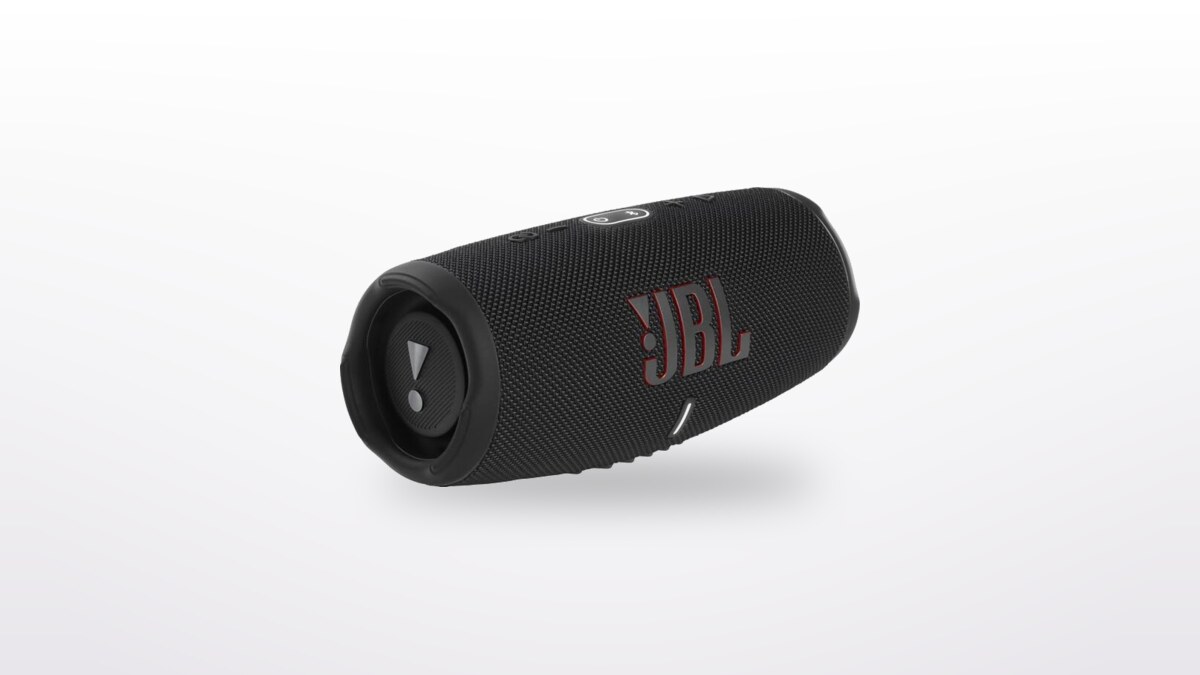
40 W in reality: 30 W for the driver, 10 W for the tweeter, not two tweeters
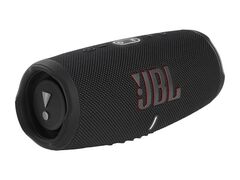
The simplified spec sheet still circulating on many product pages describes the Charge 5 as fitted with two tweeters, for a power split of 30 W plus 2 times 5 W. The manufacturer's official documentation states a different configuration: a single oblong-shaped main driver (52 x 90 mm) for the low and mid frequencies, a single 20 mm tweeter dedicated to the highs, and two lateral passive radiators that reinforce the bass without drawing any power of their own. The real power split is 30 W for the main driver and 10 W for the tweeter, for 40 W in total.
The two passive radiators explain part of the smoother bass at moderate volume: these are unpowered membranes that vibrate in response to the air pressure the main driver generates, a common technique on compact speakers for extending the bass without adding an amplifier. Their mechanical travel stays limited, though, which plays a role in the behavior at very high volume detailed further below.
92.3 dB at 1 metre, a high sound level for its size
The sound level at 1 metre, in pink noise with a neutral EQ, reaches 92.3 dB. That is higher than a similarly sized direct competitor (about 91.3 dB) and the more compact model from the same brand (about 89.3 dB). At maximum volume, the level climbs to around 93 to 94 dB, but distortion becomes clear beyond about 60 % of the available volume range; below that point, the signal stays clean.
A composite scoring system, which weighs several listening criteria (timbre, dynamics, soundstage, sound level, artifacts) rather than raw level alone, puts the Charge 5's power sub-score clearly below that of a considerably larger competitor (about 3 kg versus 960 g). This apparent contradiction with the 92 to 94 dB range mentioned above comes down to the different nature of the two figures: one reflects raw sound pressure at a fixed distance, the other combines several listening dimensions that go beyond maximum volume alone. Both figures are valid, they simply describe different things.
No bass boost at low volume, a deliberate tuning choice
At low volume (below about 25 % of the available range), the Charge 5's bass turns discreet, without the automatic boost some competing speakers apply to compensate for the ear's lower sensitivity to bass frequencies at low levels. This is not a manufacturing flaw but a deliberate tuning choice: favouring a stable, low-distortion curve over a loudness correction that could have artificially inflated the bass at low volume at the cost of more distortion.
Beyond about 60 % of the volume range, the opposite happens: distortion increases and the bass stops climbing with the sound level. The most plausible mechanism is the limited mechanical travel of the two passive radiators: past a certain threshold, they can no longer track the electrical signal without distorting, regardless of how much electrical power remains available. This physical limit is common to most compact speakers fitted with passive radiators, not specific to this model.
20 hours advertised, more like 12 to 19 hours at sustained volume
JBL advertises up to 20 hours of battery life. At a fixed, sustained volume (75 dB SPL continuous), battery life drops to about 17 hours and 12 minutes. At other moderate to high volumes (between a third and half of the available range), it instead runs between 12 and 19 hours depending on the audio content. One isolated figure exceeds 24 hours: it sits well above the other figures available here, and is not treated as representative.
| Volume condition | Battery life |
|---|---|
| 75 dB SPL fixed (sustained volume) | ≈17h12 |
| About a third to half volume | 14 to 16 h |
| High volume | >15 h |
| Advertised by the manufacturer | Up to 20 h |
The gap between the advertised figure and battery life at sustained volume, on the order of 15 to 40 %, stays within the norm for the category: every Bluetooth speaker's battery life depends heavily on listening volume, and the marketing figure almost always matches the most favourable scenario.
A fairly slow recharge of its own, about 4 hours for 27 Wh
The manufacturer's official documentation states a full recharge in about 4 hours, for an input capped at 15 W (5 V / 3 A) over the USB-C port. A full charge, from 0 to 100 %, comes out to about 3 hours and 30 minutes. For only 27 Wh of battery, that is fairly slow next to recent external batteries that often accept 20 W or more: the Charge 5 accepts no recognised fast-charging protocol, neither Power Delivery nor Quick Charge beyond its own 15 W.
The power bank function: an emergency top-up, not a real energy reserve
The USB-A port dedicated to charging external devices delivers a maximum of 10 W (5 V / 2 A). Out of the battery's 27 Wh, and with a typical USB conversion efficiency of about 80 to 85 %, the energy actually transferable comes to around 22 to 23 Wh. A current smartphone generally carries between 11 and 20 Wh depending on the model: the Charge 5 can therefore fully recharge one once, sometimes a bit more depending on the device, but not several times in a row as the term power bank might suggest. This number of charges hasn't been measured directly: the calculation starts from the battery's known specifications and a typical conversion efficiency, not a count of charges actually performed.
PartyBoost: a proprietary ecosystem at the end of its generation
The PartyBoost function pairs multiple compatible JBL speakers, either in a stereo pair (two speakers maximum) or in Party mode (several speakers on the same mono stream). It stays proprietary to the brand: no compatibility with a generic Bluetooth speaker is planned, and the older Connect+ generation is not recognised by PartyBoost. The manufacturer dedicates a support page to the audio dropouts and distortion encountered in PartyBoost or Connect+, a sign that the issue comes up often enough to justify an official procedure. The Charge 5 only supports the SBC Bluetooth codec, without aptX: in a crowded radio environment (several simultaneous Bluetooth connections, 2.4 GHz interference), that is a plausible technical factor behind dropouts.
More recent JBL models, including the Charge 6 that succeeds this one, are shifting to Auracast, an open Bluetooth standard that is progressively replacing PartyBoost. The Charge 5 is therefore part of the last JBL generation built around this proprietary ecosystem.
A USB-C port with no cover, but no widespread manufacturing defect
The USB-C charging port sits directly exposed, with no flap or protective cover, unlike the USB-A port which has one. The IP67 rating (immersion up to 1 metre for 30 minutes, full protection against dust) describes the device new and closed, not its behavior after an impact or a fall: it is a starting state, not a guarantee over time after an impact.
No widespread failure pattern or product recall concerns the Charge 5 to date. Gradual swelling of a lithium-ion battery remains, as with any device of this type, a possible long-term aging mode, with no numerical data available to estimate its frequency on this specific model.
Against the JBL Flip 6, the smaller sibling in the lineup
Within the JBL lineup itself, the Charge 5 goes head-to-head with the Flip 6, a more compact model from the same family.
| Criterion | Charge 5 | Flip 6 |
|---|---|---|
| Weight | 960 g | 544 g |
| Advertised power | 40 W | 30 W |
| Advertised battery life | 20 h | 12 h |
| Battery life at 75 dB SPL fixed | ≈17h12 | ≈9h25 |
| Charging time | 4 h | 2h30 |
| Power bank function | Yes, USB-A 10 W | No |
At notably higher weight and size, the Charge 5 offers greater power and longer battery life, plus a power bank function the Flip 6 lacks. The Flip 6 stays better suited to daily carrying where every gram counts.
Against the Xtreme 3 and the competition, a clearly defined place
Within the JBL lineup itself, the Xtreme 3, larger and heavier, carries a battery at a different voltage (7.26 V versus 3.6 V for the Charge 5): its 5000 mAh capacity works out to about 36 to 37 Wh, against 27 Wh for the Charge 5. Comparing the raw mAh figures of the two models makes no sense without accounting for this voltage gap. The Xtreme 3's advertised battery life (15 h) is actually lower than the Charge 5's (20 h) despite its larger Wh capacity, since the Xtreme 3's higher sound power draws more energy.
Against competitors from other brands, the Charge 5 sits in a weight and power range close to the Anker Soundcore Motion+ (1050 g, 30 W, 12 h advertised) and the Ultimate Ears Megaboom 3 (18 h advertised, recharges in 2h45). The Sony SRS-XG300, in a whole different size class (60 W, about 3 kg), stays a product in a different weight category, not a direct competitor in format.
Who it suits, and who it does not
It suits anyone looking for a rugged, loud portable speaker for outdoor use (patio, beach, camping), who wants to pair it with other PartyBoost-compatible JBL speakers, and who appreciates being able to bail out a dead smartphone once in a while.
It does not suit anyone looking primarily for a genuinely versatile external battery (the single 10 W USB-A port stays modest next to dedicated batteries), nor anyone who prioritizes lightness for daily carrying, for whom a more compact format like the Flip 6 is better suited.