
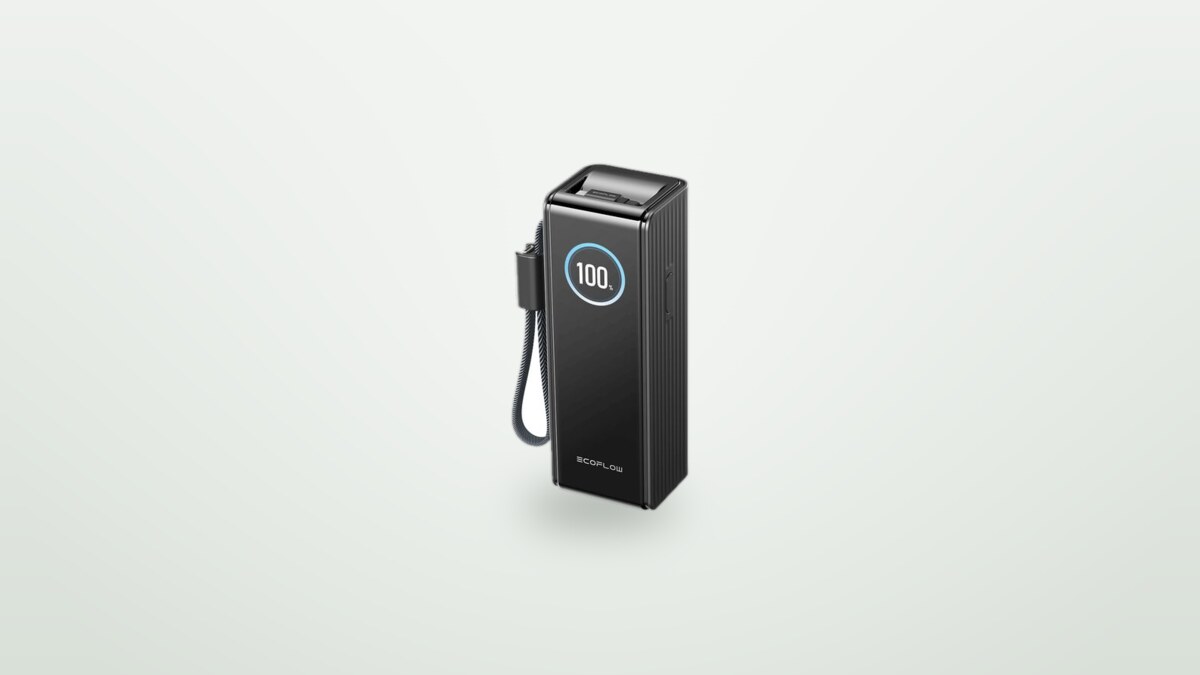
Two near-identical EcoFlow batteries, even the official site mixes them up
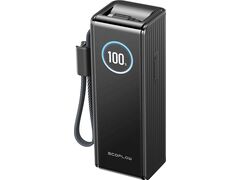
EcoFlow sells two distinct products under near-identical names ("RAPID 25K", "RAPID Power Bank 25000mAh"), distinguishable only by their internal reference. The first (EF-HB-001) is the one covered in this review: two USB-C retractable cables built into the case, each port capped at 100 W, a charging input of 100 W maximum, and a charging curve of 26 min / 53 min / 80 min for 50, 80 and 100 %. The second (EF-HB-002) has no built-in cable, each port goes up to 140 W, the charging input accepts 140 W, and 50 % is reached in about 20 minutes.
The confusion is not limited to third-party retailers: EcoFlow's own official European product page for the cable-equipped model shows, at the time of writing, a 140 W charging input and a 20-minute figure, exactly the numbers for the other model. The US page for the same product, by contrast, correctly lists 100 W and 26 minutes, consistent with the specifications in this review. Any "140 W input" or "20-minute" figure found online for this product is therefore worth double-checking before taking it at face value: it most likely refers to the other reference, or to a mistaken regional page.
87.5 W on a real laptop, 170 W never verified combined
On the main port, with the 100 W Power Delivery profile active, a MacBook Pro plugged in draws 87.5 W, a normal gap from the claim since the power actually drawn depends on the laptop's own charging curve, not only on the port's ceiling. On input, with a 100 W mains charger, the power reaches 90 W.
The split of the claimed 170 W across both ports at once (for example 100 W plus 70 W), on the other hand, has not been the subject of any independent test. It is mathematically consistent with the official specifications (each port capped at 100 W, 170 W total), but no independent verification of this split, or of the priority between the two ports in simultaneous use, exists to date.
Thermal behaviour at full load: a completely blank spot
No usable data was found on thermal behaviour at 170 W. The available technical documentation, which otherwise details the device's internal components, itself includes no infrared thermography, no sustained-load test with temperature readings, and no ageing test.
The documented internal design (graphite sheets, a raised metal heatsink on the circuit board, monitoring thermistors) shows that the question was considered at the design stage, but that is not a substitute for a measurement. A throttling figure sometimes associated with this type of product (power halved after 8 to 12 minutes) actually relates to a different model, from another brand: it is not attributable to the Rapid 25K and is not used here. This, together with the reliability of the built-in cables covered below, is the main blind spot in this review.
Two built-in retractable cables: the central argument, with no field track record
The two retractable USB-C cables (67 cm and 26 cm) are the product's main selling point: no more need to carry a separate cable. EcoFlow claims a 10000-cycle twist test and a 3000-cycle plug/unplug test for the retraction mechanism, a manufacturer figure not independently verified.
No documented user reports of wear, breakage, or a connector coming loose after several months of use were found, despite more than a year on the market. This absence could reflect a reliable mechanism, or simply the low volume of feedback available for a product still recent on this segment for the brand: both hypotheses remain open, and it is this very uncertainty that deserves to be known before buying a product whose central argument rests entirely on this mechanism.
Recharging matches the claim, functional screen, no app
Recharging the battery itself follows the claimed curve: 50 % in 26 minutes, 80 % in 53 minutes, 100 % in 80 minutes (1h20) at 100 W. The built-in colour screen shows in real time the battery level, power per port, health status and temperature. Unlike other EcoFlow products, this model has no companion app: no charge history, no remote firmware updates, everything relies on the physical screen.
The interface design comes across as dated, even though it remains functionally adequate for daily use. No further independent assessment of the screen was located.
604 g actual against 565 g claimed
The actual mass comes to 604 g, against 565 g on this listing and about 580 g on EcoFlow's general product page, a gap of 24 to 39 g (4 to 7 %) between the actual weight and the marketing claims. That is not a massive gap, but it consistently runs in the same direction: the battery is a little heavier than the listing states, whichever official page is checked.
Partial efficiency: about 80 % at low power, nothing measured beyond that
The device's regulatory label states a rated output capacity of 14500 mAh at 5 V and 3 A, or 72.5 Wh delivered at that specific measurement point. Set against the claimed 92.5 Wh, that gives an implied efficiency of about 78 %; set against the 90 Wh calculated from the cells (25000 mAh at 3.6 V nominal), it rises to about 81 %. That measurement point, however, sits at a low power level (15 W): converters of this type are generally more efficient near their rated power than under light load, so this figure says nothing about the likely efficiency at 100 W or 170 W, the power levels most relevant to real laptop-charging use. No timed high-power discharge test was found to calculate this efficiency under more representative conditions.
Under 100 Wh, but the "TSA-approved" label is a misnomer
At 92.5 Wh (or about 90 Wh on a cell basis), the Rapid 25K stays under the 100 Wh threshold beyond which prior airline approval is generally required for the cabin. One nuance is worth knowing: the "TSA-approved" marketing label, common on this type of product, does not correspond to any product-specific approval procedure by the US administration. The TSA sets a general rule (under 100 Wh with no paperwork) without approving any product by name. Some airlines also require the battery to stay visible and accessible in the cabin while in use.
A single EcoFlow recall, unrelated to this product, and a very unstable price
Only one EcoFlow recall has been identified to date, on the Delta Max 2000, a power station rather than a pocket battery, fixed with a firmware update and no hardware recall. Nothing links that recall to the Rapid line: the Rapid 25K's cells are standard lithium-ion, a chemistry that does not match the one typically used in large stations. No recall specific to EcoFlow power banks was found.
The listed price swings sharply depending on the period and the retailer, from €75 to more than €115 for the same product, with a starting list price given as €99.99 or €109.99 depending on the version. Quoting a single price would be misleading: this is a near-permanent promotion, not a one-off exception, a pattern shared with the rest of the category.