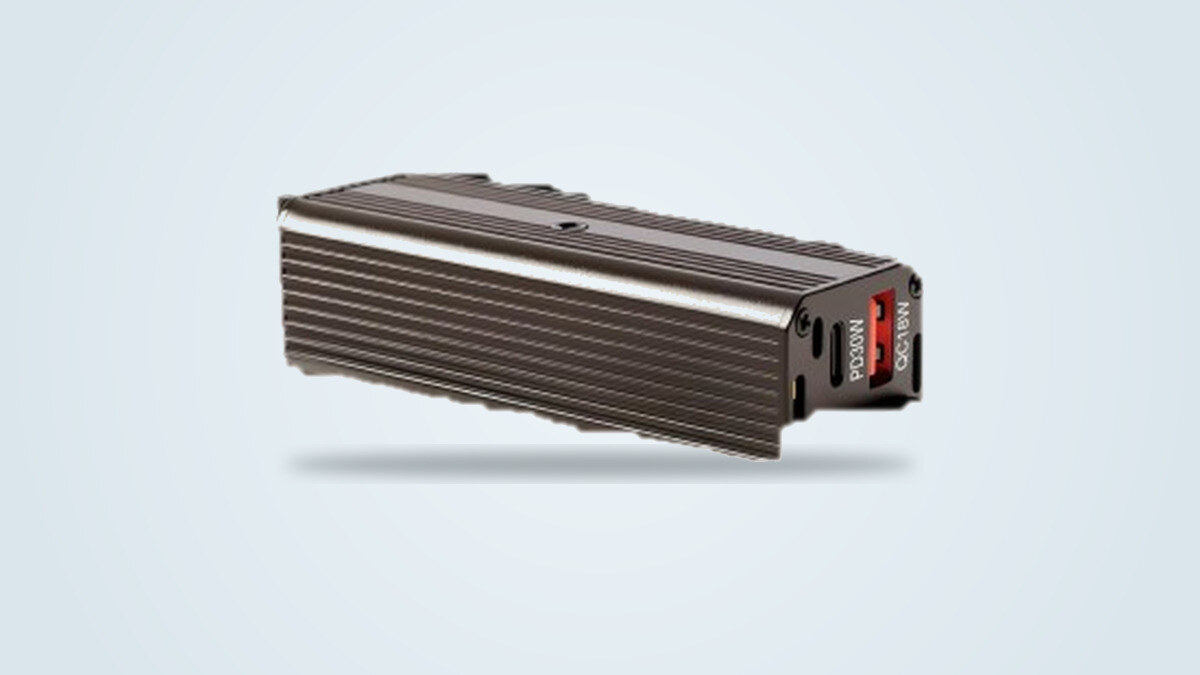
The rated 200W, and what it is worth depending on how you connect it
The nameplate on the Bestek inverter states 200W continuous, converting a 12V battery or cigarette lighter socket into 230V AC. That is a fair figure for this size and price, but it comes with a condition the manufacturer's own manual spells out clearly: under 150W, the cigarette lighter socket is enough; beyond that, up to the rated 200W, a direct connection to the battery is recommended.
This limit comes from the cigarette lighter socket itself, not from the inverter: its fuse and wiring are not built to carry unlimited current continuously. The catch with this exact unit is that no battery clamps are included in the box, unlike the 500W model in the same lineup, which does include them. To use the full 200W, you would need to source your own clamp cable, or stick to the 150W available through the cigarette lighter, which is plenty for a laptop charger, a lamp, or an air pump.
This 150W threshold is worth knowing before buying, rather than discovering it in use, at the moment a hungrier device fails to start or trips the vehicle's cigarette lighter fuse.
Modified sine wave: what it powers well, what to avoid
The Bestek 200W does not produce a pure sine wave like household mains power, but a stepped signal known as modified sine wave (or quasi-sine). It is the most common technical choice for inverters of this size and price: it costs less to produce and suits the large majority of everyday uses.
In practice, simple resistive appliances (lamps, small heaters, most USB chargers) and a good number of laptop chargers run without particular issue. Caution is warranted, though, for motor-driven appliances (some power tools, small compressor fridges), high-end switching power supplies, sensitive audio equipment, and any medical device: on a modified sine wave, they can run hotter, lose efficiency, produce an audible hum, or in rare cases fail to start at all. No harmonic distortion (THD) figure is published by the manufacturer for this model, which limits how far the technical detail of its output signal can be taken.
Four USB ports and two AC outlets: how the power is really shared
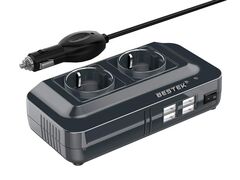
On the UK market, this Bestek inverter comes with four USB-A ports and two AC outlets, side by side on the same face. Enough to power one appliance on mains voltage, keep a second outlet free, and charge up to four USB devices at the same time: phones, e-readers, small lamps, GPS units.
The detail worth knowing concerns the current available on those USB ports: Bestek rates the total at 4.2A shared across all four. Plugging in a single device gets the full benefit, but as soon as several are connected together, the current is shared between them. With four modern phones plugged in at once, each gets a little over 1A on average, noticeably slower than a dedicated modern USB charger. That is not a flaw specific to this unit: it is the mechanical result of a fixed total current budget shared across the active ports.
This configuration (four standard USB-A ports, two AC outlets) is not universal across Bestek's catalogue, though: depending on the market and commercial revision, the same 200W lineup is also sold with USB-C ports and a single AC outlet, a different combination geared towards fast charging rather than multiplying outlets. Always check the photos and the exact listing for the unit you are buying rather than assuming identical ports from one retailer to another.
Left connected permanently: the real electrical cost
Plenty of owners, particularly in a campervan, on a boat, or as home backup, leave this type of inverter connected permanently, switched on or not. On this point, the product listing makes no mention of a power-saving standby mode or an automatic cutoff below a given load.
In practice, an inverter left powered up draws a small but continuous current to run its control electronics and, depending on load, its fan. That draw is small in absolute terms, but it adds up hour after hour on a secondary battery of limited capacity, and it continues even when nothing is plugged into the outlets.
Protections and safety: a complete list for the price
For an accessory selling for well under £30, the list of electronic protections is complete, and it recurs consistently across Bestek's whole 200W inverter lineup: protection against short circuits, protection against overload, protection against low voltage (a weak battery), and protection against overheating, with a built-in fuse and a cooling fan.
On top of that comes a Soft Start function, which limits the inrush current the moment the unit is switched on: a useful detail on a simple cigarette lighter socket, whose fuse can blow on too abrupt a current draw.
No safety recall has been identified for the Bestek brand at the time of writing. That does not replace ordinary caution: check that your vehicle's cigarette lighter socket is itself in good condition, and avoid leaving a device connected unattended on questionable wiring.
Build quality, fan noise, and finish
The housing is ribbed aluminium, a choice that helps dissipate heat without needing a large passive heatsink. At this price point, the build stays modest but sound: materials that do not feel flimsy, tidy assembly, ports that stay firmly in place.
The point that comes up most often concerns the built-in cooling fan: it kicks in as soon as the load increases, and its noise level becomes audible in an enclosed space (a cabin, a campervan interior). This is not specific to this Bestek model: it is a trait shared by almost every compact inverter of this power class, whose interior volume leaves little room for a passive heatsink large enough to do the job alone. Worth factoring in if you plan to use it near a sleeping area.
Bestek generally advertises an 18-month warranty across its 200W inverter lineup, a fairly standard term for this type of product and price bracket.
Against the Bestek 500W: when to move up
Bestek's catalogue also includes a 500W version of this same type of inverter, sold at a higher price. The difference is not limited to the wattage on the box.
| Criterion | 200W (this review) | 500W |
|---|---|---|
| Price seen | £24.92 | £51.30 |
| Continuous power | 200 W | 500 W (higher peak) |
| Connection | Cigarette lighter only | Cigarette lighter or included battery clamps |
| Outputs | 4 USB-A + 2 AC outlets (market-dependent) | AC outlet(s) + USB ports |
| Safety | Short circuit, overload, low voltage, overheating | Fan, electronic protections |
The choice comes down to the intended use. For charging small devices, a lamp, a laptop charger, or several phones, the 200W is enough and costs less. For heavier-duty use (a power tool, a small appliance, several demanding devices at once), the 500W model brings both more power and, crucially, the battery clamps the 200W lacks for reaching its full output without improvising a cable.
Cars, boats, and home backup: the right use cases
This type of inverter naturally fits three settings: the vehicle (car, campervan, converted van), the boat, and the home during a power cut, provided you have a 12V battery and a way to recharge it.
In a campervan or van, it lets you keep a 230V outlet available for a laptop charger, a low-power travel kettle, or a fan, alongside a solar setup or a leisure battery. The usual caution still applies: do not let it drain the vehicle's starter battery with the engine off, and prefer an auxiliary leisure battery for extended use.
For home backup, it does not replace a generator or a large domestic battery: its 150 to 200W are enough to charge phones, run a home router, or power a lamp, not to run a fridge or a heater.
Who it suits, and who it does not
It suits anyone after a simple, inexpensive 230V fix for small devices: chargers, lamps, small electronics, in a car, a van, or a boat. It also suits anyone who needs several USB ports at once without stacking adapters.
It suits less well anyone hoping to run power-hungry appliances or devices sensitive to a modified sine wave (small motor-driven appliances, audio or medical equipment), anyone planning to leave it connected permanently without watching the battery drain, or anyone who needs a direct battery connection to exceed 150W: in that last case, the 500W model in the same lineup, which ships with clamps, is the logical choice.
What matters most: for occasional, light-duty use, this inverter does exactly what is asked of it, at a price that remains among the lowest in its category.