
76.1 % wireless efficiency, a notch behind its siblings
The MagGo (10K) actually stores 38.5 Wh, not the 37 Wh often quoted from a simple conversion at 3.7 V: its cells actually run at 3.85 V, a calculation nuance rather than an error, but one that slightly shifts the basis for comparison.
| Condition | Efficiency |
|---|---|
| Wireless discharge at 15 W (full power) | 76.1 % |
| Wireless discharge at 5 W (reduced power) | 88.2 % |
| Charging the pack, USB-C port | 94.9 % |
Against two direct competitors, this product shows the lowest wireless efficiency of the three at full power: 76.1 % here, against 78.3 % for its own MagGo Slim cousin and 77.3 % for the EcoFlow Rapid 10K. The gap stays modest (1 to 2 points), and does not undermine the charge count the product promises, which holds up honestly elsewhere.
Efficiency drops sharply as power increases: from 88.2 % at 5 W to just 76.1 % at 15 W. In practice, using the device at full wireless power, the use case pushed hardest in marketing, is also the one where the most energy gets lost in conversion.
For comparison, charging the pack itself from a wall outlet, by cable, reaches 94.9 % efficiency: the energy loss is concentrated almost entirely in the wireless conversion step, not in storage itself. This is a general trait of magnetic batteries, not a flaw specific to this model, but the gap with its own siblings in the range shows that the same technical principle can be implemented more or less efficiently from one variant to another.
1.8 iPhone charges: an honest figure, not a marketing trick
Anker states that the MagGo recharges an iPhone 15 Pro up to 1.8 times. A simple calculation shows what that figure really implies. An iPhone 15 Pro's battery totals around 12.7 Wh. Out of the pack's 38.5 Wh, a perfect transfer with no loss at all would give 38.5 / 12.7, or roughly 3 full charges.
For the 1.8 figure to be accurate, the real end-to-end efficiency (from the pack to the phone's own battery) has to sit around 60 %, a lower level than the wireless coil's own efficiency covered above (76.1 %). The gap comes from the extra losses in the iPhone's own charging circuit, the power drawn by the MagGo's screen and standby electronics throughout the cycle, and the fact that it is never drained or filled from exactly 0 to 100 %.
One point deserves credit in the brand's favour: Anker also states elsewhere that "usable capacity is generally between 65 and 75 %". The advertised 1.8, consistent with an efficiency of around 60 %, actually sits below that range. This is not an inflated figure: on an iPhone 15, the actual charge obtained sits around 1.7, a small gap from the claim.
In everyday use, that 1.7 to 1.8 charges translate into enough reserve to cover a heavy day away from a power outlet, but not enough for a full weekend without recharging the power bank itself in between, short of seriously rationing phone use.
Three "10K" models in the Anker MagGo range: which one are you buying?
The commercial name "MagGo Power Bank (10K)" is not enough to identify this product with certainty: at least three distinct Anker models share this same capacity label.
| Model | Screen | Kickstand | Distinctive feature |
|---|---|---|---|
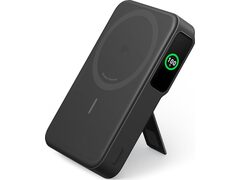
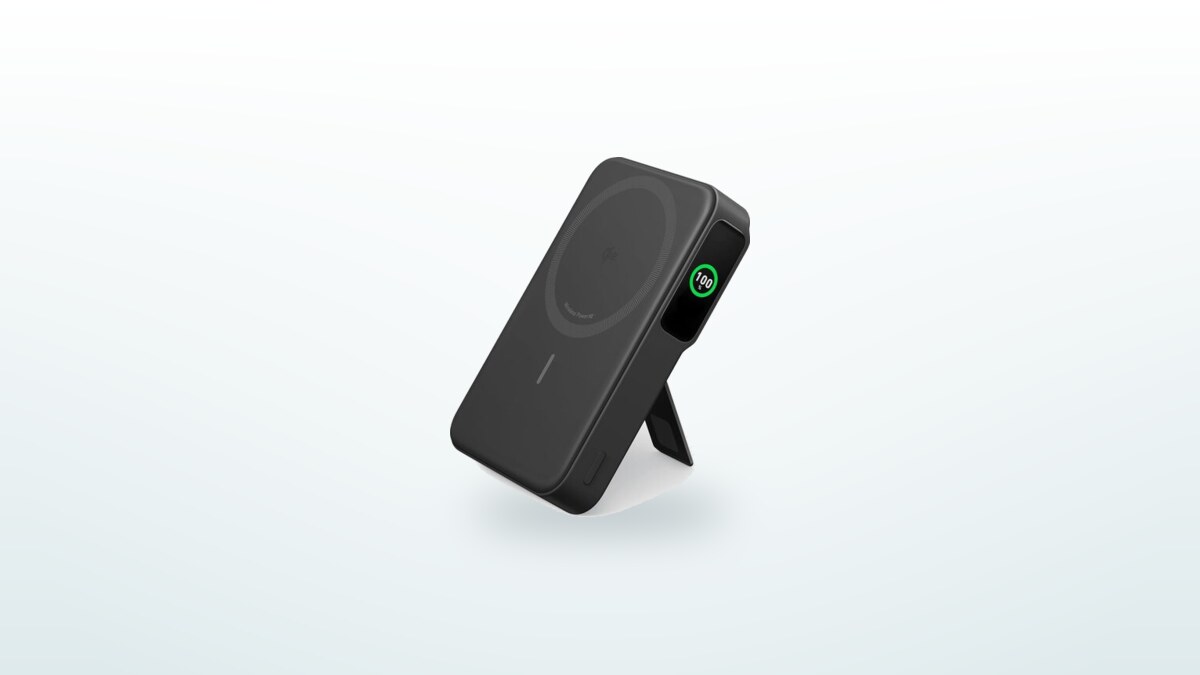
| MagGo (10K), ref. A1654 | Yes, LCD | Yes | The subject of this review, 19.8 mm thick |
| MagGo (10K) Slim, ref. A1664 | No | No | 15 mm thick, better wireless efficiency (78.3 %) |
| MagGo (10K, 35 W), ref. A1657 | Yes, different | Apple Watch cradle | 35 W total power, not 27 W |
This confusion is not theoretical: the product identification data (EAN) shown until now on this site's own product page for THIS model actually pointed to the screen-less Slim variant, an error corrected after direct verification with the partner retailer. If a technical product page can get its reference wrong, a buyer in a hurry can just as easily do the same.
The weight illustrates this possible confusion well: this model actually weighs 250 g, not the 215 g sometimes quoted, a figure that fits more with what one would expect from a slimmer version. The weight gap with the Slim version (25 % thinner, at 19.8 mm versus 15 mm thick) is not a minor detail: it is the direct cost of the built-in screen and kickstand, two additions that justify the more generous size.
Before buying, it is worth checking the exact reference (A1654 for this specific model) rather than relying on "10K" alone, and remembering that an efficiency or dimension figure found online without a stated reference often belongs, in practice, to the Slim version rather than this one.
The "35 W" model deserves a separate mention: it is aimed above all at Apple Watch owners, with a dedicated charging cradle in addition to iPhone support, and a higher total power split between the two devices charged at the same time. It is not simply a higher-power evolution of the model described here, but a product built for a different use.
A further ambiguity circulates among some European retailers, who sometimes list this same reference under the name "Anker 633 MagGo" rather than its usual commercial name. Nothing indicates that this is actually a different product rather than a simple naming variation between distributors, but the mere existence of this doubt reinforces the point that checking the reference is more reliable than trusting a commercial name for this type of product.
Qi2 and MagSafe: the same technology, two different governance models
The MagGo (10K) is Qi2 certified, the open standard from the Wireless Power Consortium introduced in late 2023. Technically, Qi2 relies on the same magnet ring and the same charging principle that Apple itself contributed to the consortium: there is no fundamental difference in how it works compared with a native MagSafe accessory.
The difference lies mainly in governance: MagSafe remains an Apple trademark, whose full 15 W speed in theory requires certification through the manufacturer's own MFi programme; Qi2 is a multi-brand standard that any manufacturer can certify through the WPC, with no licence fee owed to Apple.
A widely repeated claim online states that a MagSafe accessory not certified for Qi2 is automatically capped at 7.5 W. This claim remains plausible, but no reliable, independent confirmation was found to establish it as settled fact: worth treating with caution rather than repeating at face value.
For the buyer, the practical consequence is simple: this product reaches its advertised 15 W on a compatible iPhone without needing a specific Apple licence, since Qi2 certification is enough on its own. That is also what lets brands outside the Apple ecosystem, such as the EcoFlow already mentioned above, offer comparable products in the same segment.
A kickstand built for upright use, less so for landscape
The folding built-in kickstand lets the iPhone stand upright while it charges, a use case it handles well. In landscape position, though, this model's body, wider than the smaller formats in the MagGo range, does not always sit the phone perfectly flat.
On the long-term mechanical durability of the kickstand itself, no reliable, dated data was found to settle the question either way, the product still being too recent for enough hindsight. This point therefore stays open rather than settled.
In practice, for anyone mostly watching videos or taking video calls while charging, upright position is more than enough for the intended use. The reservation about landscape mode matters most for anyone who favours that display format day to day, for instance to follow a recipe or read subtitles comfortably.
Real warmth, but never quantified
Wireless charging generates, as on any device of this type, some warming of the phone, real but within proportions that are typical for this charging mode. No precise temperature figure was found, however: a genuine gap in the numbers rather than an identified problem.
Magnet strength has not been quantified in newtons for this specific model, and no data was found on how it holds up after several months of regular use. The manufacturer's warranty runs for two years, a standard term for this type of accessory rather than a sign of any particular commitment from the brand to the product's longevity.
27 W out, 20 W in: two speeds not to confuse
The MagGo's USB-C port works in both directions, but not at the same speed depending on the direction of flow. Outbound, to charge another device by cable, it delivers up to 27 W. Inbound, to recharge the power bank itself, it caps at 20 W.
This full recharge time, around 2 h 45, comes solely from official documentation, with no independent confirmation found elsewhere. Pass-through (using the power bank while it recharges) is stated by the manufacturer, with no data available on any power reduction during this combined use.
In practice, this asymmetry between the two speeds is nothing unusual for this type of product: it reflects charging and discharging circuits sized separately, each optimised for its own job. The key thing to remember is not to expect the mains charger to fill the battery as fast as the port empties it into another device.
Compatibility with real physical limits
For reliable alignment and charging, official documentation specifies a maximum phone case thickness of 2.5 mm: beyond that, the magnet and coil risk no longer aligning correctly through the case.
On Android, magnetic wireless charging requires a Qi2-compatible device or a compatible magnetic case; without that, only the USB-C port remains available for standard wired charging, on any device.
The device has neither a built-in torch nor water-resistance certification, two features sometimes found on other power banks on the market but absent here: a design choice consistent with a product built for indoor use and urban mobility rather than demanding outdoor conditions. A backpack or a jacket pocket remain the most natural settings for this format.
Against the Belkin BoostCharge Pro Magnetic
In the 10,000 mAh magnetic battery segment, the Belkin BoostCharge Pro Magnetic is a direct benchmark.
| Criterion | Anker MagGo (10K) | Belkin BoostCharge Pro Magnetic |
|---|---|---|
| Capacity | 10,000 mAh | 10,000 mAh |
| Wireless | Qi2 15 W | Qi2 15 W |
| USB-C | 27 W | 10 W |
| Screen | Yes | No |
| Kickstand | Yes | Yes |
The Anker keeps a clear edge on wired power (27 W versus 10 W) and on having a control screen, two concrete day-to-day advantages. Both offer a built-in kickstand for upright use.
On wireless power, both brands target the same 15 W ceiling allowed by the Qi2 standard, with no gap between them on this specific point: the difference plays out elsewhere, in wired versatility and the display, rather than in the magnetic charging speed itself.
Who it suits, and who it does not
It suits anyone with a recent iPhone who wants a versatile magnetic battery, with a control screen and a genuinely fast USB-C port as a wired backup.
It does not suit anyone after the best possible wireless efficiency within the Anker range itself (the Slim version does better on this specific point), nor anyone planning to use the kickstand in landscape position day to day, nor anyone who prioritises lightness and slimness above all for all-day pocket use.