
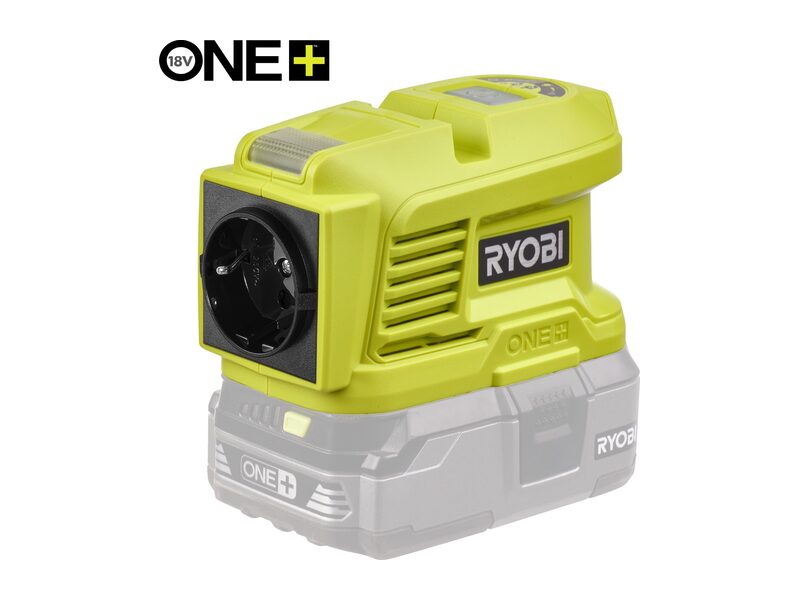

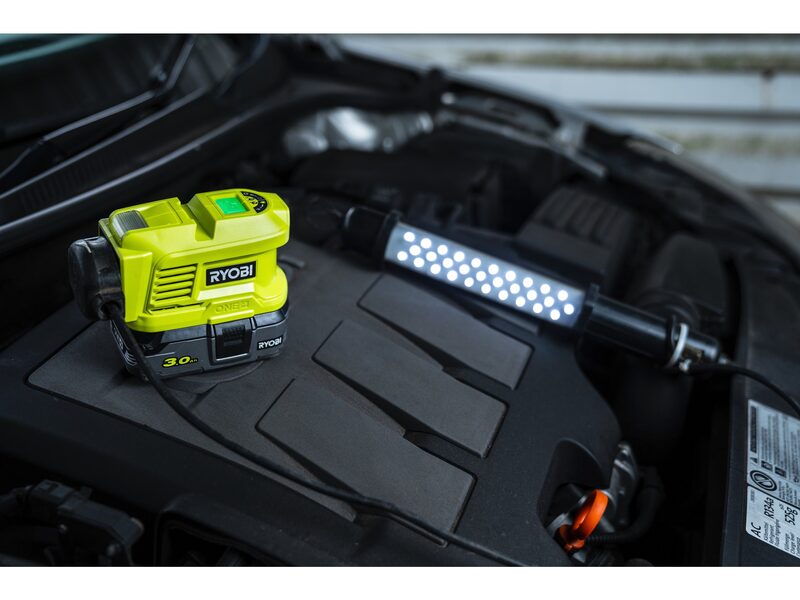
Ryobi 18V One+ 150W Power Inverter
(13 reviews)
A 230 V socket and two USB ports running off any 18V One+ battery: enough to turn a collection of tool batteries into a portable power source.
Buy at AmazonAs an Amazon Associate I earn from qualifying purchases.
Characteristics
- Output: 150 W continuous, 300 W peak
- Sockets: 1 x 230 V outlet + 2 x USB-A 2.4 A
- Power source: 18V One+ battery (not included)
- Format: 0.76 kg without battery, built-in LED lamp
- Mains power anywhere from a tool battery
Detailed overview: Ryobi RY18BI150A battery-powered inverter
The principle behind the RY18BI150A fits in one sentence: it converts the 18 volt direct current of a tool battery into 230 volt alternating current, the kind that comes out of your wall sockets. Technically it is an inverter, exactly like the one inside a power station, but sold without a battery or a storage housing. You supply the energy, it supplies the socket. The unit clips onto any Ryobi 18V One+ battery, from the small 1.5 Ah pack up to the 9 Ah, and starts with a single button.
On the output side, one European mains socket accepts up to 150 watts continuous and absorbs peaks of 300 watts, enough to swallow the inrush current of an appliance starting up. Two USB-A ports add 2.4 amps at 5 volts for a phone or a lamp. A two-setting LED lamp sits on top. In concrete terms, a 4 Ah battery, meaning 72 watt-hours, gives around twenty minutes at full power, roughly an hour for a 60 watt laptop and four hours at a 15 watt load. Conversion losses explain the gap with the theoretical figure: an inverter of this size returns about 85 % of what it draws.
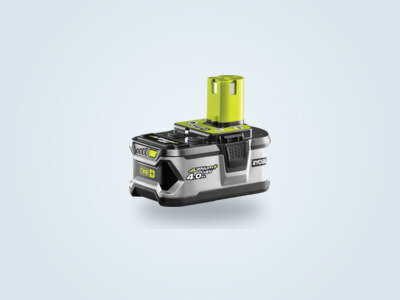
The real value lies in the ecosystem. The 18V One+ range covers more than two hundred tools and the batteries are interchangeable: the one in your drill powers the inverter, and the other way round. If you do not own one yet, or want to double your runtime in the field, our page on the Ryobi RB18L40 18V One+ battery covers the 4 Ah model used as the reference in every calculation above.
It is worth knowing what this device does not do. It does not charge the battery: it drains it. It shows no power draw reading, unlike a power station that tells you in real time what your appliances are pulling. And it holds no reserve of its own: without a charged battery to hand, it is just an empty housing.
So who is it for? For the Ryobi owner who wants to charge a camera battery at camp, run a small pump, power a work light or keep a router alive during an outage. For longer or heavier use, a proper portable power station remains the right tool, with its built-in reserve of several hundred watt-hours.
EAN: 4892210190901
Comparison
At a little under £60, the Ryobi competes with two very different families of product: the other tool-battery inverter in our catalogue, the Einhell TC-ES 18/150/1, and the entry level of self-contained power stations, here the Allpowers Volix P300. The table below sums up what you gain and lose moving between them.
| Criterion | Ryobi RY18BI150A | Einhell TC-ES 18/150/1 | Allpowers Volix P300 |
|---|---|---|---|
| Mains output | 150 W (300 W peak) | 150 W | 300 W |
| USB ports | 2 x USB-A 2.4 A | USB-A 10 W + USB-C PD 60 W | USB-A and USB-C |
| Energy available | Battery dependent (72 Wh at 4 Ah) | Battery dependent | 256 Wh built in |
| Ecosystem | Ryobi 18V One+ | Einhell Power X-Change | Self-contained |
| Weight | 0.76 kg without battery | Not stated | 3.6 kg |
| Observed price | ≈ £57 | ≈ £77 | ≈ £144 |
In short, the choice comes down first to the tools you already own: the Ryobi only makes sense with One+ batteries, the Einhell TC-ES 18/150/1 only with Power X-Change packs. At identical mains output, the Einhell takes the lead thanks to its 60 watt USB-C Power Delivery port, able to charge a modern laptop without going through the mains socket, but it costs some twenty pounds more. Against a station like the Volix P300 the trade-off is starker still: the station offers twice the power and a guaranteed reserve, the inverter offers the price, the 760 grams and above all the ability to swap batteries indefinitely. If you are heading out for several days with no charging point, take the station. If you want a backup socket in the tool bag, the Ryobi is plenty.
Related video
Video: Ryobi 150W Battery Inverter Review - UK 3 Pin Socket - RY18BI150A-0 - Published on 07/04/2021
Our tester's review: Yoni Marchal-Laporte
The RY18BI150A has to be judged for what it is: not a power station, but an accessory that gets more value out of batteries you have already bought. If you own Ryobi tools, the maths is quick. Around sixty pounds buys a self-contained 230 V socket, against a hundred and thirty to a hundred and seventy for the most modest power station, and you gain two USB ports and a lamp along the way. What strikes you in use is the flexibility rather than the endurance. Runtime is short, there is no hiding it, but it changes in nature the moment you carry two or three batteries: swapping one takes three seconds and involves no waiting, where a flat power station means hours on charge. Anyone already equipped with One+ tools usually owns that reserve without thinking about it, and is only buying the housing here. The other pleasant surprise is the size. Bare, it weighs less than a large bottle of water and slips into the tool box: you grab it at the last moment, which is not how you treat a five kilo station you have to decide to bring along. It is exactly the sort of object that ends up living permanently in the vehicle. Two reservations deserve to be known before buying. First, Ryobi does not state the waveform it produces, and nothing suggests a pure sine wave. We therefore avoid sensitive electronics, medical devices and older switching chargers in particular. Second, the housing gets noticeably hot as soon as you approach 150 watts continuous, a point raised in several independent tests, so it is better left in open air than shut inside a case. With those limits understood, it is an excellent secondary purchase, and arguably the most useful single item in the One+ range for anyone who camps or works away from a socket.
Frequently asked questions: Ryobi RY18BI150A battery-powered inverter
It depends on the pack and the load. With a 4 Ah battery, meaning 72 watt-hours, expect around twenty minutes at full output (150 W), an hour on a 60 watt laptop and four hours at a 15 watt load. A 9 Ah pack comfortably doubles those figures.
As long as consumption stays under 150 watts continuous, yes. Ryobi does not however state the waveform delivered, which is reason enough to avoid sensitive electronics such as medical equipment or older switching chargers. Resistive loads and recent power supplies pose no problem.
No, the exchange runs one way only: it consumes the battery to produce 230 V. You therefore need to keep a One+ charger on hand, or carry a second battery, which remains the system's main advantage over a power station whose reserve is fixed.
Yes. Converting 150 watts inside a housing this small inevitably produces heat, and several independent tests mention it. That is not a fault in itself, but it is better set down in open air than left in a boot or a closed bag during extended use.
Need help choosing?
Related articles
Other products in the "Power tool battery inverters" category
Einhell PXC 150W Power Inverter
See price (6)
A 230 V socket, a 60 watt USB-C Power Delivery port and a dimmable LED lamp, all running off a Power X-Change battery you already own.
Einhell PXC 150W Power Station
See price (6)
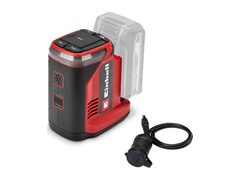
The only one in the range with a 12 V output, a car adapter lead in the box, and the ability to recharge the very battery it runs on, over USB-C.
Published on 25/07/2026, updated on 14/08/2026