
XTAR VC4L
(17 reviews)
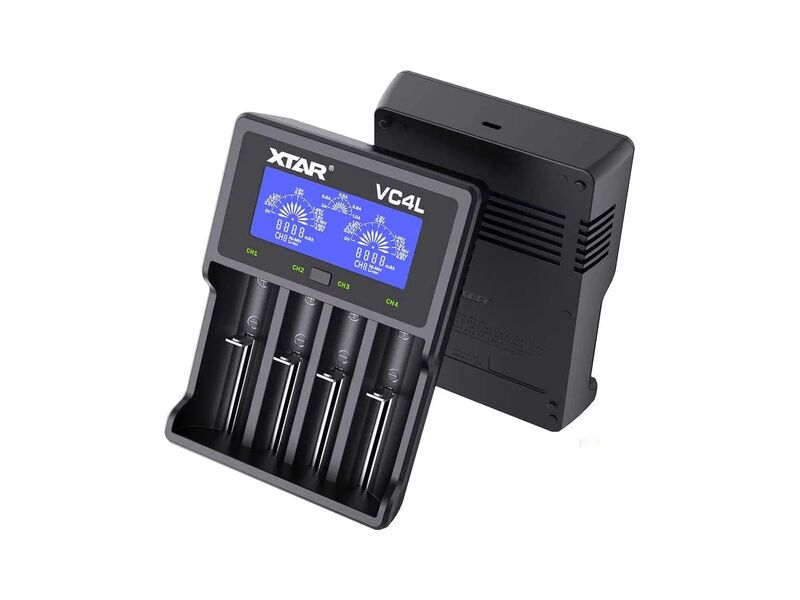
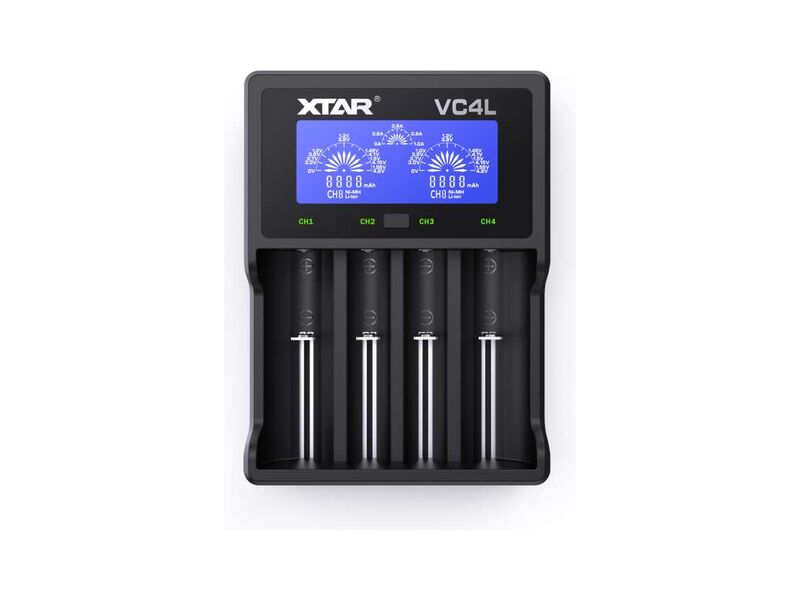
The XTAR VC4L charges up to 4 Li-ion or NiMH batteries over USB-C, with an LCD screen showing voltage, current and capacity for each bay.
Buy at AmazonAs an Amazon Associate I earn from qualifying purchases.
Characteristics
- Bays: 4 independent bays
- Power input: USB-C, 5V/2.1A
- Charging current: 1A max (CH1 & CH4), 0.5A otherwise
- Compatibility: Li-ion 10440 to 32650 (protected 21700) + NiMH AA/AAA
- Detailed LCD screen, supports protected 21700 cells
Detailed overview: XTAR VC4L USB-C battery charger
The XTAR VC4L is a universal 4-bay charger for Lithium-ion batteries and NiMH cells, designed for torch users, vapers and photography enthusiasts who juggle several battery formats on a daily basis. It automatically detects the chemistry of each inserted battery and applies the right charging profile on its own, with nothing to configure.
Its compatibility spans a wide range of cylindrical formats. For 3.6/3.7V Lithium-ion: 10440, 14500, 16340, 18350, 18650, 20700, 21700 (including longer protected cells) and up to 32650. For 1.2V NiMH/NiCd: AA, AAA and other common formats. Each bay works independently, so you can mix a Li-ion cell with a NiMH battery, or a heavily discharged cell with an almost full one, without affecting the charging of the others.
Power comes via USB-C, a genuine plus for a charger launched back in 2021: plug it into a standard mains charger, a power bank or a car socket fitted with a USB-C port. Charging current is managed automatically, from 0.1A to 1A: bays 1 and 4 can each reach up to 1A, but as soon as a battery is inserted into bay 2 or 3, all four channels drop to 0.5A. That is the trade-off XTAR made to keep the device simple and affordable, without a more complex conversion stage.
The LCD screen remains the VC4L's strong point: for each bay it displays battery voltage, current charging rate, capacity already charged in mAh and the detected battery type. This makes it easy to track charging progress precisely, rather than guessing from a single LED. The VC4L does not, however, offer an internal resistance test or real capacity measurement, features reserved for its bigger sibling, the VC4SL.
Compact (149 x 115 x 35mm) and light (210g), the XTAR VC4L remains a good choice for anyone who wants a reliable, easy-to-read multi-format charger for everyday use, without paying for analysis features they will not use.
Full specifications
Detailed characteristics
Charging capacity
| Number of slots?Number of batteries that can be charged at the same time. | 4 |
|---|---|
| Compatible formats?Accepted battery formats (AA, AAA, 18650, 21700...). | AAAA, AAA, AA, C, D, 10440, 14500, 14650, 16340, 17350, 17500, 17670, 18350, 18490, 18500, 18650, 18700, 20700, 21700, 22650, 25500, 26650, 32650 |
| Compatible chemistries?Recognised battery chemistries (Li-ion, LiFePO4, NiMH, NiCd...). | Li-ion, NiMH, NiCd |
| Max charging current?Maximum charging current per slot, in milliamps. | 1000 mA |
| Adjustable charging current?The user can manually pick the charging current. | No |
| Independent charging per slot?Each slot manages its own charge, independent of the other cells (different formats and chemistries can be mixed). | Yes |
Power input
| Power source?Built-in mains plug, USB port (Micro-USB or USB-C) or 12 V car socket. | USB-C |
|---|
Output and features
| USB output (device charging)?The charger can also act as a power bank: it uses the inserted cells to charge another device. | No |
|---|
Display and diagnostics
| Display?Type of visual feedback on charging status. | Detailed LCD screen |
|---|---|
| Automatic chemistry detection?The charger automatically adapts its charging profile to the inserted cell, with no manual setting. | Yes |
| Test / repair functions?Advanced functions beyond plain charging: real capacity measurement, internal resistance, reconditioning of worn cells, discharge cycles. | Reconditioning / revival |
Size
| Weight?Weight of the empty charger, in grams. | 234 g |
|---|---|
| Dimensions (L × W × H)?Length × width × height, in millimetres. | 154 × 115 × 34 mm |
Comparison
Alongside the XTAR VC4L, several universal 4-bay chargers come up in searches for "VC4L vs VC4SL" or "best cheap 18650 charger": its own bigger sibling the XTAR VC4SL, the Nitecore UM4 and the MiBoxer C4-12. Here is how the VC4L compares with these three alternatives.
| Criterion | XTAR VC4L | XTAR VC4SL | Nitecore UM4 | MiBoxer C4-12 |
|---|---|---|---|---|
| Bays | 4 | 4 | 4 | 4 |
| Power input | USB-C 5V/2.1A | USB-C 5V/2.1A + QC3.0 | USB-C 5V/2A | Micro-USB 5V/2A |
| Max charging current | 1A (bays 1 & 4), 0.5A otherwise | up to 3A (1 battery) | 1.5A (1 battery), 0.5A (4 batteries) | up to 3A per bay |
| LCD screen | Voltage, current, capacity, type | + internal resistance | Voltage, current, type | Voltage, current, type |
| Internal resistance / capacity test | No | Yes | No | No |
| Observed price | £21.99 | £32.99 | ≈ £24 | ≈ £28 |
Overall, the XTAR VC4L remains the simplest and most affordable USB-C option for charging 18650 cells or NiMH batteries without any fuss, with an LCD screen that is noticeably clearer than average. The VC4SL wins out once you want to analyse your batteries (internal resistance, real capacity) and charge faster, at a higher price. The MiBoxer C4-12 charges faster across all four bays at once but still relies on Micro-USB, and the Nitecore UM4 is a fair competitor but slower once several batteries charge in parallel.
Related video
Video: Xtar VC4L USB-C universal charger Review - Published on 13/06/2021
Our tester's review: Christophe Delpuech
The VC4L earned a spot in our charger drawer for topping up both the 18650s from our torches and the AA batteries from our controllers. First nice surprise: it plugs in via USB-C, just like our phones, so no need to hunt for a proprietary cable. The LCD screen is clear, with each bay showing its own voltage and current at a glance, handy for spotting a cell that charges slower than the others. We liked being able to mix a protected 21700 and two NiMH batteries in the same batch without any issue. The one real downside: as soon as you use the middle bays, all four channels drop to 0.5A, so a full charge of 4 batteries can easily take well over two hours. We also missed an internal resistance test, useful for sorting out ageing cells. For everyday use on a tight budget, the VC4L remains a reliable, easy-to-read charger that we recommend without hesitation to anyone who does not need advanced analysis tools.
In-depth review XTAR VC4L: our full review 3.9/5 Read our full review → Actual charging current not measured Battery compatibility not measured Safety and protections 3.8 Build and endurance 3.8 Cables and connectors not measured Actually delivered power not measured Multi-port power sharing not measured Protocol compatibility not measured Size and technology not measured Format and chemistry compatibility 4.5 Charging precision 3.2 Display and control 4.5Frequently asked questions: XTAR VC4L USB-C battery charger
3.6/3.7V Lithium-ion cells from 10440 to 32650, including protected 21700 cells, as well as 1.2V NiMH/NiCd batteries in AA and AAA formats. The charger automatically detects the chemistry of each inserted battery.
No. Unlike its bigger sibling the VC4SL, the VC4L only displays voltage, current and charged capacity. For an internal resistance test, you need the VC4SL.
Through a USB-C port, compatible with any mains charger, power bank or car socket delivering 5V. Bays 1 and 4 can each charge at up to 1A.
Yes, this is exactly what sets the VC4L apart from the basic VC4: its bays are long enough to fit protected 21700 cells, which are longer than bare cells.
Yes. All four bays are independent, so you can freely mix Li-ion and NiMH cells, or different capacities, without affecting the other channels.
Related articles
Other products in the "Battery chargers (AA/AAA/18650)" category
Ansmann Powerline 5 Pro charger
See price (17)
The charging and reconditioning station for enthusiasts: all formats (AA to D, 9V), LCD screen and test, discharge and refresh programmes to maintain your batteries.
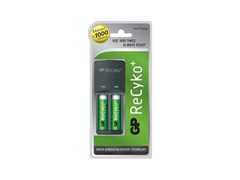
GP ReCyko AR02 charger
£8.54 (11)
The clever entry-level charger: simple, compact and affordable, supplied with 2 ReCyko AA cells ready to use. Perfect to start with rechargeables.
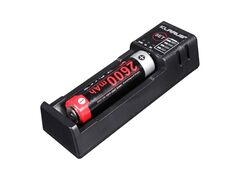
Klarus K1 Charger
See price (6)
The Klarus K1 charges your Li-ion cells and NiMH or NiCd batteries over USB from a single bay, with a clear LED indicator you can trust.
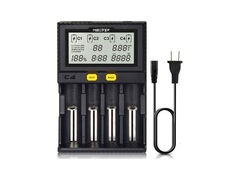
MiBoxer C4 Charger
See price (27)
The MiBoxer C4 charges 4 cells at once, shows voltage, current and capacity on its LCD screen, and even handles LiFePO4: the clever universal charger.
Published on 01/09/2026