
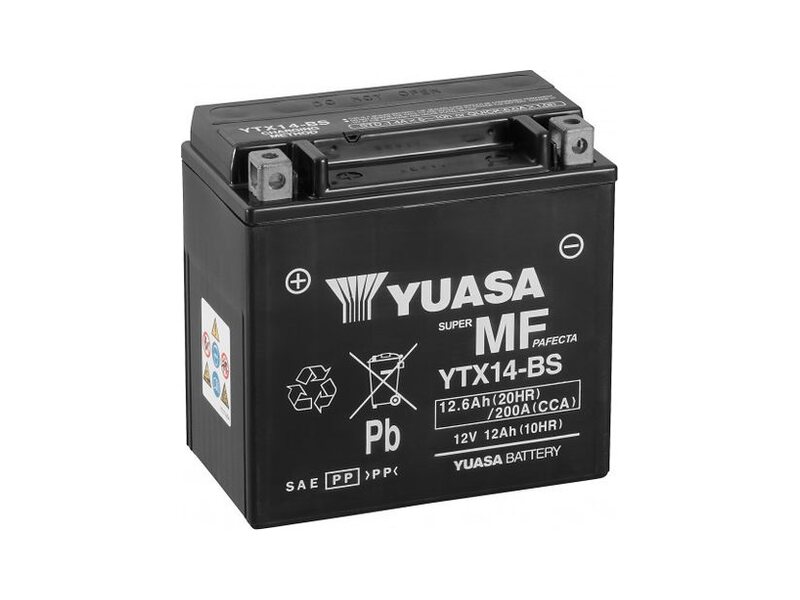
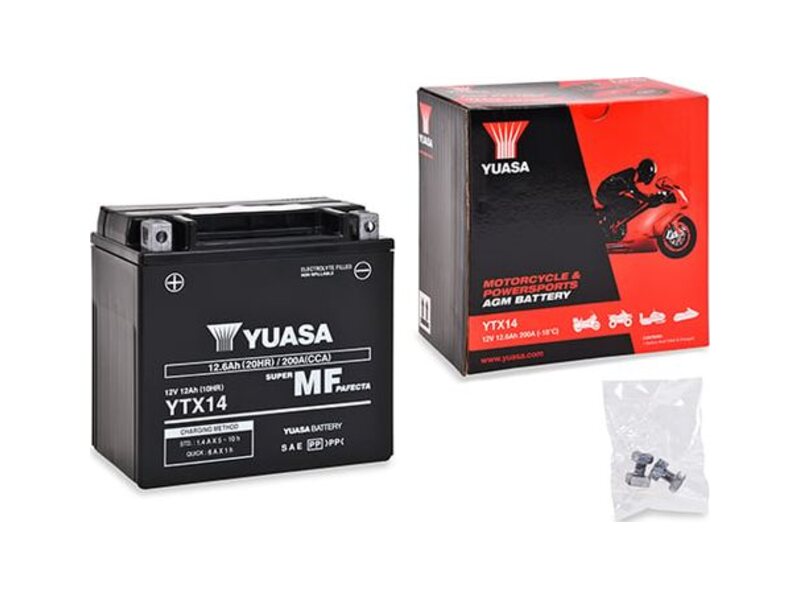
Yuasa YTX14-BS 12V 12 Ah
(6 reviews)
Two hundred cranking amps: the reference that spins big twins, cruisers and adventure bikes where a YTX9 starts to struggle.
Buy at AmazonAs an Amazon Associate I earn from qualifying purchases.
Characteristics
- Capacity: 12 V, 12 Ah (200 cranking amps)
- Technology: Sealed AGM (VRLA), maintenance free
- Format: 150 x 87 x 145 mm, 4.6 kg
- Polarity: Positive terminal on the left
- 200 A, the reference for big-capacity bikes
Detailed overview: Yuasa YTX14-BS AGM motorcycle battery 200 A
The Yuasa YTX14-BS is a 12 volt starter battery for large-capacity machines: cruisers, adventure bikes, sports tourers, utility quads, ride-on mowers and leisure boats. It is rated at 12 amp-hours over the 10 hour rate, 12.6 amp-hours over 20 hours, and 200 cold cranking amps.
That cranking figure is its whole reason for existing. A large high-compression twin demands a current peak the smaller references cannot supply: where a YTX9-BS tops out at 135 amps, the YTX14-BS delivers 200. The higher capacity, meanwhile, absorbs the constant drains of a recent motorcycle, from the ECU to the alarm.
The technology is sealed AGM, also called VRLA. The electrolyte is held in a glass-fibre separator and the plates use a cast calcium-calcium alloy: no topping up, good resistance to the vibration of a big single or twin, and no leakage if tilted. The case measures 150 x 87 x 145 mm for 4.6 kilos, with the positive terminal on the left and type 5 terminals.
The battery ships dry, with a 0.69 litre acid bottle. Activation happens once, at fitting: pour in the electrolyte, let it settle, then charge fully before first use. That initial charge determines the capacity the battery will subsequently reach.
Take care not to confuse it with the neighbouring YTX14H-BS, YTX14AH-BS or YTX14AHL-BS references, whose dimensions and performance differ. For a mid-capacity machine the YTX9-BS is enough, and for a 125 or a scooter it is the YTX7L-BS. Finally, a trickle charger such as the Bosch C30 or the Einhell CE-BC 4 M markedly extends its service life.
EAN: 5050694004513
User manual / Instructions for use
Comparison
The battery format is dictated by the bike: the table shows what stepping up buys you, and helps avoid mixing up neighbouring references.
| Criterion | Yuasa YTX14-BS | Yuasa YTX9-BS | Yuasa YTX7L-BS | Generic equivalent |
|---|---|---|---|---|
| Capacity | 12 Ah | 8.4 Ah | 6 Ah | Variable |
| Cold cranking | 200 A | 135 A | 100 A | Often overstated |
| Dimensions | 150 x 87 x 145 mm | 150 x 87 x 105 mm | 115 x 72 x 132 mm | By reference |
| Weight | 4.6 kg | 3.1 kg | 2.5 kg | Variable |
| Observed price | ≈ £77 | ≈ £62 | ≈ £56 | ≈ £30 to £38 |
Stepping from the YTX9-BS to the YTX14-BS is not a choice: the two cases share a footprint but not a height, and the bike's battery housing decides. What the comparison does show is the price of current: a modest premium buys fifty per cent more amps and an extra kilo and a half of lead. Against generic equivalents sold for around thirty-five pounds, the reasoning is the same as across the range: the dimensions match, the durability does not, and on a large machine the dismantling needed to reach the battery makes a false economy expensive.
Our tester's review: Gilles Caron
On a large-capacity machine the battery works far harder than on a 125. It has to spin a twin of over a litre with high compression, often after several weeks standing, and meanwhile feed an alarm, a tracker, a digital dashboard and sometimes heated grips. That is exactly the brief of the YTX14-BS, and the figure that counts is not its 12 amp-hours but its 200 cold cranking amps: half as much again as a YTX9-BS. That current reserve is the difference between a starter that turns lazily and an engine that fires first time on an October morning. Sealed AGM technology is particularly relevant here. Cruisers and big adventure bikes vibrate, run hot and tilt their battery inside cramped housings: electrolyte held in a glass-fibre separator does not leak, needs no topping up and copes better with shaking than a flooded battery. The 4.6 kilos and the tall 145 millimetre case simply reflect the amount of lead needed to deliver those 200 amps. Three things to know. The battery ships dry with its 0.69 litre acid bottle: activation happens at fitting, with gloves and goggles, and a full charge is mandatory before first use. Second, the YTX14-BS reference is not the same as the YTX14H-BS or the YTX14AHL-BS despite the similar names: dimensions and performance differ, and several retailers' catalogues keep that confusion alive. Finally, on a machine that hibernates, a trickle charger remains the best way to protect the seventy-five pounds invested here.
In-depth review Yuasa YTX14-BS: our full review 4.3/5 Read our full review → Current actually delivered 4.4 Cold-weather performance 4.4 Capacity and versatility 4.2 Safety and protections 4.4 Build and endurance 4.1 Measurement accuracy not measured Connectivity and app not measured Compatibility and installation not measured Actual charging current not measured Battery compatibility not measured Control and programming not measured Output signal quality not measured Standby consumption not measured Actual available power not measuredFrequently asked questions: Yuasa YTX14-BS AGM motorcycle battery 200 A
They are two distinct references despite the similar names. The H version offers higher capacity and cranking current, with dimensions that are not identical. Always check the marking on your original battery rather than trusting a near-matching name.
Yes, that is mandatory. The battery arrives dry with a 0.69 litre acid bottle: after pouring in the electrolyte and letting it settle, a full charge is required. Without it the battery will never reach its rated capacity.
Because a large high-compression twin demands a far higher current peak than a 600 cc four, especially when cold. It is that figure, not the amp-hour capacity, which decides whether the engine fires first time in winter.
Three to four years in regular use. On a machine that hibernates for months, a trickle charger connected during the break is the best possible investment: a battery this size left flat sulphates and permanently loses part of its capacity.
Other products in the "Motorcycle batteries" category
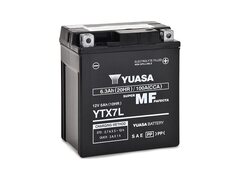
Yuasa YTX7L-BS 12V 6 Ah
See price (4)
The small battery fitted to half the 125s and scooters on European roads: tall and narrow, 100 cranking amps, and the seriousness of an original-equipment maker.
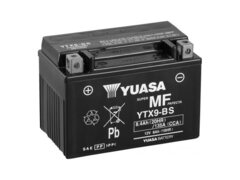
Yuasa YTX9-BS 12V 8.4 Ah
See price (15)
The factory-fitted reference on many mid-capacity motorcycles and maxi-scooters: sealed AGM, 135 cranking amps, and the reliability of a century-old maker.
Published on 26/07/2026, updated on 14/08/2026