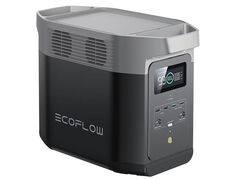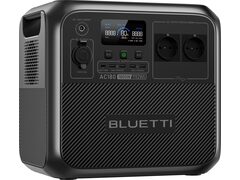

Two portable power station stars, face to face
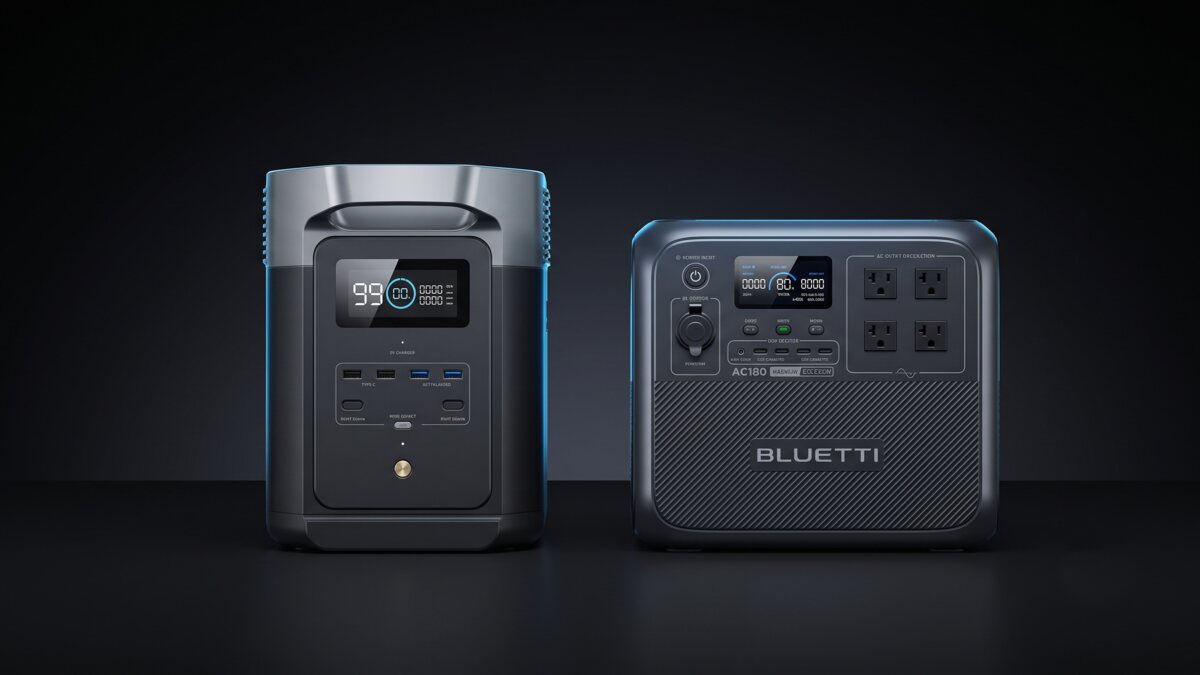
In the fiercely contested 1,000 Wh power station segment, two models come up again and again in searches and conversations: the EcoFlow Delta 2 and the Bluetti AC180. Both target the same audience (motorhome, power cuts, mobile working, DIY away from an outlet) and play in the same price range. Yet they make different choices.
Good news up front: there is no bad choice here, only a choice better suited to your use. Here, point by point, is what really sets them apart.
The essentials in one table
| Criterion | EcoFlow Delta 2 | Bluetti AC180 |
|---|---|---|
| Capacity | 1,024 Wh | 1,152 Wh |
| Chemistry | LiFePO4 | LiFePO4 |
| AC output | 1,800 W (up to 2,400 W with X-Boost) | 1,800 W (2,700 W peak) |
| Mains charge (0 to 80 %) | ~50 min | ~45 min (Turbo mode) |
| Cycles (to 80 % capacity) | ~3,000 | ~3,500 |
| Expandable | Yes, up to 3,040 Wh | No |
| Wireless charging | No | Yes (15 W pad) |
| Weight | ~12 kg | ~16 kg |
Manufacturer specifications, indicative figures. Exact values are on each product page.
These are the manufacturers' figures. We also measured the energy each station actually delivers: 930 Wh for the Delta 2 (rated 4.4 out of 5) and 1,030 Wh for the AC180 (rated 4.2 out of 5), a real-world gap of 11 % rather than the 12 % on the spec sheet. The full measurements are in our Delta 2 review and our AC180 review, among all our product reviews.
Capacity and runtime: the AC180 edges ahead
With 1,152 Wh versus 1,024 Wh, the Bluetti AC180 carries about 12 % more energy. On paper, that translates into a little more runtime for the same devices.
What does 1,000 Wh actually get you? Enough to recharge a smartphone around fifty times, run a laptop about ten times, keep a small camping fridge going all night, or power a router and a TV for a whole evening. For a weekend in a van without electricity, it is comfortable for two people.
The real difference lies elsewhere: the EcoFlow Delta 2 is expandable up to 3,040 Wh thanks to add-on batteries. If your needs grow (holiday home, extended runtime), that is a major asset. The Bluetti AC180 is not modular: what it offers out of the box is what you will always have.
Output power: enough to run (almost) anything
Both stations deliver 1,800 W continuous, which covers the vast majority of household appliances: kettle, coffee maker, power tools, a small microwave. The difference is in how they handle start-up surges.
The Bluetti AC180 absorbs peaks up to 2,700 W thanks to its Power Lifting feature, handy for starting a slightly greedy resistive appliance. The EcoFlow Delta 2 answers with X-Boost technology, which adapts the voltage to run appliances up to 2,400 W by slightly limiting their power.
Charging: EcoFlow's home turf
This has historically been EcoFlow's strong suit, and the Delta 2 does not disappoint: its X-Stream technology takes it from 0 to 80 % in about 50 minutes on a simple mains outlet, and to 100 % in a little over an hour. It is spectacular, and very useful when you have a short charging window before heading off again.
The Bluetti AC180 is no slouch either: its Turbo mode also targets 45 minutes to reach 80 %. Both stations also recharge from solar (up to 500 W for the Delta 2, 500 W as well for the AC180), from the car's cigarette lighter, or by combining mains and solar.
Want to recharge from the sun? Take a look at our selection of portable solar panels, compatible with both stations.
Lifespan: LiFePO4, a promise of longevity
Key shared trait: both stations use LiFePO4 (lithium iron phosphate) cells, a chemistry renowned for its safety and endurance. Where a conventional lithium battery starts to fade after a few hundred cycles, LiFePO4 lasts far longer.
The Bluetti AC180 claims around 3,500 cycles before dropping to 80 % of its original capacity, versus 3,000 cycles for the EcoFlow Delta 2. In both cases, that means about a decade of regular use. This LiFePO4 longevity advantage is well documented by the specialists at Battery University. To understand what really sets these chemistries apart, read our feature Li-ion vs LiFePO4.
Everyday practicality: weight, screen, app
This is where the personalities show. The EcoFlow Delta 2 is lighter (about 12 kg versus 16 kg), a gap that matters when you move it often between home, car and campsite. It also offers more AC sockets (six versus four).
The Bluetti AC180 replies with a clever touch: a wireless charging pad on top, to set a Qi-compatible phone straight down. A small luxury you appreciate daily. Both stations are controlled from a mobile app (Bluetooth and Wi-Fi) and clearly show, on their screen, incoming and outgoing power and remaining runtime.
The verdict: which one should you pick?
There is no outright winner, but two clearly distinct profiles:
- Choose the EcoFlow Delta 2 if charging speed is your priority, if you want the lightest station to carry, or if you plan to grow your capacity later thanks to modularity.
- Choose the Bluetti AC180 if you value a little more runtime and longevity from the start, the highest surge power, and the convenience of built-in wireless charging.
Either way, you are investing in a reliable, safe and durable station. Your real-world use (frequent mobility and express charging on one side, runtime and ruggedness on the other) will tip the balance. To broaden the comparison, explore our whole portable power stations range.