
What is bidirectional charging?
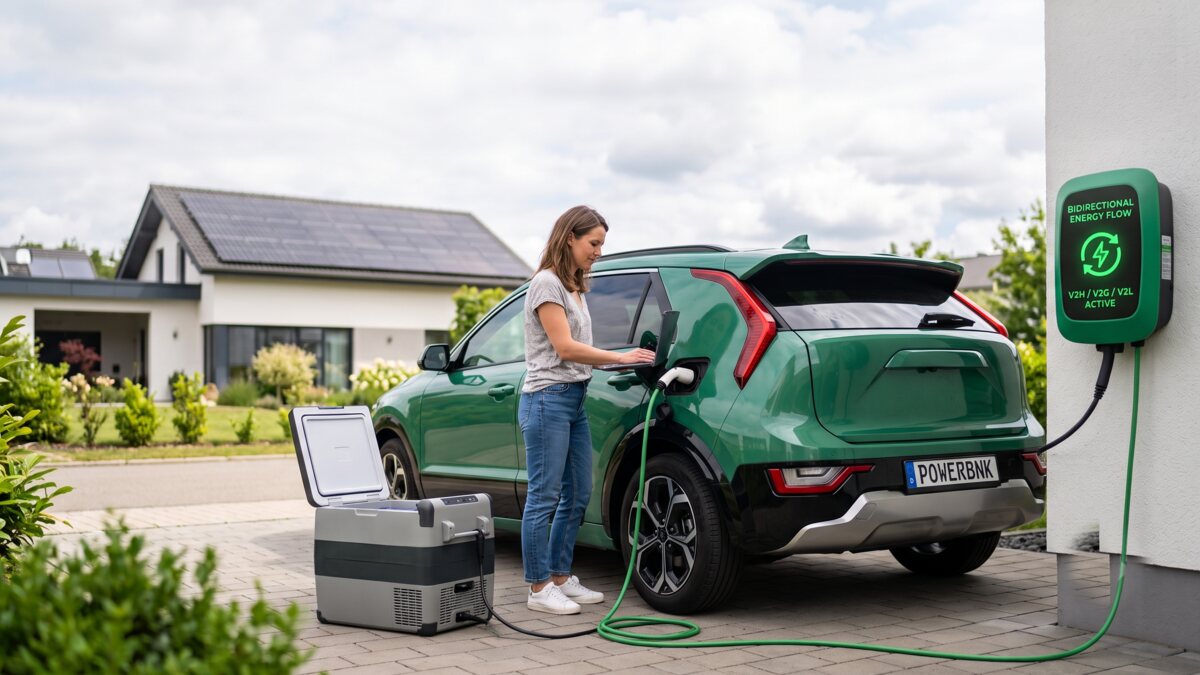
A classic charger only makes a one-way trip: it takes electricity from the grid and stores it in your vehicle's battery. Bidirectional charging reverses that flow: your car can also give energy back. It is the equivalent of a big power bank on wheels, but at a whole other scale.
To make this flow bidirectional, the vehicle's on-board charger (OBC) must be able to work as an inverter: it converts the battery's direct current (DC) into alternating current (AC) usable by a home or a grid. Not all vehicles are equipped for it today, but the number of compatible models grows every year.
In ten years of testing and selling portable power solutions, we have never seen a technology progress so fast. Bidirectional charging, long confined to prototypes, became a commercial reality from 2020 with Nissan, then Toyota, Hyundai, Kia, Ford and Volkswagen.
V2G, V2H, V2L: what are the differences?
These three acronyms describe three distinct uses of bidirectional charging. Here is how to tell them apart.
| Acronym | Meaning | Energy flow | Typical use case | Equipment needed |
|---|---|---|---|---|
| V2G | Vehicle to Grid | Car to power grid | Sell energy back to the grid at peak hours | Grid-approved bidirectional charger + supplier contract |
| V2H | Vehicle to Home | Car to home | Power the home at night with energy charged off-peak | Home bidirectional charger + dedicated panel |
| V2L | Vehicle to Load | Car to any device | Run a fridge, a drill or a power station on site or camping | V2L cable or 230 V socket built into the vehicle |
V2L is the simplest and most accessible form today: several cars (Hyundai Ioniq 5, Kia EV6, Ford F-150 Lightning) have a 230 V socket built into the boot or under the floor. No special charger needed, just a cable.
V2H requires a home bidirectional charger (expect 2,000 to 5,000 EUR for the installation) and an electrical panel adapted to isolate the home from the grid during an outage. V2G additionally implies a commercial agreement with your energy supplier.
Which protocols and technical standards?
For the car and the charger to "understand each other" in both directions, a standardised communication protocol is needed. Two big families coexist today.
CHAdeMO is the Japanese standard, the pioneer of V2G. The Nissan Leaf has been its ambassador since 2013. It uses dedicated communication between the vehicle and the charger, reliable and proven. Its drawback: the CHAdeMO connector is fading in Europe, replaced by CCS (Combined Charging System) and the recent NACS (Tesla/SAE J3400).
ISO 15118 (nicknamed "Plug & Charge") is the international standard on the rise. It enables automatic authentication of the vehicle and supports bidirectional flow (the -20 profile for bidirectional DC). Most European and Korean makers are migrating to it. The ISO 15118-20 standard, published in 2022, is the current reference for high-power bidirectional DC.
Alongside these two families, CCS Combo 2 (dominant in Europe) integrates the ISO 15118 layer and will be the main gateway to V2G in France and Germany in the coming years. A few makers such as Volkswagen (ID.Charge 2.0) and BMW have already announced software updates enabling V2H on their recent models.
Which vehicles are compatible today?
The market has grown considerably since 2023. Here are the flagship models available in Europe with their real bidirectional capabilities.
| Model | Battery | Native V2L | V2H/V2G | Max V2G power |
|---|---|---|---|---|
| Nissan Leaf (2nd gen.) | 40 or 62 kWh | No | V2H via CHAdeMO | 6 kW |
| Hyundai Ioniq 5 | 58 or 77.4 kWh | Yes (3.6 kW) | V2H (market-dependent) | 3.6 kW |
| Kia EV6 | 58 or 77.4 kWh | Yes (3.6 kW) | V2H (market-dependent) | 3.6 kW |
| Ford F-150 Lightning | 98 or 131 kWh | Yes (7.2 kW) | V2H Ford Intelligent Backup | 9.6 kW |
| Volkswagen ID.4 (2025+) | 77 kWh | No | V2H via update (ISO 15118) | 11 kW |
| Toyota bZ4X | 71.4 kWh | No | V2H (Japan, EU rollout) | 6 kW |
On the electric car accessories side, V2L cables compatible with the Ioniq 5 / EV6 are available from around 150 EUR. For full V2H, specialised chargers like the Wallbox Quasar 2 (CCS, for ISO 15118 vehicles) are gaining ground; bidirectional CHAdeMO solutions, historic with the Nissan Leaf, are becoming rare as that connector disappears in Europe.
How much energy can your car give back?
This is the key question: what does an EV battery's capacity really amount to in home use? Here are some concrete benchmarks.
An average French home consumes around 11 kWh/day (source: ADEME). A Hyundai Ioniq 5 with a 77 kWh battery could therefore cover 7 days of consumption if full... but of course, you need the car to drive! In practice you keep 20 to 30 % of the battery for trips and give back 50 to 70 % depending on needs. Result: 38 to 54 kWh available for the home, that is 3 to 5 days of autonomy during an outage or for tariff optimisation.
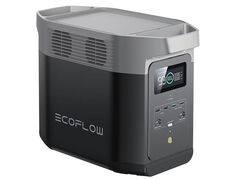
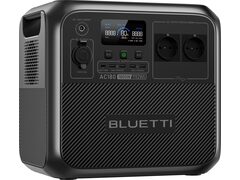
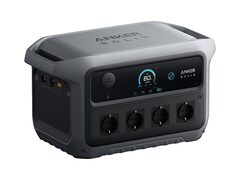
Compare that with the best portable power stations on the market: an EcoFlow DELTA Pro offers 3.6 kWh expandable to 25 kWh with extension batteries. Useful, but far from an EV's 77 kWh. The car remains the cheapest option per stored kWh, simply because the battery is already there.
Watch out, though, for charge cycles: each full charge/discharge cycle slightly wears the battery. Most makers (Hyundai, Nissan) confirm that V2H use is covered by the battery warranty, provided you stay within the recommended charge ranges (generally 20-80 % of total capacity).
How to install a V2H system at home?
Switching to bidirectional charging at home takes a few steps. Here is the typical journey in France in 2026.
1. Check your vehicle's compatibility. Consult the official spec sheet or the owner community. Some models need a paid software update or an additional hardware module.
2. Choose the right bidirectional charger. The current reference is the Wallbox Quasar 2 (bidirectional CCS, for ISO 15118 vehicles, a few thousand euros), and bidirectional AC chargers like the Easee Charge are coming (rollout planned for late 2026). For a Nissan Leaf on CHAdeMO, compatible bidirectional chargers are hard to find. Expect 1,500 to 3,000 EUR for installation depending on the complexity of the electrical setup.
3. Adapt your electrical panel. A V2H system needs an energy management system (EMS) and an automatic grid cut-off (to protect grid technicians during outages). This step is mandatory and must be carried out by a certified electrician.
4. Combine with solar if possible. Pairing solar panels + car battery + V2H is the ideal combination: you recharge the EV with your solar production and give it back at night. Our solar guides detail the best kits compatible with this kind of setup.
5. Negotiate a demand-response or V2G contract. Several suppliers are testing "flexible energy" contracts in France that pay you to inject energy at peak hours. In 2026 these offers are still experimental in France, but already commercial in the UK (Octopus Energy) and the Netherlands.
V2L in the field: the ultimate power bank for nomads
For those who have no home to power, V2L is already a concrete revolution. A 230 V socket in the boot of your Ioniq 5 or EV6 means 3.6 kW available at all times: enough to run a camping fridge, a laptop, a drill and a small portable air conditioner at once.
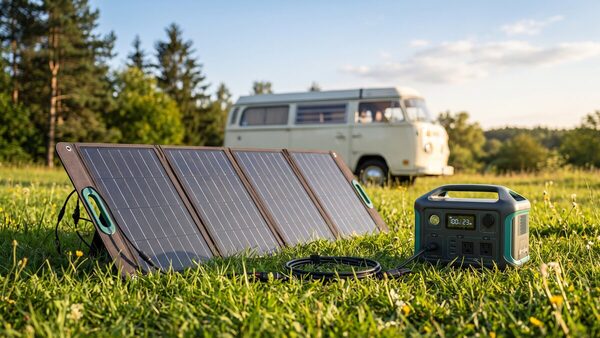
The applications are endless: sites with no mains supply, festivals, van life, wild camping, emergency response, powering heavy photo/video gear. Adapter cables even let you plug in solar chargers or recharge a portable power station for an extra buffer when the car is parked far from the point of use.
Beware of one often-forgotten point: overload protection. The built-in V2L of electric cars usually includes an electronic breaker (BMS, Battery Management System), but it is better not to exceed 80 % of the rated power in prolonged use. Avoid plugging in at once devices whose combined draw exceeds the maximum power stated by the maker.
What future for bidirectional charging?
Bidirectional charging is redefining the role of the electric car in our everyday energy life. A few trends to watch for 2026-2030.
Integration into smart grids is V2G's great promise. Millions of EV batteries connected to the grid could partly replace peaking plants, cutting CO2 emissions and stabilising prices. Pilot projects already exist in Germany (Elli/VW project), the Netherlands (The New Motion) and Japan (Nissan-Enel). The International Energy Agency highlights V2G's considerable potential: millions of connected vehicles form a flexible storage capacity that could support the grids by 2040.
Standardisation is speeding up. The ISO 15118-20 standard and the rollout of the OCPP 2.0.1 protocol (Open Charge Point Protocol) will harmonise exchanges between vehicles, chargers and operators. Europe has built V2G into its AFIR (Alternative Fuels Infrastructure Regulation) directives, requiring member states to prepare their grids.
Bidirectional charger prices will fall. Just as portable power stations went from 3,000 EUR to under 500 EUR in five years, V2H chargers should reach 1,500 EUR all-in before 2028, according to maker estimates. Democratisation is under way.