
Which power station for a camping fridge?
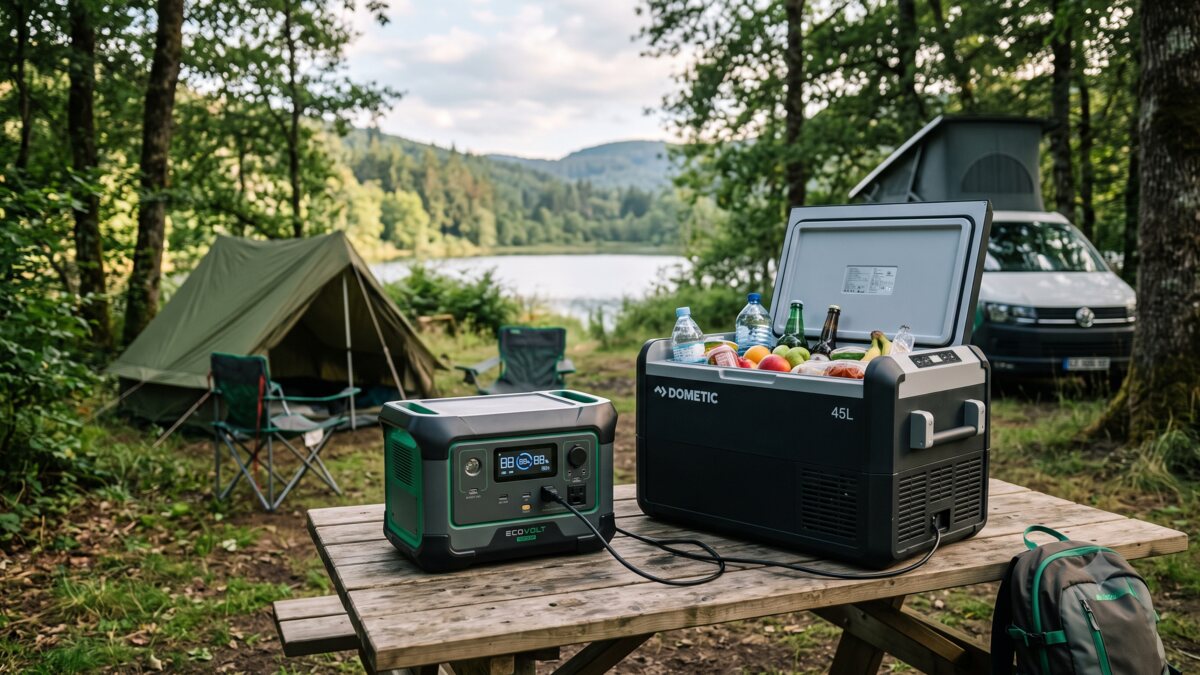
To power a compressor camping fridge for a weekend, aim for a power station of roughly 500 to 700 Wh. That capacity covers most 30 to 50 litre compressor coolers, provided you set off with an already cold unit and keep it out of direct sun. For a single night, 250 to 300 Wh can be enough. For three to five days without recharging, 1,000 Wh or an added solar panel becomes far more comfortable.
In ten years testing and selling off-grid power solutions, we have found that the decisive figure is not the power rating in watts, but the energy stored in watt-hours, written Wh. A 600 Wh station can deliver 600 watts for one hour in theory, or 60 watts for ten hours. In practice, you have to subtract the conversion losses and keep a safety margin.
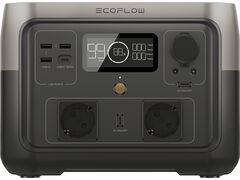
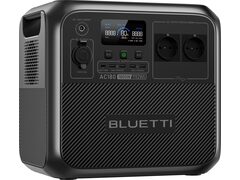
A portable power station is the simplest format: it bundles a battery, a BMS, 12 V, USB and sometimes 230 V outputs, plus an inverter. For a fridge designed for 12 V or 24 V, use its native DC socket first: you avoid the losses of converting to 230 V. Ordinary power banks remain fine for phones and tablets, but rarely for a fridge, lacking a stable 12 V output or enough capacity.
Another option, for anyone who would rather skip that calculation and the link between two separate devices: electric coolers with a built-in removable battery, such as the EcoFlow Glacier or the Anker SOLIX EverFrost 2, carry their own energy reserve directly. Our partner all-cool.net, a specialist in cooling and freshness, covers this trend of battery-integrated coolers in detail.
How to calculate the real runtime?
The useful calculation is: runtime in hours = the station's usable capacity in Wh divided by the fridge's average consumption in W. If the label or manual gives a consumption in Wh per 24 hours, it is even more direct: usable capacity divided by daily consumption, then multiply the result by 24.
A realistic example: your compressor cooler draws 400 Wh over 24 hours. A 600 Wh station used on the 12 V socket delivers roughly 510 to 540 usable Wh depending on its electronics and the cable. It will therefore run the fridge about 31 to 32 hours. On a 230 V socket, count on 480 to 510 usable Wh instead, because the inverter turns the battery's direct current into alternating current. Result: about 29 to 31 hours.
| Fridge consumption | Recommended capacity | Indicative runtime | Use |
|---|---|---|---|
| 250 Wh per 24 h | 300 Wh | About 24 h | One night or a drive |
| 400 Wh per 24 h | 600 Wh | About 30 h | Short weekend |
| 500 Wh per 24 h | 1,000 Wh | About 40 h | Two nights with margin |
| 500 Wh per 24 h | 1,000 Wh plus solar | Several days | Bivouac or van |
Do not confuse mAh and Wh. The mAh measures an amount of charge, but without knowing the voltage it does not let you compare two batteries properly. The Wh measures energy and works for every device. The formula is simple: Wh = Ah x V. So a 50 Ah battery at 12 V represents about 600 Wh.
To get the most reliable consumption figure, use the manufacturer's data or measure your unit over 24 hours in conditions close to your trip. Set it to the target temperature, put a few water bottles inside and watch the consumption. This method beats an estimate based on the compressor's peak power.
What criteria before buying?
Choose the right capacity first, then check the compatible output, the peak power and the battery chemistry. A modern camping fridge often draws few watts once running, but its compressor can briefly pull more at start-up. A regulated 12 V output and a suitable cable are therefore the priority.
Capacity and reserve
Add 20 to 30 % margin to your calculation. This reserve absorbs a hot day, still-warm drinks, a lid opened too often or charging a phone. If you travel as a family, 1,000 Wh is better than 500 Wh: the surplus also powers lights, a pump, cameras and USB-C PD chargers. USB-C Power Delivery, or USB-C PD, is a protocol that negotiates the power between the charger and the device.
LiFePO4 or lithium-ion?
For a station used regularly, favour the LiFePO4 battery, also called lithium iron phosphate. It is known for its large number of cycles, its thermal stability and its longevity. Classic lithium-ion cells stay lighter for the same capacity, an asset for carrying. In every case, the BMS, or Battery Management System, protects the cells against overcharge, over-discharge, over-current and abnormal temperature.
Outputs and noise
Prefer direct 12 V, then 230 V only if the fridge requires it. Check the socket type, the cable length and the available current. Some stations have a low-power mode that automatically cuts an output when the draw is low: test that it does not cut the fridge between two cycles. A station should not be stored in a closed boot in full sun, as heat and poor ventilation reduce performance.
Should you add a solar panel?
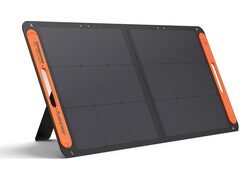
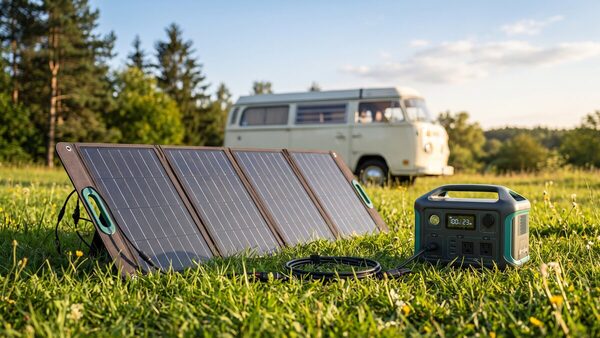
Yes, a solar panel is very useful as soon as you camp for more than two days, but it must be sized for the daily consumption, not just for the station's capacity. For a fridge needing about 400 Wh per day, a 100 W folding panel can help in fine weather, without guaranteeing a full recharge. A 200 W panel offers a more realistic margin, because the rated power is reached in laboratory conditions rarely met while camping.
The chain is simple: solar panel, MPPT controller built into the station, battery, then fridge. The MPPT looks for the operating point where the panel delivers the most available energy. Aim the panel at the sun, avoid shade on a single cell and clean off the dust. Even a small shadow can penalise the output.
Choose your gear in our portable solar section and check three figures: the input voltage the station accepts, the maximum current and the connector. Never connect a panel whose open-circuit voltage exceeds the limit set by the maker. To learn more about battery ageing mechanisms, Battery University explains the best practices to prolong lithium batteries.
How to reduce the fridge's consumption?
A good spot and pre-cooling can cut consumption far more than a marginal gain in battery capacity. Run the fridge on mains the day before departure. Put already cold food inside and, if possible, chilled water bottles that will stabilise the temperature. A cooler loaded with room-temperature goods forces the compressor to work hard for several hours.
On arrival, set the unit in the shade, on a flat, ventilated surface. Leave space around the grilles, do not push it against the tent fabric and do not leave it in a closed car. Set a sensible temperature: 3 to 5 °C for fresh food, without needlessly chasing 0 °C. If your model lets you choose between eco and max modes, keep max mode for the initial cool-down.
Open the lid or door as briefly as possible. Organise the food, use baskets and avoid putting warm drinks in several times a day. An insulating cover can also help in very hot conditions, as long as it never blocks the compressor's ventilation.
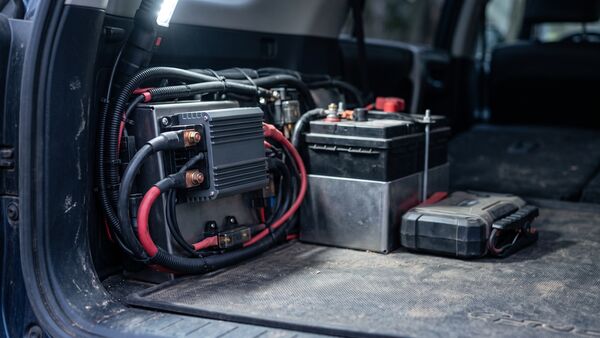
The station can also serve in a vehicle, but an auxiliary battery and a suitable 12 V connection remain useful for driving. Find our tips and accessories in the car batteries and mobility section. For head torches, backup batteries and small camp gear, see also batteries and other batteries. Separating uses this way avoids drawing needlessly on the reserve dedicated to cooling.
Checklist before you leave
Before leaving, test the fridge, cable and station together for a full night at home. You will confirm the real runtime, the absence of an automatic cut-off and the temperature reached. It is the surest way to avoid a nasty surprise at the first bivouac.
- Pre-cool the fridge and the food the day before.
- Charge the station to 100 % and take its mains charger.
- Use the native 12 V or 24 V output when available.
- Plan for 20 to 30 % safety capacity.
- Test the behaviour at compressor start-up.
- Add a solar panel if you stay several days off-grid.
- Keep the station dry, ventilated and out of direct sun.
Finally, match your choice to the type of unit. A thermoelectric cooler can draw continuously and empty a battery far faster than a compressor fridge. Conversely, an absorption model, often used with gas, follows a different runtime logic. Read the manual, look up the consumption over 24 hours and build your setup around that figure. You will then enjoy fresh food without sacrificing the calm of the camp.
To dig deeper into that technology choice, our sister site All Cool compares compressor and thermoelectric coolers in detail, a difference that makes a real dent in power consumption.